At 103, “He Remains the Oldest Star Still With Us”: The Truth Behind Viral Celebrity Longevity Claims
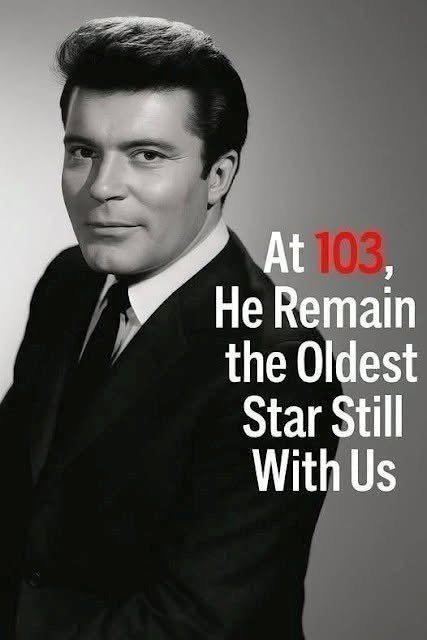
A striking black-and-white photograph of an older male celebrity has been circulating online with a dramatic caption: “At 103, he remains the oldest star still with us.” The accompanying message asks readers to guess who the person is, adding: “Some people love him. Others hate him. But no one can ignore him.”
Posts like this are designed to create curiosity. The photograph looks like an old publicity portrait, while the large text suggests that the person has reached an extraordinary age and is still alive.
But there is an important problem with this kind of viral post: the image and caption alone do not provide enough reliable information to establish the person’s identity, age, or whether the claim that he is the oldest living star is accurate.
More importantly, the idea of being “the oldest star still with us” depends on how the word star is defined. Does it mean a film actor? A television actor? A singer? A celebrity from a particular country? Someone who achieved fame during a particular decade? Different definitions can produce completely different answers.
Rather than relying on a mysterious caption, it is worth looking at what these posts are actually communicating and why claims about celebrity age should be treated carefully.
Why Do Viral “Guess Who?” Posts Attract So Much Attention?
The format is extremely effective.
Instead of simply naming a person, the post asks the reader a question.
“Who is he?”
“Do you remember him?”
“Some people love him, others hate him.”
“Can you guess?”
This creates a small challenge. People naturally want to test their memory and see whether they recognize the face.
The photograph itself adds another layer of curiosity. An old black-and-white portrait can trigger memories of classic cinema, television, music, or other forms of entertainment.
People may then comment with a name, tag friends, or share the image.
The problem is that the engagement generated by the question does not prove that the information in the caption is correct.
A viral post can spread thousands of times even when important details are missing or inaccurate.
Why Age Claims About Celebrities Can Be Difficult to Verify
A person’s age sounds like a simple fact, but celebrity biographies can sometimes contain conflicting information.
Different sources may list different birth dates.
Some older celebrities became famous before modern digital records were common.
There can also be confusion involving stage names, professional names, transliterations, or incomplete biographies.
For someone who was born more than a century ago, reliable documentation becomes especially important.
A claim that a person is 103 years old should therefore be based on a documented birth date rather than simply repeating the age written on a social-media image.
What Does “Oldest Living Star” Actually Mean?
This phrase sounds definitive, but it is actually ambiguous.
Suppose one person is 103 and another is 104.
If both are actors, the 104-year-old would appear older.
But what if the 104-year-old was never a major international celebrity?
What if the 103-year-old was a famous film actor while the older person was known primarily for another profession?
What if the claim is limited to a particular country?
What if the word “star” refers only to actors who appeared in movies?
The answer can change depending on the definition.
This is why phrases such as “oldest living star,” “oldest actor alive,” or “oldest celebrity” should be treated carefully unless the post clearly explains its criteria.
The Meaning of “Still With Us”
Another emotional phrase often used in these posts is “still with us.”
It is designed to emphasize longevity.
Reaching an advanced age is certainly unusual, and people who live beyond 100 years are often called centenarians.
But simply reaching 100 does not automatically mean someone is the oldest person in a profession or the oldest celebrity.
There may be other people in the same profession who are older.
There may also be individuals who are less famous but have reached even greater ages.
Fame and longevity are separate characteristics.
What Is a Centenarian?
A centenarian is a person who has reached at least 100 years of age.
People who reach 100 are relatively uncommon compared with the general population.
Living to 100 or beyond can be influenced by many factors, including genetics, environment, lifestyle, socioeconomic circumstances, access to healthcare, and chance.
Some people remain active and independent at very advanced ages, while others experience significant health limitations.
There is no single lifestyle that guarantees someone will reach 100.
Why Do Some People Live So Long?
Longevity is complicated.
Researchers have identified associations between longer life and several factors, including not smoking, maintaining physical activity, eating a balanced diet, managing chronic diseases, maintaining social connections, and having access to appropriate healthcare.
Genetics also plays a role.
However, these factors do not provide a guaranteed formula.
A person can follow healthy habits and still develop serious disease at a relatively young age.
Another person may live to an extraordinary age despite having habits that would generally be considered unhealthy.
Population-level research can identify patterns, but it cannot predict exactly how long any individual will live.
Is There a “Secret” to Reaching 100?
Social media frequently promotes the idea that very old people have discovered a secret.
One person might say the secret is drinking a particular beverage.
Another might credit a specific food.
Someone else might claim that avoiding a certain ingredient is responsible.
These personal stories can be interesting, but they should not automatically be treated as scientific evidence.
A person’s individual experience is only one example.
If a 100-year-old says they ate a particular food every day, that does not prove that the food caused their longevity.