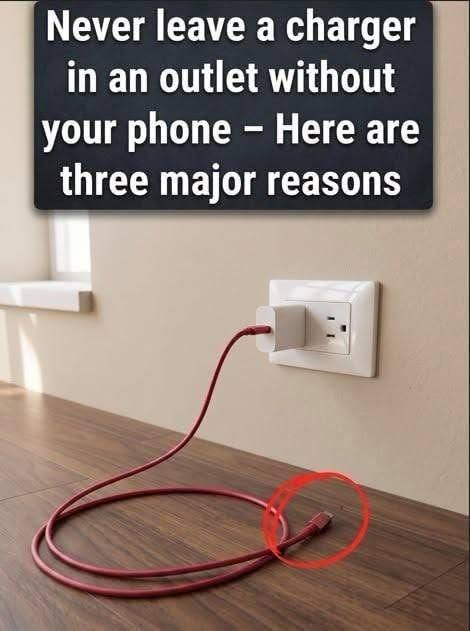
Why You Should Never Leave a Charger in an Outlet Without Your Phone: 3 Important Safety Reasons
Many people unplug their phones after charging but leave the charger connected to the wall outlet. It seems harmless because the charger is small, uses little electricity, and may not feel warm when nothing is connected to it.
However, leaving a charger plugged in all the time can raise several safety and practical concerns, especially if the charger is damaged, poorly manufactured, or connected to an unreliable electrical outlet.
You may have heard warnings that an unused charger can cause a fire, waste electricity, or damage your home’s electrical system. Some of these concerns have a real basis, but others are exaggerated. A modern, properly manufactured charger is generally designed to operate safely, and leaving it plugged in does not automatically make it dangerous.
Understanding the actual risks can help you make safer decisions without unnecessary fear.
Here are three important reasons to consider unplugging your phone charger when you are not using it, along with practical advice for protecting your home and electronic devices.
1. Electrical Safety: A Faulty Charger Can Overheat
The most important reason to pay attention to an unused charger is electrical safety.
Phone chargers convert the electricity supplied by a wall outlet into the lower-voltage power needed to charge a phone. Most modern chargers contain electronic components that regulate this process.
When a charger is connected to an outlet, some of its internal circuitry may remain energized even when no phone is attached.
A properly designed charger should handle this condition safely. However, problems can arise if the charger is damaged, poorly manufactured, or exposed to unsuitable conditions.
Why can a charger become dangerous?
Several factors may increase the risk of an electrical problem.
Poor-quality or counterfeit chargers: Some products sold as inexpensive replacements may not meet appropriate electrical safety standards. Their internal components, insulation, and protective systems may be inadequate.
Damaged electrical components: A charger that has been dropped, crushed, exposed to moisture, or otherwise damaged may no longer operate safely.
Worn or loose connections: If a plug fits loosely into an outlet, the connection may become unstable. Poor electrical contact can generate heat and may produce sparks.
Manufacturing defects: Even products that look normal can occasionally contain defective components.
Exposure to moisture or extreme heat: Chargers are electrical devices and should be kept away from water, damp areas, and excessive heat.
These risks are not limited to chargers that are left plugged in without a phone. A faulty charger can also become dangerous while actively charging a device.
Does an unused charger automatically overheat?
No.
A functioning charger from a reputable manufacturer generally consumes very little power when nothing is connected to it. Many modern chargers are designed to enter a low-power standby state.
Consequently, an ordinary charger that remains cool and is in good condition is not automatically a fire hazard simply because it is plugged into the wall.
The concern is the possibility of a defect, damage, or electrical fault.
Unplugging a charger when it is not needed removes it from the electrical supply and eliminates the risk of that charger developing an energized electrical fault while disconnected.