8 Fascinating Optical Illusions That Challenge Your Self-Awareness
Have you ever looked at an image and wondered how someone else could see something completely different from what you see? Optical illusions have a remarkable ability to confuse the brain, challenge our assumptions, and reveal how differently people can interpret the same visual information.
A simple picture might appear to move when it is perfectly still. A shadow may resemble a face, or a familiar object may suddenly look like something entirely different. These experiences remind us that vision is not simply a matter of recording what is in front of our eyes. The brain actively organizes, interprets, and makes sense of the information it receives.
Optical illusions are especially fascinating because they encourage us to examine our perceptions. They can help us understand attention, visual processing, memory, expectations, and the assumptions we make about the world around us.
Some popular online illusions claim to reveal whether someone has a male or female brain, whether they are left-brained or right-brained, or whether they possess particular personality traits. However, these claims should be treated cautiously. What you see in an optical illusion cannot reliably determine your sex, gender, personality, intelligence, or psychological profile.
Instead, these eight fascinating illusions offer an entertaining way to explore how the human mind interprets visual information.
1. The Running Woman: Which Direction Is She Moving?
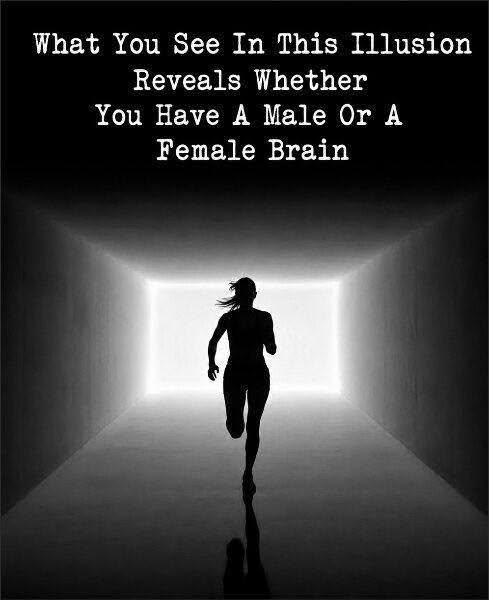
One popular illusion shows the silhouette of a woman running toward a bright opening in a dark corridor.
At first glance, the image may appear straightforward. However, some viewers interpret the woman’s movement differently, particularly when they focus on her legs, arms, or body position.
The image may encourage you to consider how the brain uses visual cues to estimate movement and direction.
Why the Illusion Works
Your brain does not process every visual detail independently. Instead, it combines shapes, shadows, body positions, and contextual information to construct an interpretation.
When an image contains ambiguous visual cues, your brain may settle on one interpretation even when another is possible.
Movement perception can also be influenced by what you focus on first and how you mentally organize the image.
What Does Your Interpretation Reveal?
Seeing the woman move in one direction rather than another does not establish that you have a male or female brain.
Although researchers have identified some average sex-related differences in particular cognitive abilities, there is substantial overlap between individuals. A single ambiguous image cannot reliably classify someone’s brain or personality.
The interesting question is not which answer is supposedly correct, but how your brain arrives at its interpretation.