Which Watermelon Would You Choose? How to Tell When a Watermelon Is Really Ripe
Choosing a watermelon can feel like a guessing game. You pick one that looks green and healthy from the outside, carry it home, cut it open—and sometimes discover that the inside is pale, underripe, or lacking sweetness.
The good news is that you don’t have to rely entirely on luck.
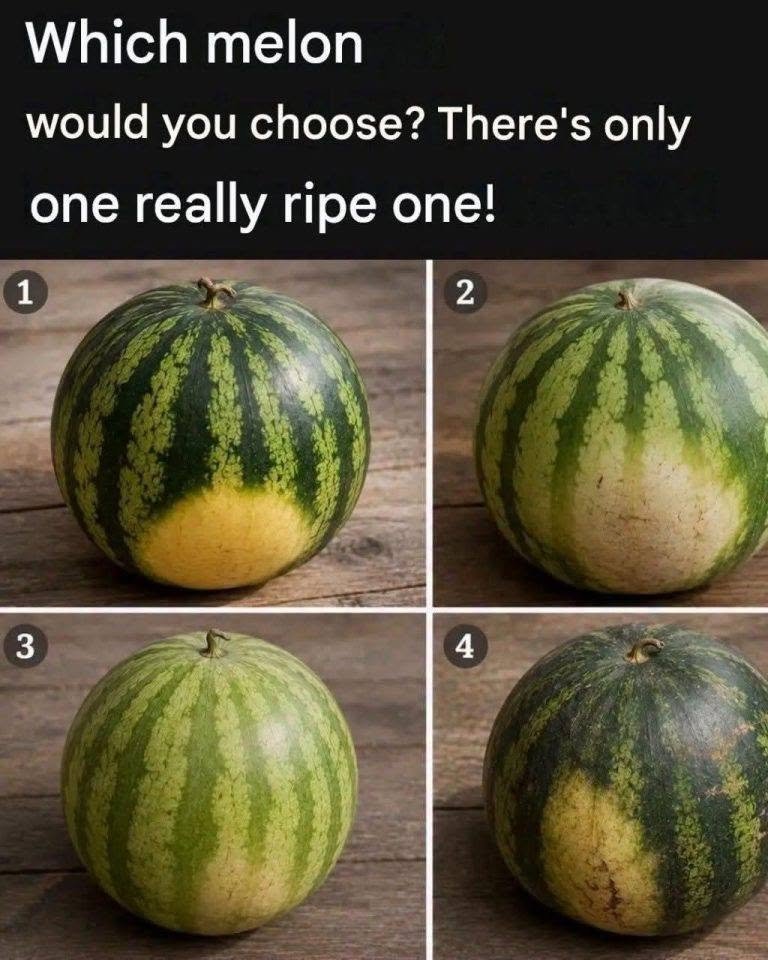
There are several clues that can help you select a watermelon that is more likely to be ripe, juicy, and flavorful. The image shows four watermelons, each with a different-looking field spot—the area where the melon rested on the ground while growing.
So which one would I choose?
Number 1 is the strongest choice based on the visible field spot.
Its large deep yellow/creamy-yellow spot is a useful sign that the watermelon remained on the ground long enough to mature. By comparison, the pale whitish spot on #2 is less encouraging.
But the field spot is only one clue. A truly good watermelon should be judged using several signs together.
1. Look for a Creamy Yellow Field Spot
This is probably the most useful clue shown in the picture.
A watermelon develops a lighter-colored patch where it rests against the soil. Because that part doesn’t receive sunlight like the rest of the rind, it doesn’t turn green.
When the patch is creamy yellow, yellow, or even orange-yellow, it generally indicates that the melon spent sufficient time developing on the vine.
What about a white spot?
A very pale or white field spot can indicate that the watermelon was harvested earlier, although color alone cannot guarantee whether a particular melon is ripe.
That’s why #2 isn’t the one I’d choose from this image.
What does #1 show?
Number 1 has a prominent deep yellow field spot, making it the most appealing choice based on this particular clue.
2. Don’t Choose the Whitest Watermelon
A common mistake is assuming that the brightest, cleanest-looking watermelon must be the best.
Not necessarily.
The rind can remain beautifully green even when the fruit isn’t at its best inside.
Instead of focusing only on the overall color, look at the ground spot.
A creamy yellow spot is generally more useful than a perfectly white one.
3. Look for a Dull, Not Shiny, Rind
Another useful clue is the overall appearance of the rind.
A mature watermelon often has a somewhat dull or matte appearance, while an extremely shiny rind can sometimes indicate that the fruit isn’t fully mature.
This isn’t an absolute rule, because varieties differ.
But when choosing between similar melons, it’s worth considering.
4. Check the Shape
A good watermelon is generally:
Symmetrical
Firm
Well-rounded or evenly shaped
Free from major deformities
A strangely shaped melon isn’t automatically bad, but significant irregularities can sometimes reflect inconsistent growing conditions.
If you’re choosing between several melons of the same variety, look for one with a balanced shape.
5. Pick It Up
One of the simplest tricks is also one of the most useful:
Compare the weight.
Watermelon contains a lot of water, so a ripe melon should feel heavy for its size.
If two watermelons look approximately the same size, pick up both.
The heavier one may contain more water and often makes the better choice.
This is especially useful when the outside appearance of several melons is similar.
6. Give It a Gentle Tap
You’ve probably heard the classic advice to knock on a watermelon.
There is some usefulness to this technique, but it isn’t a perfect science.
People often look for a deep, resonant sound rather than a dull, flat sound.
However, tapping requires experience, and watermelon variety, size, and rind thickness can affect the sound.
So don’t use the tapping test by itself.
Combine it with:
field spot + weight + shape + rind appearance.
7. Look at the Stem
If the stem is still attached and visible, take a look at it.
A dry, brownish stem can be a useful indication that the watermelon was allowed to mature before harvest.
A very green stem may suggest that it was harvested relatively recently, although this doesn’t necessarily mean the fruit is underripe.
Again, it’s only one clue.
8. Check for Damage
Avoid watermelons with obvious:
Deep cuts
Soft rotten areas
Leaking spots
Large bruises
Mold
Cracks that penetrate deeply into the rind
Small superficial marks aren’t necessarily a problem.
Watermelons naturally develop scratches and marks during growing, harvesting, and transportation.
What matters is whether the damage appears deep, wet, soft, or deteriorated.
What About the Four Watermelons in the Picture?
Let’s compare the visible clues.
🍉 Number 1
Large yellow field spot
This is the one I would choose from the picture.
The deep yellow spot is a positive visual clue, particularly compared with the very pale spots on some of the others.
🍉 Number 2
Very pale, almost white field spot
This is less convincing.
The spot doesn’t have the deeper creamy-yellow appearance many shoppers look for.
That doesn’t prove the watermelon is bad, but I would choose another one if better options were available.
🍉 Number 3
Large pale/cream-colored area
This one has a noticeable field spot, but it appears considerably lighter than #1.
It could still be perfectly good, but based purely on the visible clues, #1 is more appealing.
🍉 Number 4
Yellowish field spot
Number 4 also has a promising-looking field spot.
It’s actually a closer competitor to #1 than #2 or #3.
However, the field spot on #1 appears more distinctly yellow and mature-looking.
If I had the opportunity to physically handle them, I’d compare #1 and #4 by weight, firmness, and sound before making the final decision.
Why Does the Yellow Spot Matter?
Watermelons don’t ripen in exactly the same way as fruits such as bananas or peaches after they’re harvested.
For watermelons, maturity at harvest is particularly important.
The field spot gives shoppers a visual clue about how the melon developed while resting on the ground.
As the fruit matures, that area commonly changes from a pale color toward a cream or yellow color.
That’s why experienced shoppers often look underneath the watermelon before buying it.