DID YOU KNOW? If Hair Grows on Your Ears, It’s Because Your Body Is Changing — Here’s What It Really Means
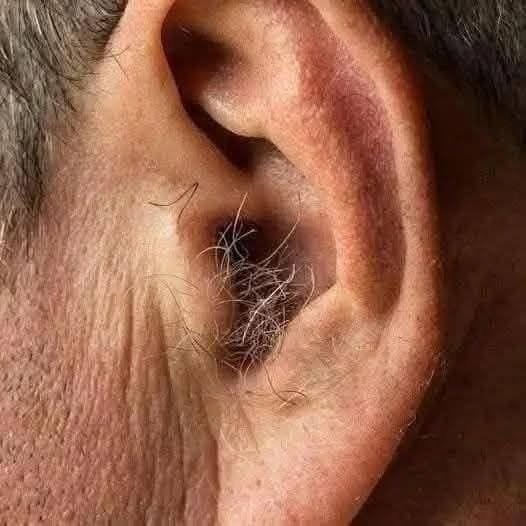
Have you ever noticed a few hairs growing on or around your ears and wondered why they suddenly appeared?
For many people, ear hair becomes more noticeable with age. It can seem strange at first, especially if you never had visible hair there when you were younger. Some viral posts claim that ear hair is a sign that the body has too much testosterone, that hormones are out of balance, or that it indicates a particular health problem.
The reality is much less dramatic.
Ear hair is usually a normal part of aging, genetics, and hormonal changes. It does not automatically mean that something is wrong with your body.
Why Does Ear Hair Grow?
Hair follicles are found on many areas of the human body, including the skin around the ears and, in some people, inside the outer ear canal.
As we age, some previously fine and barely noticeable hairs can become thicker, longer, or darker.
This happens because hair follicles can respond differently to hormones as we get older.
Androgens, including testosterone and related hormones, influence hair growth in many areas of the body. However, having ear hair does not necessarily mean that a person has unusually high testosterone.
Genetics also plays an important role.
If men in your family tend to develop noticeable facial, nose, or ear hair as they get older, you may be more likely to experience the same pattern.
Ear Hair Is More Common With Age
One of the most noticeable changes is that ear hair can become more prominent later in life.
A person may have almost invisible hair around the ears in their younger years and then notice longer strands decades later.
This is part of the broader pattern of changing body hair.
You may also notice:
More hair in the nose
Thicker eyebrow hairs
Longer eyebrow strands
More facial hair
Changes in beard growth
Hair appearing in places where it was previously difficult to notice
These changes don’t necessarily indicate disease.
The hair follicles themselves can change their growth patterns over time.
Does Ear Hair Mean You Have High Testosterone?
This is one of the most common claims surrounding ear hair, but it is an oversimplification.
Testosterone can influence the growth of certain types of body hair, but the amount of visible ear hair is not a reliable way to determine someone’s testosterone level.
Two people with similar hormone levels can have completely different amounts of ear hair because genetics and the sensitivity of individual hair follicles also matter.
In other words, ear hair alone cannot tell you whether your testosterone is high, low, or normal.
If you are concerned about your hormone levels, a healthcare professional can evaluate your symptoms and, when appropriate, order laboratory testing.
Why Does the Hair Sometimes Become Thicker?
Hair follicles go through different phases of growth.
As we age, some follicles may produce thicker or longer terminal hairs rather than the tiny, fine hairs that were previously difficult to see.
This transformation can happen in several areas of the body.
That’s why someone might suddenly notice one or two surprisingly long hairs sticking out from the ear.
It doesn’t necessarily mean that dozens of new follicles have suddenly appeared.
Instead, existing follicles may simply be producing hair that is more noticeable.
Is Ear Hair a Health Problem?
In most cases, ordinary ear hair is not a medical problem.
The hair itself doesn’t usually require treatment unless it bothers you cosmetically or becomes excessively long.
However, the skin around the ears can develop other conditions that should not be confused with ordinary hair growth.
For example, persistent itching, scaling, pain, swelling, discharge, or changes inside the ear can have other causes.
Hair itself is usually not the concern.
The important thing is to pay attention to unusual symptoms accompanying it.