If You’ve Ever Seen These Marks on Your Jeans, You’re Not Alone: Here’s What They Really Mean
Have you ever pulled on a pair of jeans and noticed strange-looking lines, shadows, or faded patterns across the fabric? Maybe they look like horizontal wrinkles on the thighs, while other pairs develop web-like marks behind the knees.
If you have, there is usually nothing wrong with your jeans.
These patterns are extremely common in denim and are generally the result of the way the fabric bends, folds, stretches, and experiences friction during everyday movement. In fact, denim enthusiasts have specific names for many of these patterns.
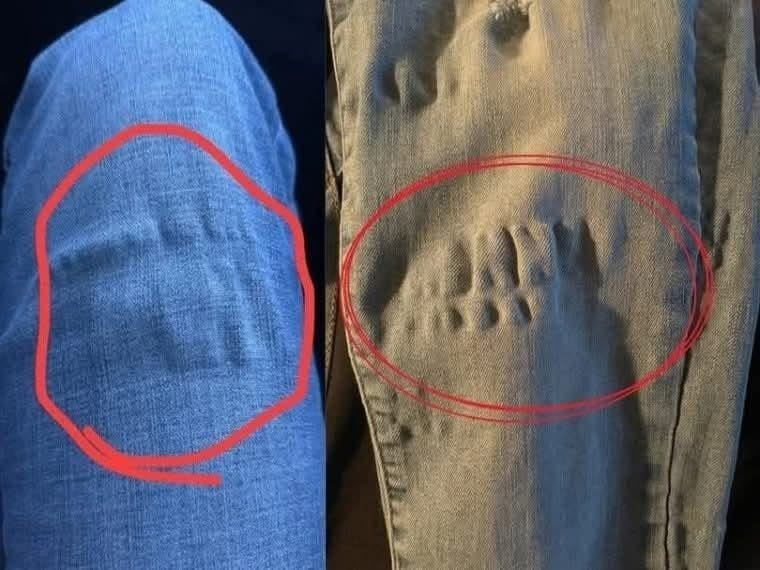
The marks shown in the image are examples of what denim experts commonly call whiskers and, depending on their location, related fade patterns such as honeycombs.
But why do they appear? Why are some pairs covered with them while others barely show them? And do these marks mean your jeans are damaged?
Let’s take a closer look.
What Are Those Faded Lines on Jeans?
The lighter lines that appear across the upper thigh and hip area are commonly known as whiskers.
They get their name because the lines can resemble the whiskers of a cat. They often spread outward from the crotch or upper thigh area and can be horizontal, slightly diagonal, curved, or fan-shaped.
They are particularly noticeable on darker blue denim because the contrast between the original indigo color and the lighter worn areas is greater.
Whiskers are essentially wear patterns.
Every time you sit down, stand up, walk, climb stairs, bend your legs, get into a car, or otherwise move your hips, the denim folds in particular places. With repeated movement, those same folds can occur again and again.
Over time, friction and movement gradually remove some of the surface dye from the raised portions of those folds.
The result is a lighter line.
That’s why a pair of jeans you’ve worn for months or years can develop a pattern that looks completely different from another person’s jeans.
Why Do Jeans Develop These Patterns?
There isn’t just one reason.
Several factors work together to create denim fading.
1. Repeated Bending and Sitting
One of the biggest causes is simple everyday movement.
When you sit, the fabric around your hips and upper thighs has to fold. When you stand, it stretches back out.
This happens hundreds or thousands of times over the life of a pair of jeans.
The repeated folding creates particular crease points. The surface of the denim at those points experiences more movement and friction than areas that remain relatively flat.
Eventually, those areas become lighter.
This is why whiskers are often concentrated around the upper thighs and crotch.
2. Friction
Friction is another major factor.
Your jeans constantly rub against other surfaces:
Your own legs
Chairs
Car seats
Office furniture
Sofas
Bed sheets
Other clothing
Your hands
Bags and accessories
Even normal walking creates friction between fabric surfaces.
As this happens repeatedly, the indigo coloring gradually becomes less intense in certain areas.
The process is usually slow, which is why you might not notice it happening from day to day.
Then one day you look at your jeans and suddenly realize that they have developed an entire pattern.
3. The Fit of Your Jeans Matters
The way your jeans fit your body can dramatically affect where these lines appear.
A tighter pair of jeans generally creates sharper, more defined creases because the fabric has less room to move.
Slim or narrow jeans may produce relatively straight, concentrated whiskers.
Looser jeans can develop wider, softer, and more irregular patterns.
The rise of the jeans also matters.
High-rise, mid-rise, and low-rise jeans don’t fold in exactly the same places because the waistband and upper portion of the garment sit differently on the body.
The shape of your hips and thighs also influences the direction of the folds.
This is one reason why two people can wear similar jeans for the same amount of time and end up with completely different fading.
Whiskers Aren’t the Same as Wrinkles
It’s easy to confuse denim whiskers with ordinary wrinkles.
They’re related, but they’re not exactly the same thing.
A temporary wrinkle disappears when you hang or smooth out the jeans.
A fade remains because the color of the fabric has changed.
For example, if you take off your jeans after sitting in a chair for several hours, you might see temporary creases across your thighs.
After the fabric relaxes, those creases may disappear.
But if the same creases repeatedly form over a long period of time, the areas receiving the most friction can gradually become lighter.
That’s when a temporary crease becomes a permanent-looking fade.
What Are the Patterns Behind the Knees?
You may also notice another interesting pattern on jeans: a series of lighter lines or shapes behind the knees.
These are commonly called honeycombs.
The name comes from their appearance.
When you repeatedly bend your knees, the denim behind the knee folds in consistent places. Over time, those repeated folds can produce a network of lighter lines.
Unlike whiskers, which are mainly associated with the upper thigh and hip area, honeycombs are particularly associated with the back of the knees.
Again, they’re usually nothing to worry about.
They’re simply evidence of repeated movement and wear.
Why Are Some Jeans Covered in These Marks When Others Aren’t?