Can You Wash Kitchen Towels and Bath Towels Together? The Answer Is More Complicated Than You Think
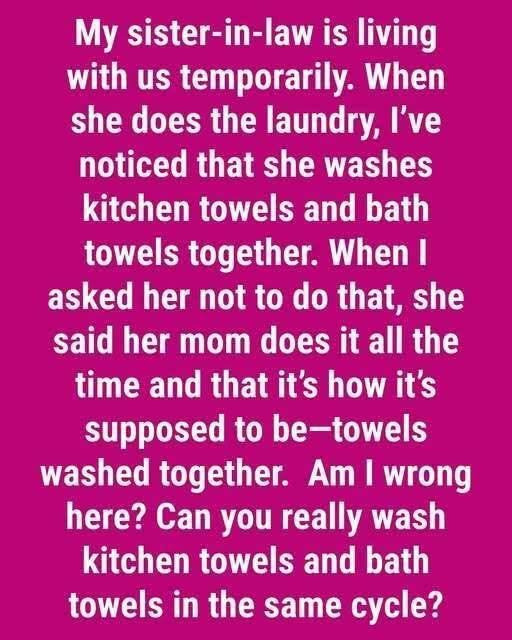
The question in the image sounds simple:
Can kitchen towels and bath towels really be washed together in the same washing machine?
The short answer is yes, they can technically be washed in the same cycle, but that doesn’t necessarily mean it’s the best laundry habit.
Kitchen towels and bath towels serve very different purposes. A kitchen towel may wipe countertops, dry dishes, handle food spills, or come into contact with raw meat juices. A bath towel, meanwhile, is used directly on freshly washed skin.
Because of those different uses, washing them separately is generally the more sensible routine, especially when kitchen towels are heavily soiled or have been used around raw food.
However, if both types of towels are ordinary washable fabrics and neither is heavily contaminated, a properly run laundry cycle with detergent followed by complete drying can clean them effectively.
So the sister-in-law in the picture isn’t necessarily doing something dangerous every time she puts both types of towels into the washing machine.
But there are good reasons why many households prefer to keep them separate.
Why Kitchen Towels and Bath Towels Are Different
The biggest difference isn’t the fabric.
It’s what the towel touches.
A bath towel generally comes into contact with:
Clean skin
Water
Soap residue
Sweat
Body oils
Dead skin cells
A kitchen towel may come into contact with:
Food
Grease
Raw meat juices
Raw eggs
Vegetables
Dirty dishes
Countertops
Sinks
Spills
Hands that have handled food
That means kitchen towels can potentially pick up microorganisms associated with food preparation.
This doesn’t mean every kitchen towel is dangerous.
It simply means that the two towels have different contamination profiles.
Kitchen Towels Can Carry Food-Related Germs
One of the reasons food-safety experts emphasize frequent washing of kitchen cloths is that they can become contaminated during food preparation.
Imagine using a towel to dry your hands after handling raw chicken.
Then you use the same towel to wipe the kitchen counter.
Then you use it again to dry your hands.
The towel has now become a potential vehicle for transferring microorganisms around the kitchen.
The same thing can happen with towels used around raw meat, seafood, eggs, or other foods.
This is why kitchen towels should be changed and washed regularly rather than being used indefinitely.
Does Washing Them Together Spread Germs?
This is where the answer requires some nuance.
A normal washing machine cycle using detergent, appropriate water temperature, agitation, rinsing, and thorough drying is designed to clean laundry.
A properly washed towel isn’t simply carrying every microorganism that was present on it before the cycle.
So the idea that “if you wash a kitchen towel with a bath towel, all the kitchen germs will permanently transfer to the bath towel” is an oversimplification.
Laundry works by removing soil and microorganisms from fabrics.
However, heavily contaminated laundry deserves more care.
If a kitchen towel is covered with raw meat juices, food residue, grease, or other significant contamination, it makes sense to wash it separately rather than mixing it with household towels.
And if someone in the household is sick or a towel has been contaminated with vomit, feces, blood, or other body fluids, follow a more careful laundry routine.
The Real Problem May Be Grease and Dirt
There is another reason to separate kitchen and bath towels that has nothing to do with dangerous bacteria.
Kitchen towels can be greasy.
A towel used to wipe cooking surfaces may contain oil, butter, food residue, sauces, and other substances.
Bath towels can also contain body oils and skincare products.
When you combine heavily soiled items, the washing machine has to deal with more dirt and grease.
The result can be towels that don’t smell fresh or don’t absorb water properly.
Kitchen towels may also transfer food odors to other laundry.
Nobody wants their freshly washed bath towel smelling faintly like garlic, onions, cooking oil, or yesterday’s dinner.
What About Towels That Look Clean?
Appearance isn’t a reliable measure of cleanliness.
A kitchen towel can look perfectly clean while still containing microorganisms or food residue.
Likewise, a bath towel can look clean while accumulating sweat, skin oils, and moisture.
That’s why washing frequency matters.
Don’t wait until a towel looks dirty before washing it.