How to Remove Car Scratches With Foam: What Actually Works and What You Should Know
Seeing scratches on a car can be frustrating, especially when they appear on an otherwise clean and well-maintained vehicle. A small scrape in a parking lot, a brush against a wall, a shopping cart, or contact with another object can leave ugly black marks across the paint.
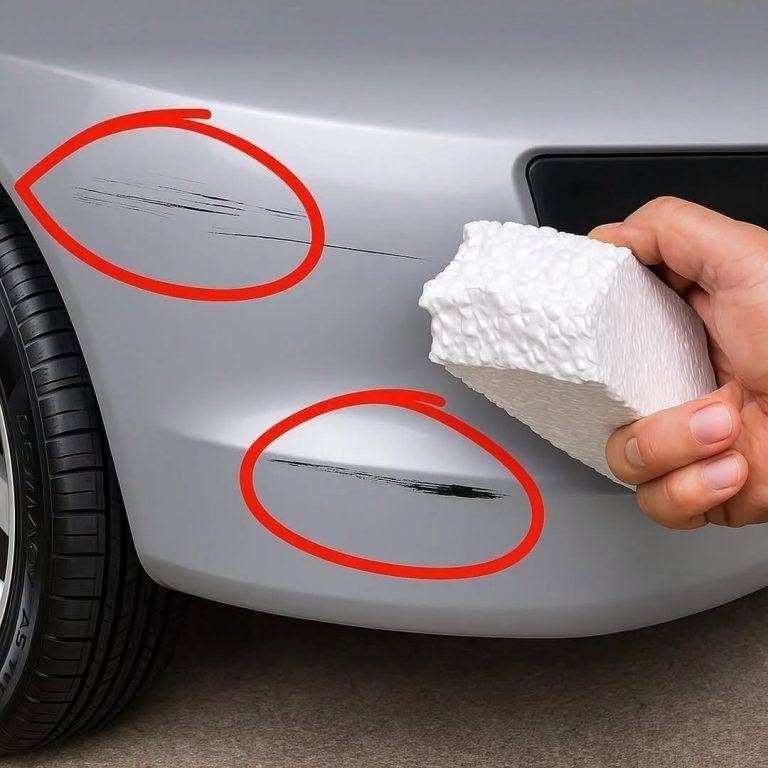
That is why simple-looking car scratch-removal tricks become popular online. One viral method shows a piece of white foam being rubbed over dark scratches, suggesting that the marks can disappear within minutes.
But there is an important detail to understand before trying this method:
Foam does not magically repair damaged automotive paint.
Depending on what is being used and how the scratch was created, rubbing a foam material over the surface may remove some transferred material or temporarily make a mark less noticeable. It will not necessarily repair a scratch that has actually penetrated the paint.
Understanding the depth and type of damage is the key to deciding what to do.
First: What Kind of “Scratch” Do You Have?
Not every black line on a car is actually a scratch.
This is one of the most important things to determine before reaching for any cleaning product.
A mark on the bumper or door can be caused by several different things:
Dirt
Rubber transfer
Paint transfer from another object
Plastic transfer
Surface scuffing
Damage to the clear coat
Damage through the paint layer
Damage reaching the primer
Damage exposing bare metal
These situations can look similar in a photograph but require very different treatments.
If another object rubbed against the car without cutting deeply into the paint, the dark mark may mostly be material sitting on top of the finish.
That type of mark can sometimes be removed relatively easily.
A genuine deep scratch is different.
Why Does the Foam Trick Sometimes Appear to Work?
The foam shown in viral videos may help with certain superficial marks because rubbing can remove or disturb material sitting on the surface.
Imagine a black rubber object rubbing against a white or silver bumper.
The black appearance may not be caused by the car’s paint being removed.
Instead, some of the rubber or other material may have transferred onto the car.
If that transferred material is removed, the original paint underneath may become visible again.
This can create the impression that the foam has “repaired” the scratch.
But technically, the foam may simply be cleaning away the transferred material.
That’s very different from repairing damaged paint.
A Scratch That Goes Through the Paint Cannot Be Erased With Foam
Modern automotive paint generally consists of several layers.
A simplified version looks something like this:
Metal or plastic body panel
Primer
Base coat
Clear coat
The clear coat is the transparent protective layer on top.
If a mark only affects the clear coat, it may sometimes be reduced through careful polishing.
If the base coat is damaged, polishing alone cannot restore the missing color.
If the primer or underlying material is exposed, the repair becomes more involved.
This is why a simple household trick cannot universally remove scratches.
The Fingernail Test
One simple way to get a rough idea of scratch depth is to gently run a clean fingernail across the mark.
Do not press aggressively.
If your fingernail glides across the mark without catching, the damage may be relatively superficial.
If your fingernail clearly catches in a groove, the scratch may be deeper.
This isn’t a professional diagnostic test, but it can provide a useful clue.
A scratch that catches strongly on the nail is much less likely to disappear simply through wiping or light polishing.
Step 1: Wash the Area First
Before trying any scratch-removal technique, clean the affected area.
This step is extremely important.
A dirty car can contain:
Sand
Dust
Road grit
Tiny pieces of gravel
Brake dust
Mud
Other abrasive particles
If you rub those particles across the paint, you can create additional scratches.
Use a proper automotive car wash solution and clean microfiber towels.
Avoid aggressively scrubbing a dry surface.
The goal is to remove loose contamination before examining the damage.
Step 2: Dry the Surface Carefully
After washing, dry the area using a clean microfiber towel.
Avoid using an old towel that may contain dirt or rough fibers.
Once the surface is clean and dry, inspect the mark under good lighting.
You may discover that what looked like a deep scratch is actually:
Paint transfer
Rubber residue
Dirt
Road grime
A superficial scuff
That’s good news because these marks can often be much easier to deal with.
Step 3: Try Gentle Cleaning Before Abrasive Methods
Don’t immediately start rubbing the area with a strong abrasive.
Start with the gentlest method.
A clean microfiber cloth and a suitable automotive surface cleaner may be enough to remove superficial contamination.
Use gentle pressure.
If the mark begins disappearing, stop once you’ve achieved the desired result.
There is no benefit in continuing to rub an area that is already clean.
Step 4: If You Try the Foam Method, Be Careful
The foam shown in the image appears to be a rigid expanded foam material.
Viral videos sometimes demonstrate rubbing such foam against a vehicle’s bumper or body panel.
The problem is that different foam materials have different properties.
A piece of foam can potentially act as a mild abrasive, depending on its structure and how it is used.
That means it may remove superficial material—but aggressive rubbing can also affect the finish.
Before trying any unconventional method, test it on an inconspicuous area.
Use very light pressure.
Don’t repeatedly scrub the same spot.
And don’t assume that because a video shows the technique working on one vehicle, it will be safe for every type of automotive paint.
Why Aggressive Rubbing Can Make Things Worse
The clear coat on a vehicle is designed to protect the underlying paint.
It isn’t infinitely thick.
Every abrasive polishing process removes at least some material from the surface.
If you repeatedly rub a small area with an abrasive material, you can create:
Dullness
Haze
Uneven gloss
Fine swirl marks
Visible polishing marks
In severe cases, excessive abrasion can damage the clear coat.
This is why “more pressure” isn’t the answer.
When working on automotive paint, gentle and controlled is generally better.
Step 5: Use a Proper Automotive Scratch Remover for Light Scratches