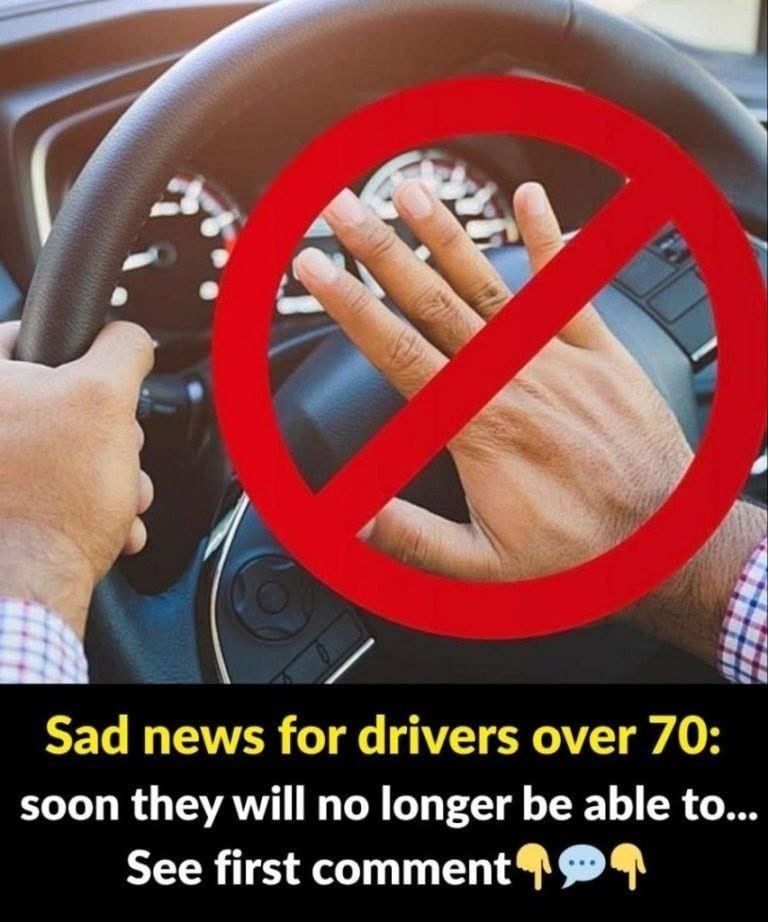
Sad News for Drivers Over 70: Will Older Adults Soon Lose the Right to Drive?
For some people, there eventually comes a time when continuing to drive is no longer appropriate.
This decision should be based on the individual’s abilities, medical circumstances, and applicable legal requirements.
Losing driving privileges can affect social relationships, access to healthcare, and the ability to complete everyday tasks independently.
However, stopping driving does not have to mean losing all independence.
Families can help by arranging regular transport, coordinating medical appointments, exploring accessible community services, and identifying nearby shops and other essential destinations.
Where available, senior transport programmes and accessible public transport can provide additional support.
It is also important to recognize the emotional impact of giving up driving. Some people experience sadness, frustration, or a loss of confidence.
Listening to these concerns and involving the person in transport decisions can help preserve their sense of control.
The objective is not simply to remove a person from the road. It is to maintain safety while helping them remain as active and independent as possible.
9. Why the Country Matters When Interpreting Driving-Law Headlines
A headline about drivers over 70 may describe a proposed change in one country while readers in other countries assume that the same rule applies to them.
This is particularly misleading because driving licence systems differ considerably.
In some places, older drivers face shorter renewal periods. Elsewhere, additional requirements may depend on medical conditions rather than age alone.
For example, Morocco has its own medical fitness requirements for older drivers. The National Road Safety Agency, known as NARSA, states that drivers over 65 must renew their medical examination every two years.
That requirement is different from a general ban on driving after age 70.
People should therefore check the rules applicable to their own driving licence rather than relying on a social media post that does not identify the country or the relevant legislation.
The same caution applies to claims that a new rule will begin on a particular date. Unless an official authority has confirmed the measure and its effective date, the claim may be incomplete, exaggerated, or incorrect.
10. The Real Message Behind the Headlines
The discussion about older drivers is not simply about age. It is about ensuring that everyone using the road can operate a vehicle safely.
Eyesight, concentration, mobility, reaction time, and general health all play important roles in driving ability. These factors deserve attention throughout a person’s driving life, not only after a particular birthday.
Additional assessments may help identify problems before they lead to collisions. At the same time, unnecessarily restricting people solely because of their age can affect their independence without accurately reflecting their actual abilities.
A balanced approach considers the individual, the evidence, the relevant medical standards, and the laws in the country where the person drives.
Older motorists should not panic because of an alarming headline. Instead, they should make sure their licences are valid, follow applicable medical and eyesight requirements, and seek advice if they notice changes that could affect their driving.
Families should also remember that respectful communication and practical support are more helpful than fear or blame.
Conclusion
The claim that drivers over 70 will soon no longer be allowed to drive is too broad to be accepted without further information.
Some countries require older motorists to renew their licences more frequently, and governments may consider additional eyesight or medical checks. These measures are not automatically equivalent to a complete driving ban or a compulsory practical driving test for everyone above a certain age.
Turning 70 does not, by itself, prove that someone is an unsafe driver. What matters is whether that person meets the applicable legal requirements and can control a vehicle safely.
The most responsible response to these headlines is to verify the rules in the relevant country, take eyesight and health concerns seriously, and avoid spreading claims that make older people unnecessarily afraid of losing their independence.