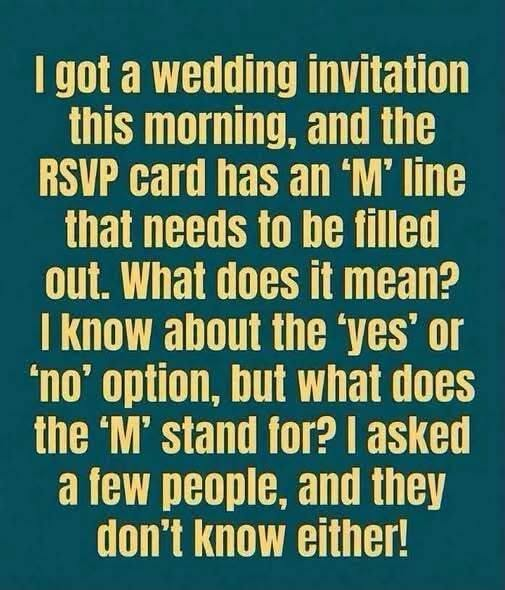
If you’ve ever opened a wedding invitation and found a response card with a mysterious “M” followed by a long blank line, you’re not alone if you wondered what you’re supposed to write there.
At first glance, the letter could seem like it refers to your middle name, your meal choice, the number of guests, or even something related to whether you’re attending.
But the answer is much simpler.
The “M” is the beginning of a formal title, such as Mr., Mrs., Ms., or Miss. It is an old-fashioned wedding-stationery tradition that has survived even though many people today have never been told what it means.
For example, if the card says:
M __________________________
and your name is John Smith, you would traditionally complete it as:
Mr. John Smith
If your name is Sarah Smith, you might write:
Ms. Sarah Smith
The little M is essentially giving you the first letter of your title.
Why Is There Only an “M”?
This tradition comes from an era when formal titles were commonly used in written correspondence and invitations.
Rather than printing:
Mr./Mrs./Ms./Miss __________________
on every response card, stationery designers could simply print the letter M and allow the guest to complete the appropriate title.
All of these traditional titles begin with M:
Mr.
Mrs.
Ms.
Miss
So the printed M acts as a starting point.
It may seem strange today because modern invitations often simply say:
Name: __________________
But older formal stationery followed different conventions.
How Do You Fill Out the M Line?
The easiest way to think about it is that the M isn’t really a separate question.
It is the beginning of the name field.
If you’re Mr. Daniel Brown, you can complete the line so it reads:
Mr. Daniel Brown
If you’re Ms. Emily Johnson, write:
Ms. Emily Johnson
If you’re Miss Olivia Taylor, you could write:
Miss Olivia Taylor
And if you’re responding for two people, you can write both names clearly.
For example:
Mr. Daniel Brown and Ms. Emily Johnson
The most important thing is that the couple getting married can clearly understand who is responding and who will attend.
What If You’re Married?
Traditionally, married couples were often written using a combined form such as:
Mr. and Mrs. John Smith
That convention is still familiar, but it isn’t the only way to write your names.
A couple can also write:
Mr. John Smith and Mrs. Sarah Smith
or:
Mr. John Smith and Ms. Sarah Smith
The goal is simply to provide the names accurately.
Modern wedding etiquette is generally much more flexible than the old-fashioned wording suggested by the traditional M line.
What If You Don’t Share a Last Name?
There’s no reason to force two people into a single surname if they don’t use one.
For example, a couple could write:
Mr. David Williams and Ms. Laura Brown
This makes it immediately clear who is attending.
The same applies to married couples who have chosen to keep their original surnames.
The old M-line convention was created during a period when naming customs were much more standardized. Modern families and couples don’t necessarily follow those conventions.
Clarity is more important than reproducing an outdated formula.
What If You Don’t Use a Title?
Not everyone uses a traditional title.
If you don’t normally identify yourself as Mr., Mrs., Ms., or Miss, you can generally write your name in the way you normally use it.
For example:
Alex Morgan
The purpose of the RSVP card is to tell the hosts who is responding, not to force you into a title you don’t use.
If the printed M doesn’t make sense for you, simply writing your name clearly is usually the most practical solution.
What If Your Title Is “Dr.”?
This is one of the obvious limitations of the traditional M system.
A person’s title might be:
Dr.
Rev.
Prof.
or another title that doesn’t begin with M.
In that situation, don’t worry about the printed letter.
You can write your actual title and name.
For example:
Dr. Michael Carter
The hosts are interested in identifying you, not testing whether you know how to complete an old stationery convention.
Does the M Mean “Married”?
No.
This is one of the most common misunderstandings.
The M does not mean that you need to indicate whether you’re married.
The titles themselves historically carried different conventions regarding marital status, particularly Mrs. and Miss, while Ms. became a widely used alternative that doesn’t indicate marital status.
So if you see:
M __________________
don’t write “married” or “single.”
Write your name, using the title you prefer if appropriate.
Does the M Mean “Meal”?
No.
Wedding invitations often include meal selections, so it’s understandable that someone might see an M and wonder whether it refers to a meal.
If the couple needs you to select a meal, there will normally be a separate section explaining the choices.
For example:
Chicken ___
Fish ___
Vegetarian ___
The M at the beginning of the name line has nothing to do with the food.
Does the M Mean “Maybe”?
Definitely not.
The RSVP itself usually asks whether you’re attending.
You might see wording such as:
Accepts with pleasure
or
Declines with regret
or simply:
Yes / No
The M line is separate.
It is simply connected to your name.
What Does RSVP Actually Mean?
Another small mystery on wedding invitations is the abbreviation RSVP.
It comes from the French phrase:
“Répondez s’il vous plaît”
which essentially means:
“Please respond.”
When a wedding invitation asks you to RSVP, the couple needs to know whether you’re attending.
They may also need to know:
Your name
How many people are attending
Your meal selection
Dietary restrictions
Sometimes other special requirements
The response allows the couple to finalize things such as seating, catering, tables, and the guest list.
That’s why responding by the requested deadline is important.