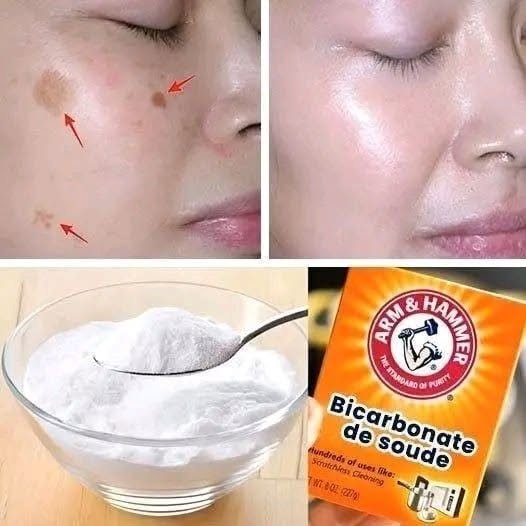
4 Ways to Address Age Spots and Achieve More Even-Looking Skin
Age spots are among the most common changes that appear on the skin over time. They often show up on areas that receive a lot of sunlight, including the face, hands, shoulders, chest, and arms. They can range from light brown to darker brown and may become more noticeable as the years pass.
Because of this, many people search for simple home remedies that promise to erase these marks. Baking soda is one of the ingredients frequently recommended online, sometimes mixed with water, lemon juice, honey, or other household ingredients.
However, there is an important distinction between something being popular online and something being safe and effective for your skin.
Baking soda is not a proven treatment for age spots. Its alkaline nature can disturb the skin’s normal protective barrier and may cause dryness, irritation, redness, or burning, particularly when used repeatedly or on sensitive facial skin. Irritation can also make pigmentation appear worse in some people.
Instead of trying to aggressively scrub away pigmentation, a better approach is to protect the skin, avoid unnecessary irritation, and use ingredients with a better-established role in improving uneven pigmentation.
What Exactly Are Age Spots?
The term “age spots” commonly refers to solar lentigines, flat areas of increased pigmentation that develop after repeated exposure to ultraviolet radiation.
They are particularly common on areas of skin that have received years of sun exposure.
Despite the name, age spots are not caused simply by getting older. Cumulative ultraviolet exposure plays an important role.
They are usually:
Flat rather than raised
Brown, tan, or darker in color
Relatively well defined
Located on sun-exposed areas
Not painful or itchy
Some people have only a few spots, while others develop many over time.
Although typical age spots are harmless, not every dark spot is an age spot. A new, changing, irregular, bleeding, or otherwise unusual pigmented lesion should be evaluated by a healthcare professional rather than treated at home.
Why Baking Soda Is Often Recommended Online
Baking soda, also called sodium bicarbonate, is a fine white powder commonly used in cooking and household cleaning.
Because it has a mildly abrasive texture and an alkaline pH, online beauty recipes sometimes suggest using it as a homemade exfoliant.
The theory is usually that rubbing baking soda onto the skin will remove dead skin cells and gradually make dark spots disappear.
The problem is that pigmentation isn’t simply a layer of dirt sitting on top of the skin.
Melanin is produced within the skin. Scrubbing the surface aggressively does not selectively remove the pigment responsible for a dark spot.
In fact, repeated irritation can damage the skin barrier and trigger inflammation. For some people, inflammation can lead to post-inflammatory hyperpigmentation, potentially making uneven pigmentation more noticeable.
So while baking soda may make the skin temporarily feel very smooth, that does not mean it is safely removing age spots.
1. Use Daily Sun Protection
If your goal is to make existing pigmentation less noticeable and prevent new spots from developing, sun protection is one of the most important steps.
Ultraviolet radiation can stimulate pigment production and contribute to the development and darkening of age spots.
A broad-spectrum sunscreen can help protect exposed skin from ultraviolet radiation.
Apply sunscreen to areas that are exposed to sunlight, particularly the face, neck, ears, hands, and other uncovered areas.
Remember that sunscreen is not only for beach days. Everyday exposure while walking, driving, working outdoors, or sitting near windows can contribute to cumulative ultraviolet exposure.
For additional protection, consider:
Wearing a wide-brimmed hat
Using sunglasses
Wearing protective clothing
Seeking shade during strong sunlight
Reapplying sunscreen as directed
If you are trying to improve pigmentation while continuing to expose your skin to strong sunlight without protection, progress can be much more difficult.
2. Consider Vitamin C for a Brighter Appearance
Vitamin C is a popular ingredient in skincare products designed to improve the appearance of uneven skin tone.
It is an antioxidant and can help protect the skin from environmental oxidative stress. Certain topical vitamin C formulations may also help reduce the appearance of excess pigmentation over time.
Unlike baking soda, vitamin C products are specifically formulated for use on skin.
However, not every vitamin C product is equally effective. Formulation, concentration, stability, packaging, and how consistently the product is used can all matter.
If you’re new to vitamin C, applying a small amount according to the product instructions can be a reasonable starting point.
Sensitive skin may react to some formulations, so irritation should not be ignored.
A skincare routine doesn’t need to contain dozens of products. A few products used consistently are often easier to maintain.
3. Look for Gentle Ingredients That Target Uneven Pigmentation
Several skincare ingredients are commonly used to improve the appearance of dark spots.
One example is niacinamide, a form of vitamin B3 used in many modern skincare products.
Niacinamide is generally considered a relatively gentle ingredient and is used in formulations designed to support the skin barrier and improve uneven-looking skin tone.
Another ingredient commonly used for pigmentation is azelaic acid.
Azelaic acid has several dermatological uses and may help with certain forms of hyperpigmentation. It can also be useful for people who have both pigmentation and acne-related skin concerns.
Other ingredients may also be used depending on the type of pigmentation and the person’s skin.
The important thing is to avoid using multiple strong products simultaneously without knowing how your skin will respond.
More products do not necessarily mean faster results.
4. Consider Professional Treatment for Persistent Spots
If age spots are particularly noticeable or do not improve with a consistent skincare routine, a dermatologist can discuss treatment options.
Depending on the diagnosis and the person’s skin type, professional treatments may include certain chemical peels, laser-based treatments, cryotherapy, or other procedures.
These treatments should only be considered after the lesion has been properly identified.
That point is extremely important.
A dark spot should not simply be assumed to be an age spot because it looks similar to another person’s pigmentation.
A dermatologist can examine suspicious or changing lesions and determine whether additional testing is necessary.
Professional treatment can also be selected according to skin type because some procedures can cause temporary or permanent changes in pigmentation, particularly in people who are prone to post-inflammatory hyperpigmentation.
Why You Should Be Careful With Lemon and Baking Soda