I Just Found These Tiny Brown Objects on My Bed — What Are They?
Finding strange objects on your bed can be surprisingly unsettling, especially when they look like tiny insects, eggs, or something that might have come from a pest.
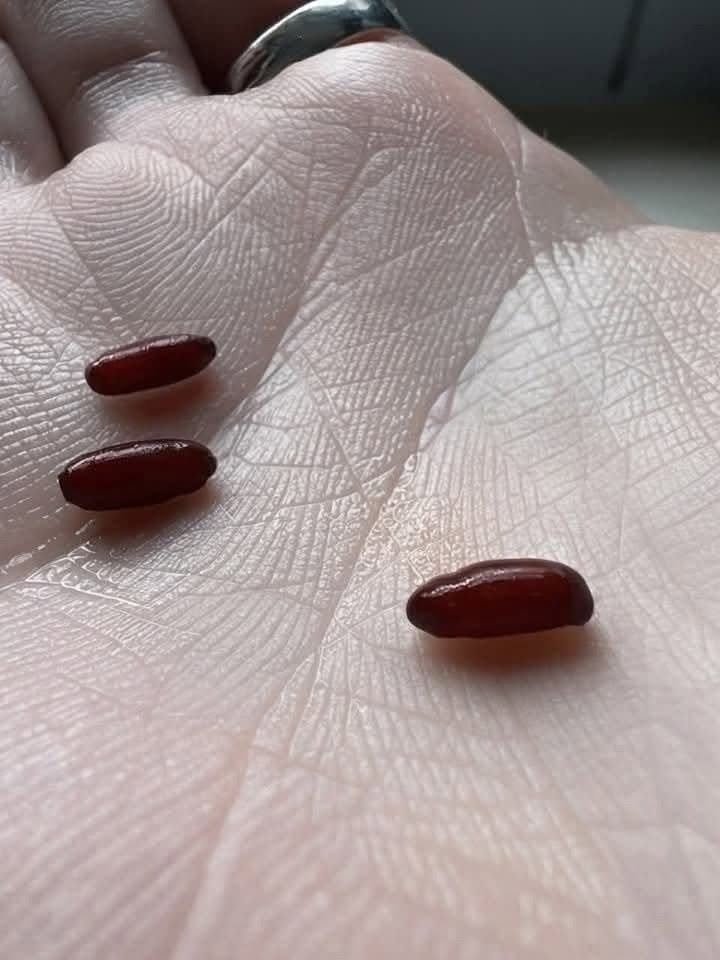
The photograph shows three small, smooth, dark reddish-brown objects resting on a person’s palm. They are elongated and rounded at the ends, with a glossy surface. At first glance, it’s understandable to wonder whether they could be bed-bug eggs, insect larvae, droppings, or some other sign of an infestation.
The good news is that their appearance does not strongly match typical bed-bug eggs or bed-bug droppings.
However, a photograph alone isn’t enough to identify them with certainty. Their exact identity depends on their actual size, texture, whether they move, where they were found, and whether similar objects are present elsewhere.
Here’s how to think about the mystery.
What Do These Objects Look Like?
The objects in the photograph appear to be:
Dark reddish-brown
Smooth and shiny
Solid-looking
Oval or capsule-shaped
Slightly elongated
Roughly a few millimeters long, based on their appearance relative to the hand
They don’t appear to have visible legs, wings, hairs, segmentation, or other obvious insect features.
That immediately makes several common pest explanations less likely.
Their smooth appearance also makes them look more like seeds, small pieces of dried organic material, or another non-insect object than a living insect.
But appearance alone shouldn’t be treated as a definitive identification.
Are They Bed-Bug Eggs?
This is probably the first question most people would have.
They don’t look like typical bed-bug eggs.
Bed-bug eggs are extremely small, generally around 1 millimeter long, and are typically pearl-white or translucent when freshly laid.
They are also commonly found attached to surfaces rather than appearing as several large, shiny reddish-brown capsules lying loose on a bed.
As bed bugs develop, their appearance changes considerably. Adult bed bugs are reddish-brown, flattened insects with visible legs and a recognizable body shape.
The objects shown in the photograph don’t resemble adult bed bugs either.
So if you’re worried because you found these three objects, the photograph by itself is not evidence that you have bed bugs.
What Do Bed-Bug Signs Usually Look Like?
If you’re concerned about an infestation, don’t focus on these objects alone.
Instead, inspect the bed for multiple signs.
Common things to look for include:
Small dark spots
Bed-bug fecal spotting can appear as tiny dark brown or black marks on sheets, mattresses, or other surfaces.
Shed skins
Bed bugs shed their outer skin as they grow. These pale, translucent skins can sometimes be found around hiding places.
Live insects
Adult bed bugs are approximately apple-seed-sized and reddish-brown. Younger nymphs are smaller and lighter.
Eggs and eggshells
These are much smaller than the objects pictured and are generally pale or whitish.
Blood spots
Small reddish stains on bedding can sometimes occur when a bed bug is crushed after feeding.
One isolated object isn’t enough to diagnose an infestation.
Could They Be Insect Droppings?
They don’t have the typical appearance of many common insect droppings.
Insect droppings are often:
Tiny
Irregular
Powdery or granular
Dark
Deposited in groups
The objects in the photograph appear unusually smooth and uniform.
That doesn’t completely rule out an insect-related origin, but it makes ordinary pest droppings a less obvious explanation.
If you find dozens or hundreds of identical objects in one location, however, that would be more significant and worth investigating.
Could They Be Seeds?
Yes, this is one possibility worth considering.
Many plant seeds are surprisingly smooth, shiny, and reddish-brown.
Seeds can enter a bedroom in numerous ordinary ways.
For example, they can arrive on:
Clothing
Blankets
Bags
Shoes
Pets
Hair
Outdoor equipment
Grocery bags
Furniture
Plants
A seed doesn’t necessarily have to come directly from a houseplant.
If someone recently spent time outdoors, sat on grass, handled plants, or brought bags or clothing onto the bed, small pieces of plant material can easily end up there.
The shape shown could potentially be consistent with a seed or another piece of dried plant material, although the photograph isn’t sufficient to determine the plant species.
Could They Be Food?
Another surprisingly common explanation for mysterious objects found in bedrooms is simply food debris.
Small seeds and pieces of food can easily become trapped in clothing, bedding, pockets, bags, or blankets.
Depending on the food, they may become darker and harder after drying.
If anyone eats snacks in the bedroom, or if children or pets spend time there, this possibility becomes even more plausible.
Some foods and seeds can have a glossy exterior that looks very unusual when photographed close-up.
Could They Be Something From a Pet?
If you have a dog, cat, or another animal in the home, investigate what the animal has recently been carrying or eating.
Pets can transport tiny objects into bedrooms on their fur, paws, or bedding.
Seeds, pieces of plant material, dried food, and other small objects can become attached to fur and eventually fall onto furniture or beds.
That doesn’t mean the objects came from the animal itself.
They may simply have been carried into the room.
What About Tick Eggs?
Another possibility people sometimes raise when they see strange objects is tick eggs.
But the objects in the photograph don’t resemble a typical tick egg cluster.
Tick eggs are generally very small and are laid in clusters, often hundreds or even thousands together.
They don’t normally appear as three large, isolated, glossy reddish-brown capsules like those pictured.
So this would not be my first explanation based on the photograph.
What About Flea Eggs?
Flea eggs also don’t look like the objects shown.
Flea eggs are tiny and generally pale or whitish rather than dark red and glossy.
If fleas are present, you are more likely to notice other evidence, such as:
Fleas jumping or crawling
Flea dirt
Scratching pets
Small bites
Tiny dark particles around pet bedding
Again, the three objects in the photograph don’t look like typical flea eggs.
Could They Be Cockroach Droppings?
Cockroach droppings can sometimes be mistaken for seeds or other small particles.
However, they are usually much smaller and more irregular.
Some cockroach species produce droppings that resemble dark grains or pepper-like material, while others leave cylindrical or ridged pellets.
The objects in the photograph appear relatively smooth and uniform, so they don’t immediately resemble typical cockroach feces.
If you are finding many dark particles around kitchen cabinets, appliances, or other hiding places, however, a pest inspection would make sense.