White Spots on the Skin: Which Vitamin Deficiencies Could Be the Cause?
White spots on the skin can be surprising, especially when they appear gradually on the arms, legs, hands, or other exposed areas. Many people immediately wonder whether these spots mean they are missing an important vitamin or mineral.
The truth is more complicated.
White or lighter-colored spots on the skin are not automatically a sign of a vitamin deficiency. Several skin conditions can produce similar-looking spots, and the appearance, location, size, texture, and progression of the spots are important when determining the possible cause.
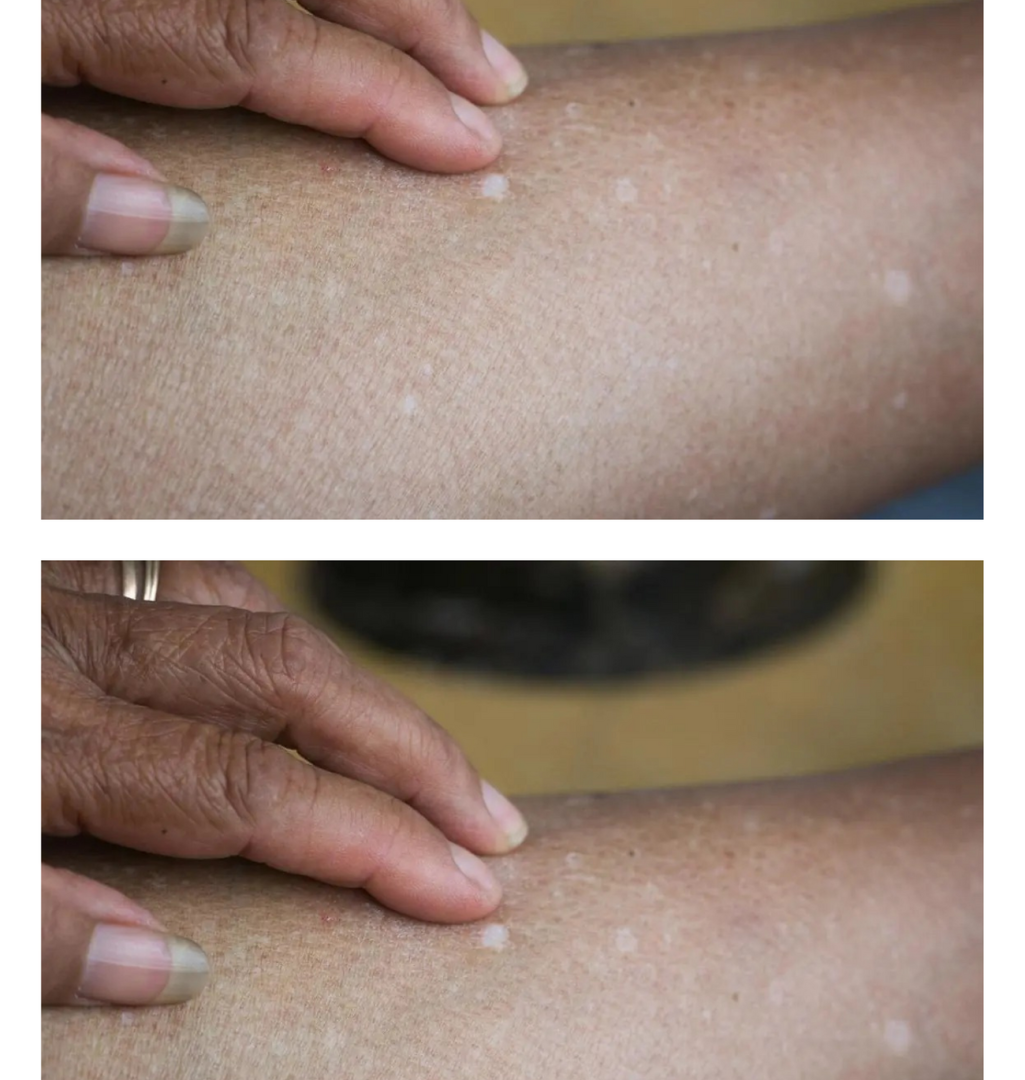
The image shown with this topic appears to show numerous small, pale spots scattered across the skin. From a photograph alone, it is not possible to make a definite diagnosis. Some patterns like this can occur with conditions such as idiopathic guttate hypomelanosis, tinea versicolor, vitiligo, or other forms of hypopigmentation.
Certain nutritional deficiencies can affect the skin, but they usually produce other characteristic symptoms rather than simply causing isolated white dots.
Understanding the difference can help prevent unnecessary supplementation and make it easier to know when a medical evaluation is appropriate.
What Causes White Spots on the Skin?
Your skin gets much of its color from a pigment called melanin. Melanin is produced by specialized cells called melanocytes.
When an area of skin produces less pigment, the area may appear lighter than the surrounding skin. If pigment is lost almost completely, the area can appear distinctly white.
This loss of color can happen for many different reasons.
Possible causes include:
Vitiligo
Tinea versicolor
Idiopathic guttate hypomelanosis
Previous skin inflammation or injury
Sun-related changes
Certain medications
Some autoimmune conditions
Less commonly, nutritional deficiencies
This is why looking at a picture and immediately concluding that a vitamin deficiency is responsible can be misleading.
1. Vitamin B12 Deficiency
Among nutritional deficiencies, vitamin B12 is one that has been associated with changes in skin pigmentation, including areas of lighter pigmentation in some people.
However, isolated white spots should not automatically be interpreted as evidence of B12 deficiency.
Vitamin B12 plays important roles in red blood cell formation, DNA production, and normal nervous-system function.
A significant B12 deficiency can cause symptoms such as:
Fatigue
Weakness
Pale skin
Numbness or tingling
Balance problems
Memory or concentration difficulties
A sore or inflamed tongue
Anemia
Some people with B12 deficiency have no obvious symptoms at first.
People at increased risk can include those with problems absorbing B12, certain gastrointestinal conditions, people who have undergone some types of gastrointestinal surgery, and people whose diets contain very little or no animal-derived food without appropriate supplementation.
If white spots are accompanied by neurological symptoms, persistent fatigue, anemia, or other signs suggesting B12 deficiency, a healthcare professional can determine whether blood testing is appropriate.
Can B12 supplements remove white spots?
Not necessarily.
If a person actually has a B12 deficiency, correcting the deficiency is important for overall health. But taking B12 simply because white spots appeared does not guarantee that the spots will disappear.
The underlying cause of the skin changes must first be established.
2. Vitamin D Deficiency
Vitamin D is frequently mentioned in discussions about skin health, but vitamin D deficiency is not a typical direct explanation for isolated white spots on the skin.
Vitamin D is important for bone health, calcium regulation, muscle function, and several other biological processes.
A deficiency can sometimes be associated with:
Bone or muscle problems
Muscle weakness
Bone pain
Increased risk of weakened bones
But seeing several white spots on your arms or legs does not by itself mean that your vitamin D level is low.
This distinction is important because vitamin D deficiency is common in some populations, but that does not mean every unrelated skin change is caused by it.
If you are concerned about vitamin D, the appropriate way to determine whether you are deficient is through appropriate medical evaluation and, when indicated, a blood test.
3. Zinc Deficiency
Zinc is a mineral, not a vitamin, but it is often included in discussions about skin problems.
Zinc is important for immune function, wound healing, cell growth, and normal skin health.
A significant zinc deficiency can cause skin changes, rashes, slow wound healing, hair loss, and changes involving the nails.
However, small isolated white spots are not the classic sign of zinc deficiency.
Someone with suspected zinc deficiency should be evaluated based on the complete clinical picture rather than assuming that white spots are proof of low zinc.
Taking large amounts of zinc without medical advice can also be harmful. Excessive zinc intake can interfere with copper absorption and create other nutritional problems.
4. Other Nutritional Deficiencies
Several nutrients are essential for healthy skin, but that does not mean that every skin discoloration is caused by a deficiency.
Deficiencies involving vitamins A, B-group vitamins, C, or other nutrients can produce various skin changes.
For example, some vitamin deficiencies can cause:
Dry or rough skin
Rashes
Changes in pigmentation
Poor wound healing
Hair changes
Nail changes
Increased bruising
The specific appearance depends on the nutrient involved and how severe the deficiency is.
This is why a person should not attempt to diagnose a vitamin deficiency simply by looking at one symptom.
A Common Cause: Idiopathic Guttate Hypomelanosis
The pattern shown in the image may resemble a condition called idiopathic guttate hypomelanosis, particularly if the spots are small, round or oval, smooth, and concentrated on sun-exposed areas such as the forearms and lower legs.
This condition produces small pale or white spots and becomes more noticeable as people age.
Despite the complicated name, the condition is generally considered benign.
It is not simply a sign that someone is lacking vitamins.
Long-term sun exposure is thought to play a role, although the exact cause is not completely understood.
The spots can be especially noticeable on darker or tanned skin because the surrounding skin becomes more pigmented while the affected areas remain lighter.
Tinea Versicolor Can Also Look Like White Spots
Another possibility is tinea versicolor, a common skin condition involving an overgrowth of a type of yeast that normally lives on the skin.
Despite its name, tinea versicolor is not the same thing as an intestinal parasite or something caused by poor hygiene.
The spots may be:
White
Light brown
Pink
Tan
Slightly darker than surrounding skin
They often appear on the chest, back, shoulders, neck, or upper arms, although other areas can be affected.
A useful clue is that tinea versicolor may produce fine scaling. The affected areas can become more obvious after tanning because the surrounding skin darkens while the affected areas do not tan normally.
Warm, humid conditions and sweating can encourage the yeast to overgrow.
If the spots are scaly, itchy, spreading, or appearing in areas typical of tinea versicolor, an evaluation can help distinguish it from other causes.
What About Vitiligo?
Vitiligo is another important possibility whenever someone develops clearly white patches.
Vitiligo occurs when melanocytes, the cells responsible for producing pigment, are destroyed or stop functioning normally.
The patches can be:
Completely white or very light
Smooth rather than scaly
Clearly different from the surrounding skin
Located on the hands, face, arms, legs, or other areas
Symmetrical in some forms
Hair growing within an affected area can sometimes also lose its pigment.
Vitiligo is an autoimmune condition and is not simply caused by a lack of vitamins.
People with vitiligo can otherwise be perfectly healthy.
Because many different conditions can produce lighter skin, a dermatologist may need to examine the spots to determine the cause.
Why the Sun Can Make White Spots More Noticeable
Sun exposure is another important factor.
When normal skin becomes darker after sun exposure, areas with reduced pigmentation remain lighter. This creates a stronger contrast.
This is why someone may suddenly notice white or pale spots after spending time outdoors.
It does not necessarily mean the spots appeared because of the sun. In some cases, the spots were already present but became more noticeable because the surrounding skin became darker.
Protecting the skin from excessive ultraviolet exposure is important, particularly when areas have lost pigment because depigmented skin can burn more easily.
Should You Take Vitamins If You Have White Spots?
This is one of the most important questions.
Do not automatically start taking large doses of vitamins simply because you have white spots.
Vitamin supplements are useful when someone has a deficiency or has a specific medical reason to take them.
But unnecessary supplementation can sometimes cause problems.
For example, excessive intake of certain vitamins and minerals can produce toxicity or interfere with the absorption of other nutrients.
A better approach is to consider the entire picture.
If you have white spots plus other symptoms such as:
Persistent fatigue
Weakness
Numbness or tingling
Hair loss
Brittle nails
Poor wound healing
Digestive problems
Unexplained weight changes
Dietary restrictions
A history of anemia
then discussing nutritional testing with a healthcare professional may be appropriate.
Foods That Support Healthy Skin
Regardless of the cause of white spots, a balanced diet provides nutrients needed for normal skin function.
Good choices include:
Eggs
Eggs provide protein and several important nutrients.
Fish
Fatty fish can provide vitamin D, protein, and omega-3 fatty acids.
Dairy products
Milk, yogurt, and other dairy foods can provide nutrients including protein, calcium, and vitamin B12.
Meat and poultry
These foods provide protein, zinc, iron, and B vitamins.
Beans and lentils
Legumes provide protein, fiber, folate, iron, and other nutrients.
Fruits and vegetables
Colorful fruits and vegetables provide vitamin C, carotenoids, and numerous plant compounds.
Nuts and seeds
These can provide vitamin E, minerals, healthy fats, and other nutrients.
The goal is not to eat one “miracle” food but to maintain a varied diet.