Vinegar: The Key to Fresher Whites and Softer Towels — But Most People Use It Wrong
White vinegar has become one of the most popular household laundry tricks, especially for people looking for a simple way to freshen towels, reduce odors, and remove detergent residue.
The idea is appealing: instead of buying another specialized laundry product, you can use something inexpensive that is already sitting in the kitchen.
But there is a lot of misinformation surrounding vinegar and laundry.
Vinegar can be useful in some laundry situations, particularly because its acidity can help dissolve certain mineral deposits and detergent residues. It may also help reduce some odors and leave fabrics feeling less coated with product buildup.
However, vinegar is not a magical whitening agent, it does not disinfect laundry in the same way as an appropriate laundry sanitizer or bleach, and using too much can be counterproductive. More importantly, vinegar should never be mixed with chlorine bleach or other incompatible cleaning products.
The key is understanding when vinegar can help, how to use it appropriately, and when another laundry product is a better choice.
Why Do People Put Vinegar in the Washing Machine?
White distilled vinegar contains acetic acid.
That mild acidity is responsible for many of the cleaning effects associated with vinegar.
In laundry, it can help loosen certain mineral deposits and residues left behind by detergents, fabric softeners, hard water, and body oils.
This can be particularly noticeable with towels.
Over time, towels can accumulate residues that make them feel less absorbent and somewhat stiff.
Sometimes people respond by adding more fabric softener.
Unfortunately, repeated use of fabric softener can leave additional coating on towel fibers, potentially reducing their ability to absorb water effectively.
Vinegar can help remove some of that buildup.
That doesn’t mean vinegar is a universal replacement for detergent.
It serves a different purpose.
Vinegar Does Not Actually Bleach White Clothes
This is one of the most important corrections to the popular claim.
If you have white clothing that has become gray, yellow, or heavily stained, vinegar is unlikely to restore it to bright white by itself.
Vinegar can help remove some residues that make fabrics look dull, but it does not work like chlorine bleach or an oxygen-based laundry whitener.
If a white shirt has a food stain, grass stain, blood stain, or other stubborn discoloration, the appropriate stain treatment is usually much more effective than vinegar.
Vinegar can be part of a laundry routine, but it should not be treated as a replacement for a dedicated stain remover or whitening product.
Why Towels Can Become Stiff
Towels are especially prone to buildup.
Every time you wash a towel, it can collect small amounts of:
Detergent residue
Fabric softener
Body oils
Skin products
Minerals from hard water
Dirt
Sweat
Laundry fragrance products
Over many washing cycles, these substances can accumulate.
The result may be a towel that feels stiff, waxy, heavy, or less absorbent.
This is one reason some towels become strangely unpleasant even though they have been washed repeatedly.
Adding more detergent isn’t necessarily the answer.
In fact, using too much detergent can contribute to residue.
Why Fabric Softener Can Make Towels Less Absorbent
Fabric softener is designed to coat fibers and make fabrics feel smoother.
That can make clothing feel soft.
But towels have a special job: absorbing water.
A coating that makes fibers feel slippery can interfere with their absorbency.
This doesn’t mean fabric softener is forbidden for every fabric.
It simply means that towels often perform better when fabric-softener use is limited.
If your towels are no longer absorbing water well, consider reducing or eliminating fabric softener for those loads.
A proper wash with enough water, appropriate detergent, and an additional rinse can sometimes make a noticeable difference.
How Vinegar Can Help Towels
When used appropriately, vinegar may help remove some detergent and mineral residues.
This can leave towels feeling cleaner and less coated.
The effect is not the same as adding a chemical softener.
Instead of coating the fibers to make them feel slippery, vinegar can help remove certain residues that have accumulated on them.
This is why some people notice that towels feel different after a vinegar rinse.
The towel may not become artificially soft in the same way that fabric softener makes clothing feel soft.
Instead, it may simply feel cleaner and less stiff.
The Best Time to Use Vinegar
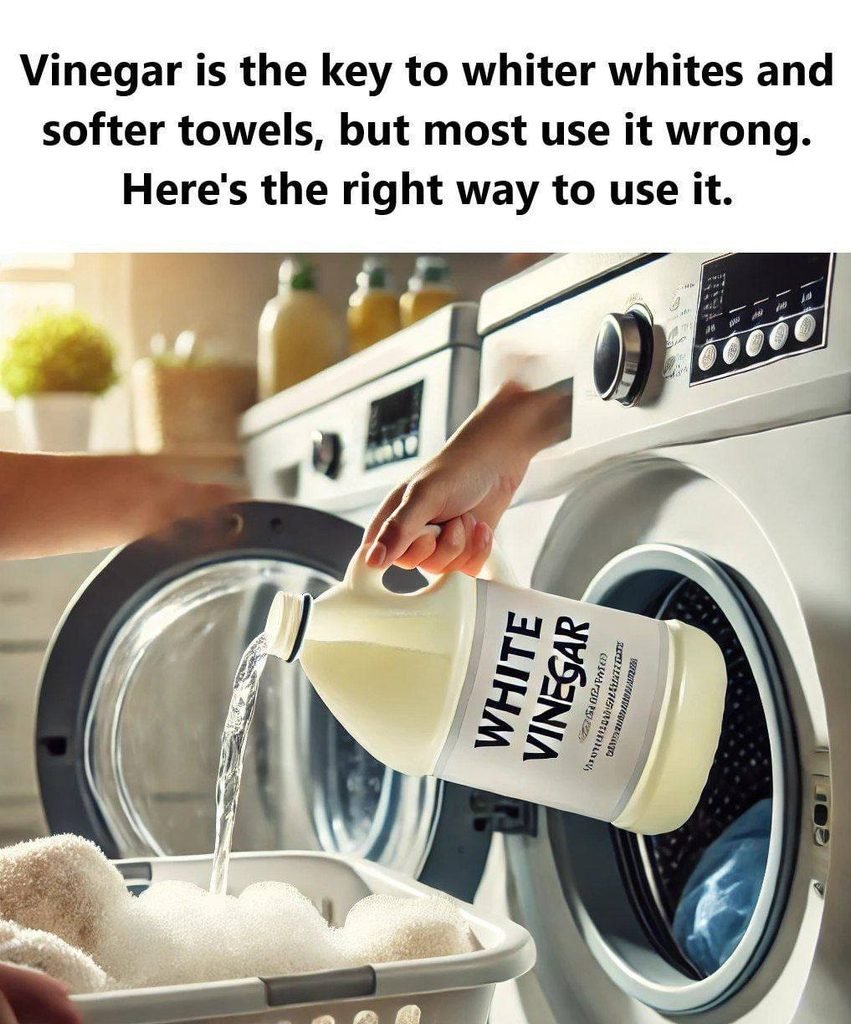
If you decide to use vinegar in your laundry, it is generally more sensible to use it during the rinse stage rather than pouring a large quantity directly onto clothes at the beginning of the wash.
The reasoning is simple.
Detergent is designed to clean the fabric during the wash cycle.
Vinegar is not a substitute for detergent.
Using them at the same time may reduce the effectiveness of the cleaning process because you are introducing an acidic product while the detergent is doing its job.
Using vinegar during the rinse stage gives the detergent time to work first.
However, washing machines differ considerably.
Some manufacturers discourage the routine use of vinegar because repeated exposure to acidic products may affect certain rubber seals, hoses, or other components over time.
For this reason, check your washing machine manufacturer’s instructions before making vinegar a regular part of your laundry routine.
How Much Vinegar Should You Use?
More is not better.
A modest amount is generally sufficient if your machine and its manufacturer allow vinegar use.
Many people use roughly 1/2 cup of distilled white vinegar in the rinse compartment for a typical large load.
For smaller loads, considerably less may be sufficient.
There is no reason to fill the machine with vinegar.
Using excessive amounts does not automatically produce cleaner laundry.
It can increase the vinegar smell and may unnecessarily expose machine components and fabrics to acidity.
If you are unsure about the appropriate amount for your machine, follow the manufacturer’s recommendations.
Use Plain Distilled White Vinegar
If vinegar is being used for laundry, plain distilled white vinegar is generally the simplest choice.
Avoid using vinegar products that contain:
Added fragrances
Coloring
Sugars
Herbs
Food ingredients
Cleaning additives not intended for laundry
The purpose is to use a simple, predictable product.
Distilled white vinegar is inexpensive and widely available.
Never Mix Vinegar With Chlorine Bleach
This is the most important safety rule in the entire article.
Never mix vinegar with chlorine bleach.
When acids such as vinegar are mixed with chlorine bleach, dangerous chlorine-containing gases can be released.
These fumes can irritate or seriously injure the eyes, skin, throat, and lungs.
This is not a laundry experiment worth trying.
Do not add vinegar to a load containing chlorine bleach.
Do not pour vinegar into a container that previously held bleach without properly cleaning it.
Do not combine vinegar with bleach in a washing machine.
If you want to use bleach for one load and vinegar for another, keep the products separate and make sure the machine has been appropriately rinsed according to its instructions.
What About Baking Soda and Vinegar?
Another popular laundry trick involves combining baking soda and vinegar.
People sometimes believe that the combination creates an especially powerful cleaner.
Chemically, however, baking soda and vinegar react with each other because one is alkaline and the other is acidic.
The reaction produces carbon dioxide bubbles, water, and other products.
The dramatic fizz can look impressive, but the reaction also means the two substances partially neutralize one another.
Using them together does not necessarily create a super-cleaning solution.
If you want to use baking soda and vinegar in your laundry routine, it generally makes more sense to use them for separate purposes rather than mixing large quantities together.