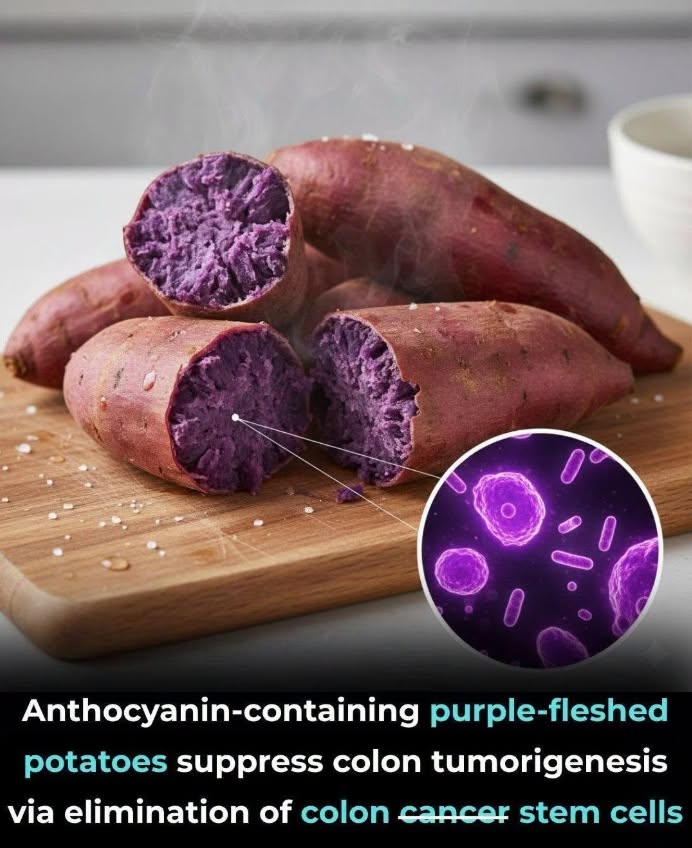
Purple Sweet Potatoes Show Powerful Effects Against Colon Tumors in Study: What Researchers Discovered
What if an ordinary vegetable found in the produce section could contain natural compounds that help scientists better understand how colon cancer develops?
Purple-fleshed sweet potatoes and potatoes have attracted growing scientific interest because of their rich concentration of anthocyanins, the natural pigments responsible for their deep purple color. These compounds are also found in blueberries, blackberries, red cabbage, and other colorful plant foods.
But purple potatoes may offer more than beautiful color and delicious flavor.
Researchers have investigated whether compounds found in these vegetables can influence the growth of colon cancer cells, including a particularly important group of cells known as cancer stem cells.
In an intriguing study published in 2015, scientists reported that anthocyanin-containing purple-fleshed potatoes suppressed colon tumor development in an experimental mouse model. The researchers also observed effects on colon cancer stem cells in laboratory experiments.
These findings generated interest because cancer stem cells are believed to contribute to tumor development, growth, and recurrence.
However, there is an important distinction: the research does not prove that eating purple potatoes prevents or cures colon cancer in humans. The findings are promising scientific observations that require further investigation.
Understanding what researchers discovered can help explain why colorful vegetables deserve a place in a healthy diet.
1. What Makes Purple Sweet Potatoes Different?
Purple sweet potatoes stand out because of their naturally intense violet or purple flesh.
Unlike ordinary orange sweet potatoes, which contain substantial amounts of beta-carotene, purple varieties are particularly rich in anthocyanins.
Anthocyanins are water-soluble plant pigments responsible for red, purple, and blue colors in many fruits and vegetables.
They belong to a larger family of plant compounds called flavonoids.
These substances have attracted scientific attention because of their antioxidant activity and their potential influence on several biological processes.
The amount and type of anthocyanins vary depending on the variety, growing conditions, storage, and preparation method.
Some purple sweet potatoes contain substantial amounts of these pigments, making them interesting subjects for nutritional research.
Why Are Anthocyanins Important?
Anthocyanins are studied for several potential biological effects:
They can help neutralize certain reactive molecules in laboratory systems.
They may influence inflammatory signaling pathways.
They have demonstrated effects on cell signaling in experimental studies.
They may influence processes involved in cell growth and programmed cell death.
They contribute to the nutritional diversity of plant-based diets.
These properties have encouraged researchers to investigate whether anthocyanin-rich foods could contribute to better long-term health.
However, antioxidant activity in a laboratory does not automatically translate into cancer prevention in people.
The human body processes food compounds in complex ways, and their effects depend on absorption, metabolism, and many other factors.
2. The Interesting Study Behind the Headlines
One particularly interesting study was published in the Journal of Nutritional Biochemistry in December 2015.
Researchers investigated anthocyanin-containing purple-fleshed potatoes and their potential effects on colon tumor development.
The study examined two main areas:
The effects of purple potato extracts on isolated human colon cancer stem cells in laboratory experiments.
The effects of baked purple potatoes on tumor development in mice.
The researchers observed that purple potato extracts reduced the proliferation of colon cancer stem cells and increased programmed cell death, also known as apoptosis.
They also investigated specific molecular pathways involved in cancer cell growth.
In the animal experiments, mice fed a diet containing baked purple potatoes showed a reduction in certain indicators associated with colon cancer stem cells and lower tumor incidence.
These results were scientifically interesting because they suggested that naturally occurring compounds in purple potatoes might influence biological processes associated with colon tumor development.
Nevertheless, the experiments were not clinical trials involving people eating purple potatoes.
Further human research is necessary before scientists can determine whether similar effects occur in humans.