Early Warning Signs of Mouth Problems: 8 Changes You Should Never Ignore
Your mouth can reveal important clues about your overall health. Sometimes, the first sign that something is wrong appears as a small sore on the lip, an unusual bump beneath the tongue, a swollen area on the gums, or a patch of discoloration inside the mouth.
Many people ignore these changes because they assume they are caused by accidental biting, stress, or minor irritation. In many cases, that assumption is correct. Common mouth sores and small bumps often disappear without treatment.
However, some oral changes require professional attention, particularly when they persist, grow, bleed, become painful, or repeatedly return.
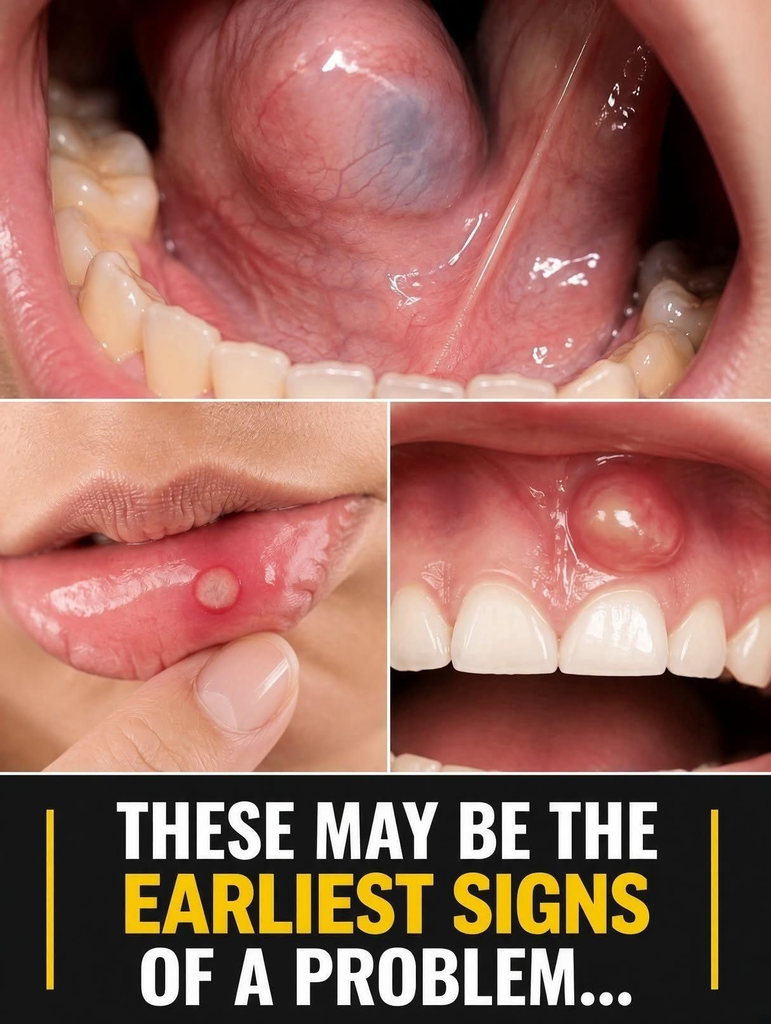
The photographs shown here illustrate several different types of oral abnormalities. They should not be interpreted as evidence of one particular disease. A bluish swelling beneath the tongue, a small ulcer on the lip, and a raised gum lesion can have completely different explanations.
Understanding these differences can help you recognize when a minor problem may need dental or medical evaluation.
1. A Bluish Swelling Beneath the Tongue
One of the most noticeable features in the image is a rounded, bluish swelling beneath the tongue.
One possible explanation is a ranula, a type of mucus-filled cyst that develops in the floor of the mouth.
A ranula is usually associated with a salivary gland or one of its ducts. Salivary glands produce saliva, which keeps the mouth moist and helps with digestion.
If a salivary gland duct becomes damaged or blocked, saliva may escape into the surrounding tissues and create a fluid-filled swelling.
A ranula may appear:
Soft or rounded.
Bluish or translucent.
Located beneath the tongue.
Relatively painless.
Larger over time.
Some ranulas remain small, while others become large enough to interfere with speaking, chewing, or swallowing.
A similar-looking swelling may have other causes, including a salivary gland obstruction, another type of cyst, or a vascular lesion.
A dentist or oral specialist can examine the area and determine whether further investigation is necessary.
Do not attempt to puncture, squeeze, or drain a swelling beneath the tongue at home. The area contains delicate structures, including blood vessels and salivary gland ducts.
2. Small Round Sores on the Lips or Inside the Mouth
The lower-left photograph shows a small, round lesion with a pale center and a reddish border.
This appearance can be consistent with an aphthous ulcer, commonly called a canker sore.
Canker sores are small, painful ulcers that develop on the soft tissues inside the mouth. They may appear on the inner lips, cheeks, tongue, or other movable oral surfaces.
Typical characteristics include:
A round or oval shape.
A white, yellowish, or gray center.
A red border.
Pain when eating or speaking.
Sensitivity to acidic or spicy foods.
Minor canker sores usually heal within one to two weeks.
Their exact cause is not always clear, but several factors may contribute, including minor mouth injuries, stress, hormonal changes, nutritional deficiencies, and immune-related responses.
Some people develop them after accidentally biting their lips or using dental appliances that irritate the mouth.
What can help?
Avoid foods that cause additional irritation, particularly very acidic, salty, or spicy foods.
Maintain gentle oral hygiene and avoid brushing directly over the sore.
A pharmacist or dentist may recommend an appropriate protective oral gel or other treatment to reduce discomfort.
If an ulcer lasts longer than two weeks, becomes unusually large, or repeatedly returns, arrange a dental or medical examination.
A persistent mouth ulcer should never automatically be assumed to be an ordinary canker sore.
3. Raised Bumps on the Gums
The lower-right photograph shows a rounded swelling above the front teeth.
A bump in this area can have several possible causes.
One possibility is a dental abscess, which is a collection of pus caused by a bacterial infection.
Dental abscesses can develop when bacteria enter the tooth through decay, cracks, or damage to the dental pulp. An infection can sometimes spread toward the surrounding gum tissue and create a swollen area.
Possible symptoms include:
Localized gum swelling.
Toothache or pressure.
Pain when chewing.
Sensitivity to hot or cold foods.
An unpleasant taste in the mouth.
Pus or drainage.
Swelling around the affected tooth.
Not every gum bump is an abscess. Other possibilities include irritation-related growths, cysts, fibrous tissue changes, or normal anatomical structures.
A dental examination is necessary to distinguish between them.
If an abscess is suspected, seek prompt dental care. Dental infections generally require treatment of the underlying source, and antibiotics alone may not resolve the problem.
Facial swelling, fever, rapidly spreading swelling, or difficulty swallowing or breathing requires urgent medical attention.
4. Persistent White or Red Patches Inside the Mouth
Another important change to recognize is the appearance of unusual patches on the tongue, gums, cheeks, or other oral tissues.
White patches can have several explanations.
For example, oral thrush is a fungal infection caused by an overgrowth of Candida yeast. It may produce creamy white patches that sometimes leave a red or irritated surface when removed.
Oral thrush is more likely in certain circumstances, including:
Recent antibiotic use.
Denture use.
Inhaled corticosteroid use.
Diabetes.
Weakened immune function.
Dry mouth.
Other white patches may be caused by repeated friction, tobacco exposure, or conditions such as leukoplakia.
Leukoplakia refers to white patches that cannot be easily explained by another condition. Some cases are associated with an increased risk of oral cancer, so persistent unexplained patches should be evaluated by a dentist or oral specialist.
Red patches also deserve attention, particularly when they remain present or occur alongside white areas.
A patch that does not disappear, changes in appearance, or becomes painful should not be ignored.
5. Unusual Changes in the Tongue
The tongue is covered with specialized tissue that helps with taste, swallowing, speech, and moving food around the mouth.
Changes in its appearance can sometimes provide clues about oral or general health.
Possible changes include:
A smooth or unusually pale tongue: This may sometimes be associated with iron deficiency or other nutritional deficiencies.
A bright red tongue: Certain infections, inflammatory conditions, or nutritional problems can produce this appearance.
A swollen tongue: Allergic reactions, infections, injuries, and other medical conditions may cause swelling.
A persistent lump: A new or growing lump on the tongue requires professional examination.
Painful cracks or sores: These can result from irritation, infection, or other inflammatory conditions.
Not every change in tongue appearance indicates illness. Natural variations in color and texture are common.
However, a persistent lump, unexplained bleeding, or ulcer that does not heal should be assessed promptly.
Sudden tongue swelling accompanied by difficulty breathing or swallowing is an emergency because it may indicate a serious allergic reaction or another urgent condition.
6. Bleeding or Swollen Gums
Healthy gums are generally firm and do not bleed easily during ordinary brushing.
If your gums frequently bleed, become swollen, or feel tender, one possible explanation is gingivitis.
Gingivitis is an early form of gum disease that develops when plaque accumulates along the gumline.
Plaque is a sticky bacterial film that forms naturally on teeth. If it is not removed regularly, it can irritate the surrounding gum tissue.
Common symptoms include:
Red or swollen gums.
Bleeding during brushing.
Bleeding when flossing.
Tenderness.
Persistent bad breath.
Gingivitis is often reversible with improved oral hygiene and professional dental cleaning.
However, if gum inflammation progresses, it can develop into periodontitis, a more serious condition that damages the tissues supporting the teeth.
Periodontitis may cause gum recession, loose teeth, and eventual tooth loss.
Regular brushing, cleaning between teeth, and dental checkups are important for prevention.
If your gums bleed frequently, do not simply stop brushing the affected area. Gentle, consistent cleaning is important, and a dentist can identify the cause.
7. Lumps, Thickened Areas, or Sores That Do Not Heal