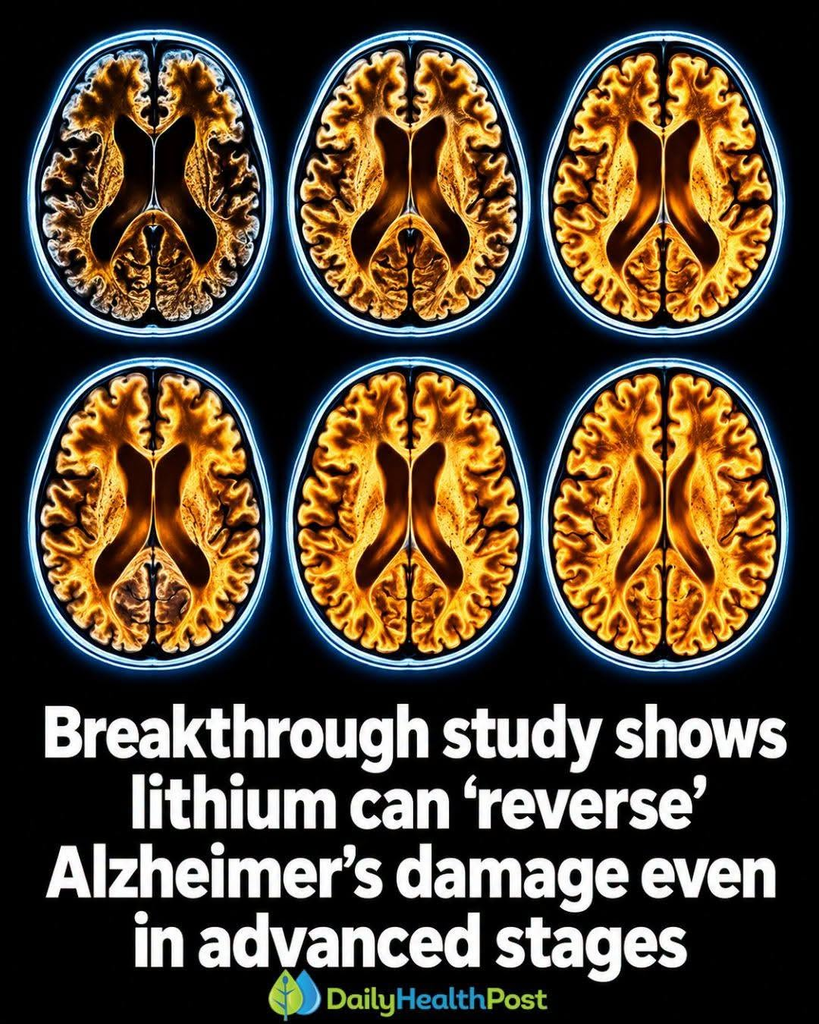
Harvard Researchers Discover a Surprising Link Between Lithium and Alzheimer’s Disease: Could It Help Protect the Brain?
Alzheimer’s disease is one of the most challenging neurological conditions facing older adults and their families. It gradually affects memory, thinking, language, and the ability to perform everyday activities. Although researchers have made important advances in understanding the disease, treatments that reliably restore lost memories or reverse advanced Alzheimer’s disease remain unavailable.
A study published in Nature in August 2025 has attracted considerable attention because it points to a potentially important role for a mineral called lithium in brain health.
Researchers led by scientists at Harvard Medical School found that lithium levels were lower in certain brain regions of people with mild cognitive impairment and Alzheimer’s disease. They also discovered that amyloid plaques, a hallmark of Alzheimer’s, appeared to trap lithium, potentially reducing the amount available to brain cells.
In experiments involving mice, a particular lithium compound called lithium orotate reduced Alzheimer’s-related brain changes and restored performance on memory tests, including in animals with advanced disease-like changes.
These findings are encouraging. However, there is a crucial distinction between reversing disease-related changes in mice and demonstrating that a treatment can reverse Alzheimer’s disease in humans.
The research is a promising scientific development, not proof that lithium supplements can reverse Alzheimer’s in people.
Understanding what the scientists discovered, why it matters, and what remains unknown can help separate the genuine findings from exaggerated headlines.
What Is Lithium, and Why Does It Matter to the Brain?
Lithium is a naturally occurring chemical element best known for its use in certain prescription medicines.
In medicine, lithium compounds have long been used to treat bipolar disorder and, in some circumstances, other psychiatric conditions. These medications can be effective, but they require careful medical supervision because excessive lithium exposure can be harmful.
Lithium also occurs naturally in the environment, including in soil, water, and some foods. Small amounts can enter the human body through the diet.
Researchers have become increasingly interested in whether naturally occurring lithium has a physiological role in the brain.
The Harvard-led research suggests that lithium may help maintain several processes important for healthy brain function. These include the activity of brain cells, communication between neurons, and mechanisms involved in inflammation and the maintenance of connections between nerve cells.
Neurons communicate through specialized connections called synapses. These connections are essential for learning, memory, and many other cognitive functions.
When synapses are lost or damaged, communication between brain cells can deteriorate. Synaptic dysfunction is an important feature of Alzheimer’s disease and other neurological conditions.
The researchers found that reducing lithium availability in experimental models was associated with changes in several biological processes connected with brain aging and Alzheimer’s-related damage.
This raises an important question: could an inadequate supply of biologically available lithium contribute to the processes that damage the brain?
The findings provide evidence worth investigating, but scientists still need to establish how lithium behaves in the human brain and whether manipulating its levels can safely improve clinical outcomes.
The Harvard Study: What Did Researchers Actually Discover?
The study, published in Nature in 2025, investigated the relationship between lithium and Alzheimer’s disease through several complementary approaches.
The researchers examined human brain tissue, studied the distribution of lithium in relation to amyloid plaques, and conducted experiments in mouse models of Alzheimer’s disease and normal brain aging.
The results suggested that lithium availability may be connected to brain health in ways that were not previously fully understood.
1. Lower Lithium Levels Were Found in Human Brain Tissue
The research team measured several metals in brain tissue from people with different levels of cognitive health.
They found significantly reduced lithium levels in the prefrontal cortex of people with mild cognitive impairment and Alzheimer’s disease compared with cognitively healthy individuals.
The prefrontal cortex contributes to functions such as decision-making, planning, and aspects of memory and attention.
The researchers examined 27 metals, and lithium was the only one that showed a significant reduction in the relevant comparisons.
This observation is intriguing because it suggests that altered lithium availability may be associated with cognitive decline.
However, an association does not automatically establish cause and effect.
Lower lithium levels might contribute to disease processes, result from changes caused by the disease, or reflect a more complicated interaction between several biological factors.
The human tissue findings alone cannot determine which explanation is correct.
Further research will be necessary to establish whether low brain lithium is a cause, a consequence, or both.
2. Amyloid Plaques Appeared to Trap Lithium
One of the most interesting findings involved amyloid-beta, a protein associated with Alzheimer’s disease.
In Alzheimer’s, amyloid-beta can accumulate into deposits called amyloid plaques. These plaques are among the characteristic biological features of the disease.
The researchers found that lithium was concentrated in amyloid plaques in human brain tissue.
They also found that the amount of lithium associated with plaques increased across the stages examined, while lithium levels in surrounding plaque-free regions were reduced.
The findings suggest that amyloid plaques may bind lithium, effectively sequestering it in places where it may not be readily available to perform its normal functions.
This provides a possible explanation for why certain areas of the brain might have reduced biologically available lithium even when lithium is present within the tissue.
Think of it as a substance becoming concentrated in one location rather than remaining available throughout a system. The total amount present and the amount accessible for normal biological activity are not necessarily the same.
The researchers proposed that this process could contribute to a cycle in which reduced lithium availability makes brain cells more vulnerable to damage, while disease-related changes further disrupt normal brain function.
Nevertheless, this is a proposed mechanism supported by the study’s findings. Scientists still need to determine how important it is in the development and progression of Alzheimer’s in humans.
What Happened When Researchers Reduced Lithium in Mice?