I Found a Strange Rock-Hard Object in an Airplane’s Cargo Pit — What Could It Be?
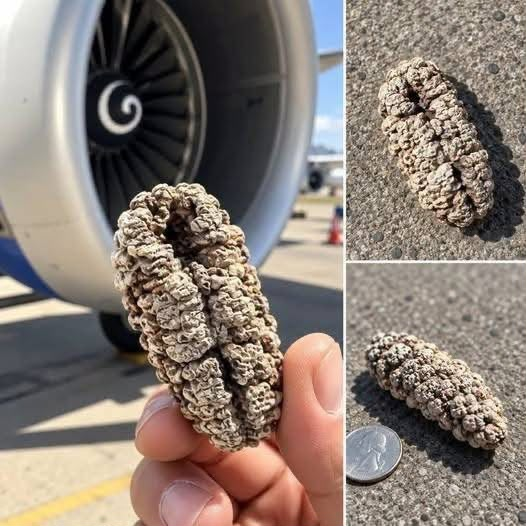
At first glance, the object in the photograph looks almost like a piece of fossilized material, a strange rock, or even something that might have fallen off an aircraft.
It is small enough to hold in one hand, has a surprisingly rough and lumpy surface, and appears extremely hard. The unusual texture makes it difficult to understand what it could possibly be.
But there is a much more ordinary explanation for this strange-looking object.
It appears to be an old, dried mud-based insect nest, most likely associated with a solitary wasp such as a mud dauber.
The exact species cannot be confirmed from this photograph alone, but the overall appearance is consistent with the way mud daubers and related solitary wasps construct nests from small amounts of wet mud or clay. These nests can become surprisingly hard after drying, and an old nest can look remarkably similar to a piece of stone.
Mud dauber nests are known to occur on structures and equipment, including sheltered areas around buildings and machinery. (Extension du Maryland)
Why Does It Look Like a Rock?
The first clue is the surface.
The object isn’t smooth like an ordinary pebble. Instead, it appears to be made up of many small rounded lumps packed tightly together.
This is an important characteristic.
A mud-dauber nest is not necessarily built as one smooth object. The female wasp collects small amounts of wet soil or mud and uses them to construct individual chambers. As more chambers are built, they can form a larger mass.
After the mud dries, those chambers can become extremely firm.
Over time, weathering can make an old nest even harder and more weathered-looking.
What started as wet mud carried by a tiny insect can eventually resemble something that has been sitting outside for years.
This is one reason old insect nests are sometimes mistaken for rocks, fossils, or pieces of hardened clay.
What Is a Mud Dauber?
A mud dauber is a type of solitary wasp.
Unlike social wasps such as yellowjackets, mud daubers generally do not live in large colonies where hundreds of workers defend a communal nest.
Instead, an individual female builds and provisions her own nest.
Different species produce different types of mud nests.