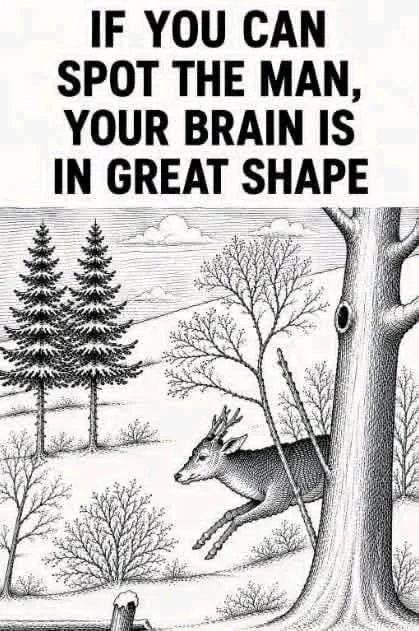
Optical Illusion Personality Test: What You See First May Reveal How You Think
This is where it is important to distinguish entertainment from psychology.
Personality is complex.
Psychologists study relatively consistent patterns of thinking, feeling, and behaving across different situations.
Established personality assessments generally use structured questions, carefully developed measurement methods, and statistical research.
A single picture cannot reliably determine whether someone is introverted, intelligent, sensitive, creative, anxious, or emotionally strong.
For example, noticing the white animal does not prove that you are more compassionate than someone who notices the background.
Likewise, focusing on the dark shape does not establish that you are more logical or practical.
Your first impression may be influenced by lighting, image quality, attention, expectations, and individual differences in visual processing.
Therefore, these optical illusion tests are best enjoyed as lighthearted activities rather than scientific personality diagnoses.
6. Why Are Visual Personality Tests So Popular?
There is a reason these challenges attract so much attention on social media.
They are simple, quick, and interactive.
Unlike lengthy questionnaires, an optical illusion requires almost no effort.
You look at a picture, choose what you noticed first, and compare your answer with an interpretation.
People also enjoy discovering that friends and family members see something completely different.
These tests create opportunities for conversation.
Someone might say they immediately noticed the animal, while another person insists that the background was obvious.
The discussion becomes even more interesting when people explain why they interpreted the image differently.
Another reason for their popularity is curiosity about ourselves.
Most people enjoy reading descriptions that encourage them to reflect on their habits, relationships, strengths, and preferences.
Even when the interpretations are not scientifically validated, they can provide an entertaining starting point for self-reflection.
7. What Optical Illusions Teach Us About Human Perception
Beyond entertainment, optical illusions demonstrate something genuinely fascinating about the human brain.
Our perception is not always a perfect representation of the physical world.
The brain continuously processes visual information and makes interpretations based on available clues.
Sometimes, those interpretations produce surprising results.
A drawing may appear to move even though it is completely still.
A shape may look larger than another even when both are identical in size.
A single image may contain two possible interpretations, and switching between them can feel almost magical.
These experiences demonstrate how visual perception depends on the interaction between incoming information and the brain’s interpretation of that information.
Optical illusions are therefore valuable tools for exploring visual processing and understanding how people experience the world.
8. How to Get More Out of This Personality Challenge
If you want to make this optical illusion more interesting, try a few simple activities.
Look at the image without reading the interpretations first.
Give yourself a few seconds to examine the entire picture.
Identify the first thing that attracts your attention.
Do not spend too much time searching for a particular answer.
Ask a friend or family member what they noticed.
Compare your answers and discuss why you focused on different parts of the image.
Consider the interpretation without taking it too seriously.
Ask yourself whether any description genuinely reflects your personality.
Remember that people are more complicated than a single visual choice.
Your personality is shaped by many factors, including experiences, values, relationships, environment, and individual characteristics.
The most useful part of the exercise may be the conversation it creates rather than the interpretation itself.
Final Thoughts: One Picture, Different Perspectives
An optical illusion can be surprisingly powerful.
One person may immediately notice a fluffy white animal, while another sees the dark background surrounding it. Both are looking at exactly the same image, yet their first impressions are different.
Popular personality interpretations associate the white animal with observation and emotional sensitivity, while the dark background is often linked to analytical thinking and big-picture awareness.
Seeing both may be interpreted as a sign of curiosity and flexible thinking.
But remember that these descriptions are for entertainment, not scientific personality assessments.
Your character cannot be reduced to what your eyes notice first.
You are shaped by your choices, experiences, values, relationships, and the way you treat others.
So, take another look at the image.
What did you notice first: the white animal, the dark background, or both?
Sometimes, the most interesting part of an optical illusion is discovering that someone sitting right next to you sees something completely different.