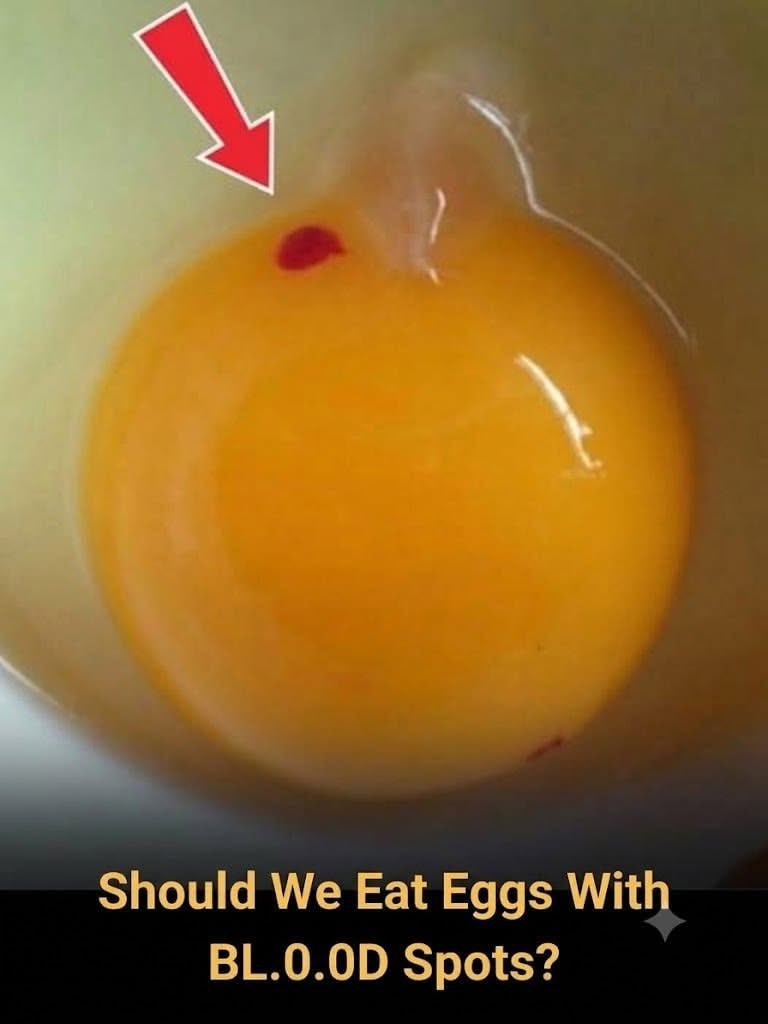
Finding a small red or brown spot inside an egg can be surprising. You crack the egg into a bowl, see a bright red mark sitting on the yolk, and immediately wonder whether the egg is spoiled, fertilized, unsafe, or somehow contaminated.
The good news is that a small blood spot inside an otherwise normal egg is usually not a sign that the egg is spoiled.
These spots are generally caused by a tiny blood vessel breaking during the formation of the egg inside the hen’s reproductive system. They can look unpleasant, but their presence alone does not mean the egg is dangerous.
However, there are still important food-safety rules to follow when deciding whether to eat an egg.
What Is the Red Spot?
The red spot in the photograph appears to be a typical blood spot, sometimes called a blood speck.
It occurs when a small blood vessel in the hen’s ovary or reproductive tract ruptures while the egg is developing.
A tiny amount of blood can become incorporated into the egg before the shell is formed.
The result may be a small red, pink, brown, or dark reddish spot on the yolk or occasionally elsewhere in the egg.
It can be alarming when you first see it, especially because most eggs have no visible blood spots.
But it is a natural occurrence during egg formation.
Does a Blood Spot Mean the Egg Is Fertilized?
No.
This is one of the most common misconceptions about blood spots.
A blood spot does not mean that the egg contains a developing chick.
Blood spots can occur in eggs that were never fertilized.
Commercial eggs are generally produced without roosters, so fertilization does not occur in those flocks. Even in backyard chickens where a rooster is present, the appearance of a blood spot by itself cannot be used to determine whether an egg is fertile.
A blood spot is associated with a small broken blood vessel, not with the development of an embryo.
Why Does This Happen?
Egg formation is a complex biological process.
An egg begins developing in the hen’s reproductive system. The yolk is released and eventually surrounded by albumen, membranes, and the shell.
During this process, small blood vessels can occasionally rupture.
When that happens, a small amount of blood can become attached to the developing egg.
The result is the little red mark you see after cracking the egg.
It doesn’t mean that the hen is sick.
It doesn’t mean that the egg was contaminated.
And it doesn’t automatically mean that the egg is old.
It is simply an occasional variation in how an egg forms.
Are Blood Spots More Common in Some Eggs?
They can occur more frequently under certain circumstances.
The likelihood can be influenced by factors associated with the hen, including age and reproductive conditions.
Blood spots may be more noticeable in eggs from certain hens than others.
They can also occur randomly, meaning that a person might crack hundreds of eggs without seeing one and then suddenly find a prominent red spot in an otherwise normal egg.
The occasional appearance of a blood spot is therefore not, by itself, a reason to assume something is wrong.