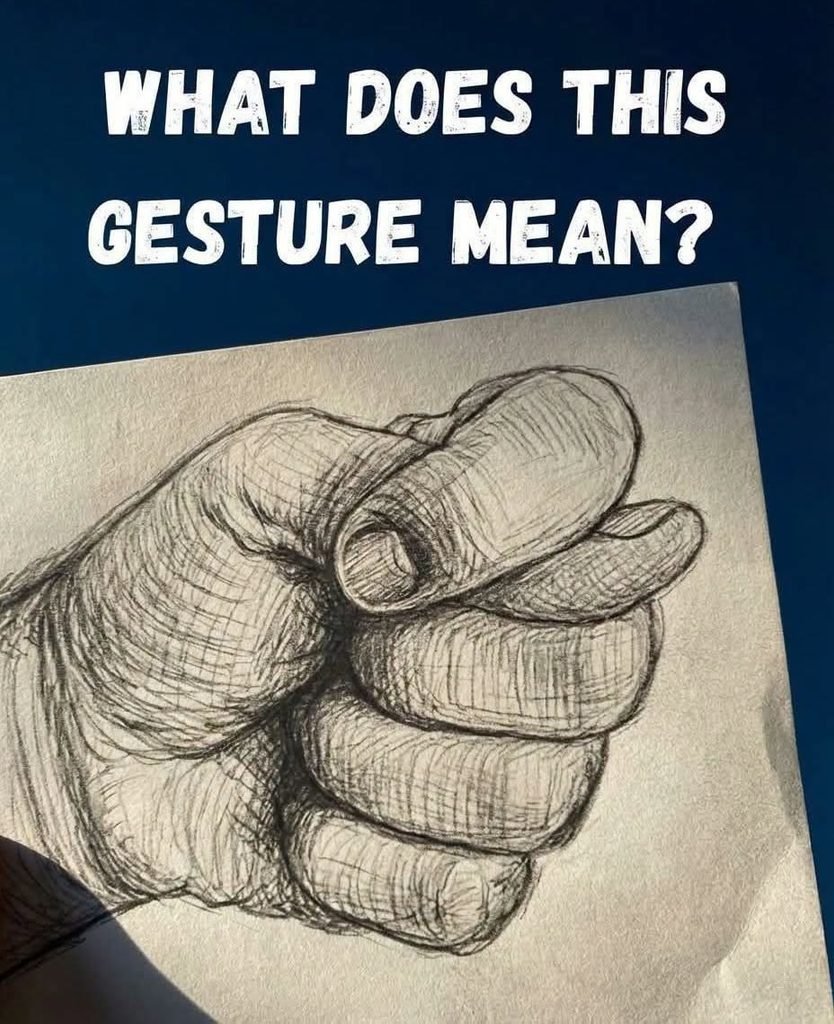
The Hidden Meaning Behind One of History’s Oldest Hand Gestures
Hand gestures have been part of human communication for thousands of years. Long before people could communicate through text messages, social media, or written language, they used their hands to express emotions, communicate ideas, show respect, and sometimes provoke or challenge others.
One particularly interesting gesture is the hand sign shown in the image: a closed fist with the thumb positioned between the fingers. Although it may look unusual, this gesture has a long history and has appeared in different cultures, traditions, and forms of popular entertainment.
But what does it actually mean? Is it an ancient symbol of good luck, a sign of protection, a playful insult, or something else entirely?
The answer depends on the cultural context, the historical period, and how the gesture is being used.
What Is This Hand Gesture Called?
The gesture shown in the image is commonly known in English as the fig sign or figa. It is made by closing the hand into a fist and placing the thumb between the index and middle fingers, so that the tip of the thumb becomes visible between them.
The name is connected to the resemblance between the thumb and the small fruit of a fig.
Although the gesture can have different interpretations, it has historically been associated with protection, fertility, sexuality, luck, and insulting or dismissive communication.
Its meaning is not universal. A gesture considered humorous or protective in one culture may be offensive or confusing in another.
Understanding its history requires looking at how people have used symbolic hand movements throughout the centuries.
An Ancient Gesture With Cultural Roots
Hand gestures have played important roles in human societies since antiquity. People have used them in religious ceremonies, public performances, everyday conversation, and social interactions.
The fig sign is often discussed in connection with ancient Mediterranean cultures, particularly Roman traditions. However, claims about its exact origin and uninterrupted history should be treated cautiously because gestures can be difficult to document and interpret across different historical periods.
The gesture is associated with the Latin word fica, meaning a fig. The term also developed sexual associations in some historical contexts.
In ancient Roman culture, hand gestures could communicate meanings that differed considerably from their modern interpretations. Some were used for humor, others for insults, and still others in connection with beliefs about luck or protection.
It is therefore important not to assume that every modern use of the fig sign carries precisely the same meaning that it may have carried centuries ago.