These Are the Consequences of Spending Too Much Time With Your Hands in Water
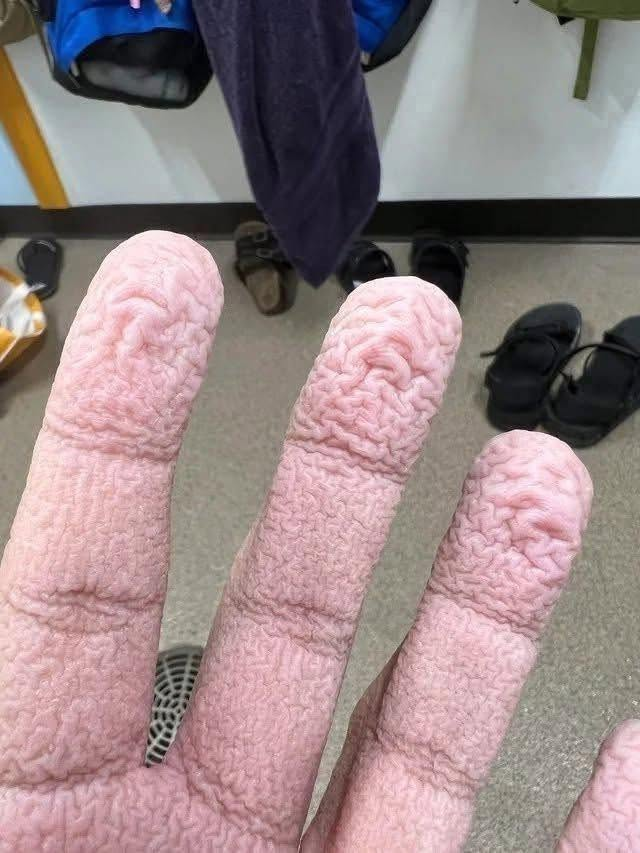
The image shows fingers with dramatically wrinkled, pale skin. At first glance, it may look unusual or even alarming, but this appearance can occur when the hands have been exposed to water for a prolonged period.
Most people have experienced wrinkled fingertips after taking a long bath, swimming, washing dishes, or spending a long time in a pool. The fingertips can become pale, soft, and deeply wrinkled, sometimes resembling the texture shown in the photograph.
This phenomenon is commonly known as water-induced wrinkling or aquagenic wrinkling of the skin.
It is usually temporary and disappears after the hands are removed from the water and allowed to dry. However, prolonged or repeated exposure to water can also contribute to other skin problems, particularly when combined with soaps, detergents, disinfectants, or chemicals.
Understanding why it happens can help you protect your skin.
Why Do Fingers Wrinkle in Water?
For many years, people thought that wrinkled fingers simply happened because the skin absorbed water and expanded.
That explanation is incomplete.
The wrinkling of fingertips after prolonged water exposure is associated with changes in the blood vessels underneath the skin. When the hands remain submerged, the blood vessels in the fingers can narrow, producing changes in the volume beneath the skin and creating the characteristic wrinkles.
This is why the effect is particularly noticeable on the fingertips and palms.
The skin doesn’t simply become “full of water.”
There is a neurological and vascular component to the process.
Interestingly, researchers have also studied whether water-induced finger wrinkling may have served an evolutionary purpose. Wrinkled fingertips may improve the ability to grip wet objects, although the exact evolutionary significance remains an area of research.
1. The Wrinkles Are Usually Temporary
The most reassuring thing about ordinary water wrinkles is that they are generally temporary.
After you remove your hands from the water, the blood vessels gradually return toward their normal state and the skin becomes smooth again.
The amount of time required varies from person to person.
If your fingers become wrinkled after swimming or bathing and return to normal afterward, there is usually no reason to consider the wrinkling itself dangerous.
The problem is more likely to arise when the skin remains irritated, painful, cracked, itchy, or discolored after the water exposure.
2. Long Exposure Can Make the Skin More Vulnerable
Although temporary wrinkling is harmless in most circumstances, prolonged exposure to water can affect the skin barrier.
The outermost layer of the skin helps keep moisture inside while protecting the body from environmental irritants.
Repeated wetting and drying can disturb this barrier.
This can be especially noticeable in people who:
Wash their hands very frequently
Work with water all day
Wash dishes regularly
Use cleaning products
Work in healthcare
Spend many hours swimming
Frequently use disinfectants
The result can be dry, rough, irritated, or cracked hands.
3. Soap Can Make the Problem Worse
Water isn’t always the only factor.
Soap and detergents can remove oils from the surface of the skin.
Those natural oils help maintain the skin barrier.
When someone repeatedly washes their hands with soap and then exposes them to water again and again, the skin may become increasingly dry.
This can lead to:
Tightness
Roughness
Flaking
Redness
Burning
Itching
Small cracks
The solution isn’t to stop washing your hands.
Hand hygiene remains important.
Instead, the goal is to wash appropriately while also protecting the skin afterward.
4. Hot Water Can Increase Dryness
Many people prefer very hot water because it feels comfortable or seems to clean better.
However, extremely hot water can contribute to skin dryness and irritation.
Warm or lukewarm water is generally sufficient for ordinary handwashing.
You don’t need painfully hot water to clean your hands properly.
If your fingers become dry after frequent washing, reducing the temperature of the water may help.
5. Dry Your Hands Thoroughly
After washing your hands, gently dry them.
Pay particular attention to the spaces between your fingers.
Leaving the skin constantly damp can contribute to irritation, especially if the hands are repeatedly exposed to moisture throughout the day.
You don’t need to rub aggressively.
Patting the hands dry with a clean towel is usually sufficient.
6. Moisturize After Washing
One of the simplest ways to protect frequently washed hands is to apply moisturizer after washing.
A moisturizer can help restore some of the skin’s protective barrier and reduce dryness.
Look for products designed for dry or sensitive skin.
Ingredients commonly found in useful moisturizers include substances such as:
Glycerin
Ceramides
Petrolatum
Dimethicone
Hyaluronic acid
The exact product isn’t as important as using it consistently.
If your hands are repeatedly exposed to water during the day, keeping a moisturizer nearby can make the habit easier.
7. Prolonged Water Exposure Can Cause “Waterlogged” Skin
When skin remains wet for a long time, it can become soft, pale, and wrinkled.
This is sometimes described informally as “waterlogged” skin.
You may notice this after:
Swimming
Long baths
Washing dishes
Cleaning
Working in wet environments
The skin may feel unusually soft.
If the exposure continues for a very long period, the softened skin can become more vulnerable to friction and irritation.
That’s one reason people who work with their hands in water should take appropriate breaks when possible.
8. Gloves Can Help During Household Cleaning
If you regularly wash dishes or work with household cleaning products, protective gloves can reduce direct contact between your skin and water or chemicals.
Choose gloves that fit comfortably.
If your hands sweat heavily inside gloves, take appropriate breaks and allow them to dry.
For people with sensitive skin, a breathable cotton liner underneath protective gloves can sometimes make them more comfortable.
The goal is to reduce unnecessary exposure while still allowing the hands to remain clean.
9. Detergents Can Irritate the Skin
Dishwashing liquid and household cleaning products are designed to remove grease and dirt.
Unfortunately, the same properties that help remove grease can also strip some of the natural oils from the skin.
Repeated exposure may lead to irritant contact dermatitis.
Symptoms can include:
Redness
Dryness
Burning
Itching
Cracking
Peeling
If you regularly work with cleaning chemicals and your hands are becoming irritated, wearing appropriate protective gloves and using a moisturizer can help.
Persistent symptoms should be evaluated by a healthcare professional.
10. Wrinkled Fingers Can Also Occur Without Long Water Exposure