The Mystery of the Little Ledge: What That Small Kitchen Island Shelf Is Actually For (And How to Love It)
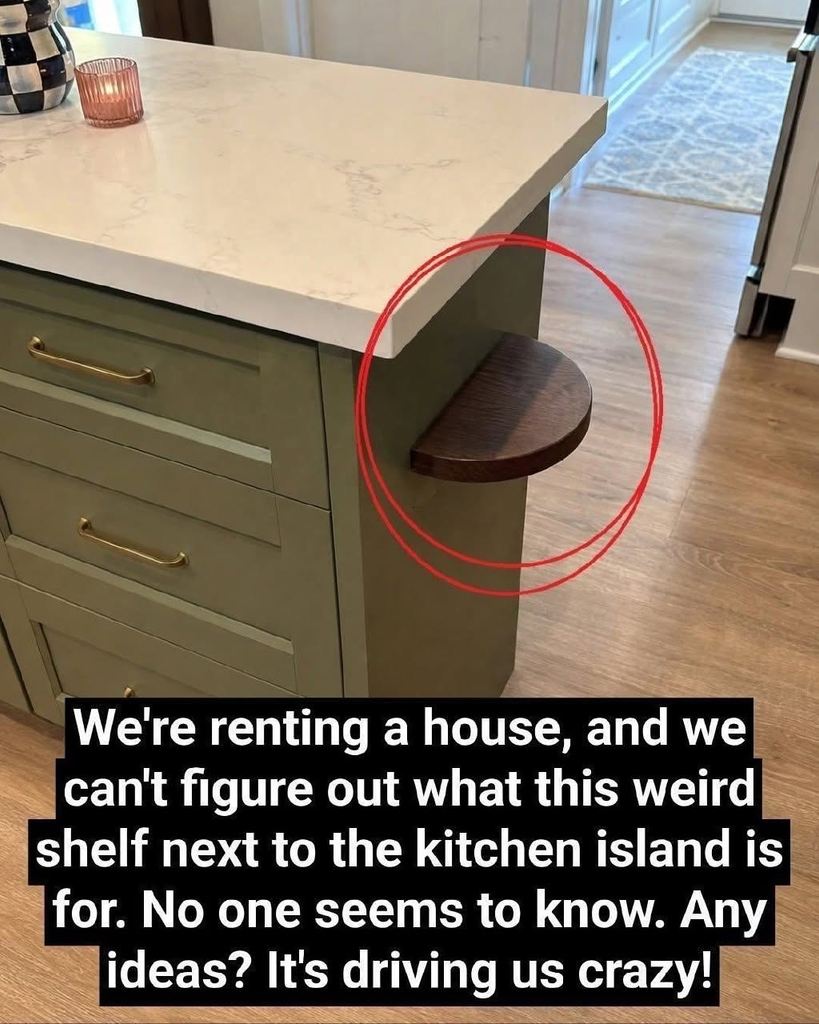
Have you ever walked into a kitchen and noticed a strange little wooden or stone shelf sticking out from the side of a kitchen island?
It looks too small to be a countertop.
It isn’t positioned like a normal dining area.
It doesn’t seem large enough for meaningful storage.
And because it sticks out from the side of the island, you might wonder whether it is simply an unusual decorative choice.
The feature shown in the image is most likely a small kitchen island side ledge or landing shelf. Its exact purpose depends on how the particular island was designed, but in this style, it is generally intended as a light-duty surface for small items, serving, display, or everyday convenience.
It isn’t necessarily a mysterious secret feature at all.
In fact, once you understand how it can be used, you may wonder why more kitchens don’t have one.
So What Is That Little Shelf Actually For?
The simplest answer is:
It’s a small secondary surface attached to the end of the island.
Think of it as a tiny “pause spot.”
Your main countertop is where you prepare food, chop vegetables, mix ingredients, roll dough, unload groceries, and perform other kitchen tasks.
But sometimes you don’t need an entire countertop.
You simply need somewhere to put a coffee cup, phone, cookbook, small bowl, recipe card, or serving dish for a moment.
That’s where a little ledge like this can become surprisingly useful.
It gives small objects a dedicated place without taking up valuable space on the main work surface.
It May Have Been Designed as a Landing Spot
One of the most practical uses is simply having somewhere to temporarily place things.
Imagine you’re preparing dinner.
The countertop is covered with a cutting board, vegetables, mixing bowls, utensils, and ingredients.
Your phone is sitting in the middle of everything because you’re following a recipe.
Instead of keeping it there where it could become dirty or get splashed, you can place it on the side ledge.
The same applies to:
A recipe book
A tablet
A coffee mug
A water glass
Keys
Sunglasses
A small wallet
A grocery list
A kitchen timer
A small bowl
Napkins
It isn’t meant to replace a drawer or cabinet.
It’s simply an easily accessible resting place.
It Can Be a Convenient Drink Shelf
One of the best uses for a little kitchen island ledge is as a drink holder.
Many people like to have coffee, tea, or water nearby while cooking.
But placing a drink directly beside food preparation isn’t always ideal.
A spill could run across your ingredients, cutting board, or electrical appliances.
A side ledge creates a little separation.
You can place your cup or bottle there while keeping the primary food-preparation area clear.
Of course, you still need to make sure the shelf is stable enough for the object and that the drink isn’t positioned where someone walking past can easily knock it over.
It Can Be Useful When Entertaining
Kitchen islands have become gathering places.
During parties, family dinners, holidays, and casual get-togethers, people naturally gravitate toward the kitchen.
A small side shelf can provide an extra location for lightweight serving items.
For example, you might use it for:
A small plate of appetizers
Napkins
A small bowl of snacks
A coffee cup
A glass
A small serving dish
Condiments
Cocktail napkins
The key word is small.
This is not a miniature buffet table.
It isn’t designed for a huge casserole dish or a heavy stack of plates.
Think of it as a convenient little serving point.
The Rounded Shape May Be Intentional
Look closely at the shelf in the image.
It isn’t simply a rectangular piece sticking out from the island.
The front has a rounded or curved shape.
That can serve an aesthetic purpose as well as a practical one.
Kitchen islands are often made from large rectangular forms with straight edges.
A curved shelf softens that appearance.
Instead of ending with a harsh square corner, the island gets a small rounded detail that makes the furniture feel more customized.
It can also make the end of the island visually interesting without adding another large cabinet or complicated structure.
Sometimes good interior design is about small details rather than dramatic features.