I Found This Strange Object Stuck to My Fence — What Could It Be?
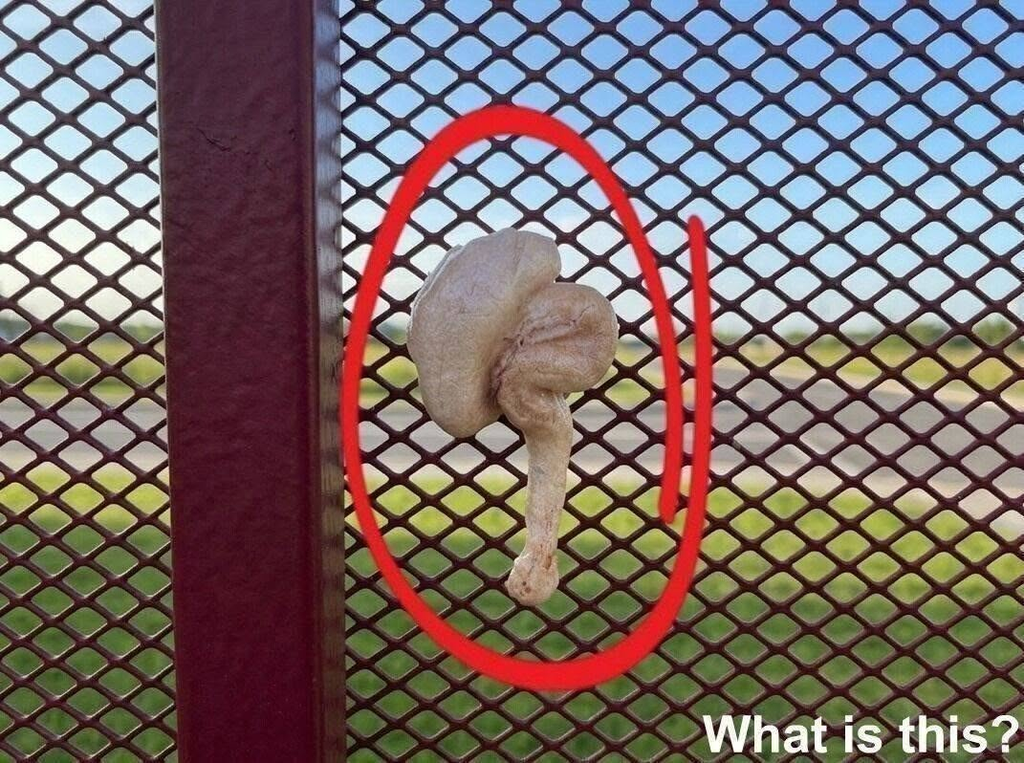
Finding something completely unfamiliar attached to a fence can be surprisingly unsettling. At first glance, the object in the photograph almost looks like part of an animal, an unusual plant, or even something that has been deliberately placed there.
Its pale beige color, irregular folded upper section, and long narrow portion hanging downward make it particularly difficult to recognize.
But there is a very good possibility that this is some type of fungus or mushroom-like growth.
The important word here is possibility. A photograph alone is not enough to identify a fungus to species with confidence, especially when the underside, attachment point, texture, and interior cannot be examined. The shape in this particular image is unusual enough that it would be unsafe to give it a precise species name based only on the photograph.
Still, there are several clues that can help explain what the object may be and why something like it could appear around a fence.
The First Clue: It Looks Organic
The object has several characteristics that make it look more like a natural growth than a manufactured object.
Its surface appears irregular rather than perfectly shaped.
The upper portion has folds and rounded lobes.
The lower portion appears elongated and somewhat stem-like.
Its color is a pale cream or beige rather than a bright synthetic color.
The overall structure also looks somewhat dry and fibrous.
These characteristics are consistent with certain types of fungi.
Fungi can produce extraordinarily strange shapes. Some have smooth caps, some resemble coral, others look like brains, ears, shelves, cups, fingers, or pieces of dried foam.
A fungus does not have to look like the classic mushroom with a round cap and straight stem.
In fact, some of the most unusual fungi barely resemble what most people imagine when they hear the word “mushroom.”
Why Would a Fungus Grow on a Fence?
This is one of the most interesting parts of the mystery.
If the fence is made from wood, fungal growth is much easier to explain.
Wood contains organic material that fungi can colonize, particularly when it becomes damp, weathered, cracked, or partially decayed.
A wooden fence exposed to rain, humidity, shade, and changing temperatures can eventually become a suitable environment for different fungi.
The fungus itself may not necessarily be feeding directly on the visible part of the fence in the way people imagine.
A fungal organism can exist as a network of microscopic threads called mycelium within suitable material, while the visible structure is the fruiting body that develops under favorable conditions.
That visible structure is what we commonly call a mushroom or fungus.
This is why a strange growth can seemingly appear “out of nowhere.”
The organism may have been present in a hidden form before producing the visible structure.
But the Fence in the Image Looks Like Metal
That makes the photograph more interesting.
The object appears to be attached to a metal mesh fence rather than obviously growing out of a wooden post.
That doesn’t necessarily rule out fungus.
There could be organic material trapped against the fence, such as:
Dead leaves
Grass
Wood fragments
Soil
Bird nesting material
Decaying vegetation
Old plant material
A fungus could potentially have developed on organic material caught against the fence.
It is also possible that the object was attached to the fence by something other than its biological growth.
For example, wind can push debris against mesh fencing, where moisture remains trapped.
So the exact attachment point is extremely important.