The Sun-Dried Mystery: What Is This Homemade Pasta Hanging in the Backyard?
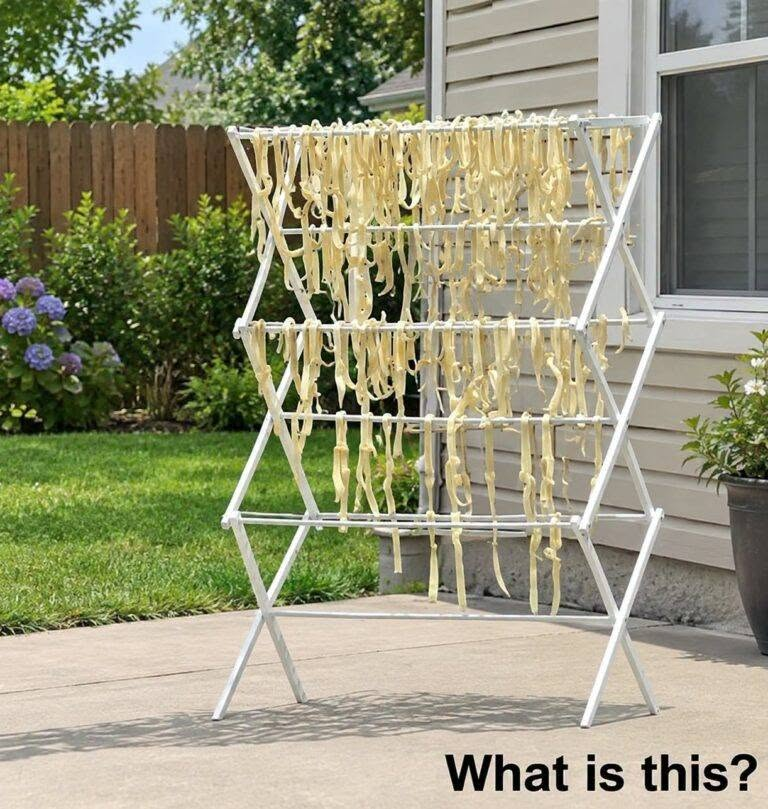
At first glance, the image looks almost mysterious. A large folding drying rack is covered with dozens of long, pale strips hanging in the sunshine. To someone unfamiliar with traditional pasta-making, it might look like noodles, ribbons, strips of dough, or even some unusual homemade craft.
But the answer is much simpler:
This is homemade pasta being dried before storage or cooking.
The long strips are most likely fresh pasta that has been shaped and draped over a drying rack so excess moisture can evaporate. This is an old-fashioned technique that allows homemade pasta to become firmer and, depending on the recipe and drying method, potentially suitable for longer storage.
However, there is an important distinction between casually drying pasta outdoors and properly drying pasta for long-term storage.
Fresh homemade pasta can contain flour, water, eggs, and sometimes other ingredients. Those ingredients require appropriate handling. Sunlight alone doesn’t make food automatically safe, and leaving pasta outdoors can expose it to dust, insects, animals, humidity, and temperature fluctuations.
So let’s take a closer look at what is happening in this unusual-looking backyard scene.
What Is Hanging on the Rack?
The strips in the photograph appear to be long pieces of pasta dough.
Homemade pasta can be shaped into many forms, including:
Fettuccine
Tagliatelle
Linguine
Pappardelle
Spaghetti
Lasagna sheets
Thin noodles
Hand-cut ribbons
Long pasta is especially convenient to dry because it can be draped over rods, dowels, pasta drying racks, clean poles, or other suitable supports.
Instead of leaving the pasta in a pile, separating the strands allows air to circulate around them.
That helps moisture escape.
Why Dry Homemade Pasta?
Drying pasta has several purposes.
Fresh pasta contains a significant amount of moisture.
If you leave freshly cut pasta in a pile, the pieces can stick together.
They may also become difficult to handle.
Drying allows the surface to become firmer and can make the pasta easier to store or cook later.
Traditional pasta-making cultures have developed many techniques for drying noodles and pasta, particularly in regions where pasta is made in large quantities.
The basic idea is simple:
Shape the dough, separate the pieces, allow moisture to leave, and store the finished product appropriately.
Why Use a Drying Rack?
A drying rack provides several advantages.
The biggest is air circulation.
If pasta is placed flat on a crowded surface, the pieces can touch one another and trap moisture.
Hanging individual strands allows air to move around more of the surface.
A folding laundry-style rack can therefore look surprisingly useful for homemade pasta.
However, the rack needs to be clean and appropriate for food contact.
A rack that is normally used for dirty laundry, shoes, or other household items shouldn’t be used for food simply because it has convenient bars.
A dedicated food-safe drying rack is a better option.
Why Does the Pasta Look So Long?
Long pasta can be surprisingly flexible before it dries.
Freshly rolled dough can be cut into ribbons several inches or even many feet long depending on the technique.
The strands can then be carefully draped over a rack.
As they dry, they become firmer and less flexible.
This creates the familiar appearance of dried pasta.
The process can look unusual when dozens or hundreds of strands are hanging at once.
But from a pasta-maker’s perspective, it’s simply a practical way to separate the noodles.
Is Sun-Drying Pasta Safe?
This is where the viral image deserves some clarification.
The sun itself is not a reliable food-safety system.
Putting food outside doesn’t automatically make it safe.
Outdoor drying exposes food to:
Dust
Insects
Wind
Birds
Animals
Moisture
Outdoor pollutants
Changing temperatures
If the pasta contains eggs, there is an additional food-safety consideration because eggs are perishable.
For this reason, casually leaving fresh egg pasta outside for hours in uncontrolled conditions isn’t the same thing as professionally produced dried pasta.
Traditional food practices can be perfectly reasonable when carried out under appropriate conditions, but the environment and recipe matter.
What About Pasta Made Without Eggs?
Egg-free pasta is generally made from flour and water, sometimes with other ingredients.
It is less perishable than fresh egg pasta, but that doesn’t mean it should be treated like a shelf-stable commercial product immediately after being made.
Moisture content is important.
A piece of pasta that looks dry on the outside may still contain considerable moisture internally.
For long-term storage, pasta needs to be dried thoroughly under appropriate conditions.
Why Humidity Matters
Humidity is one of the biggest challenges when drying pasta.
If the surrounding air is humid, water doesn’t evaporate as efficiently.
The outside of the pasta can begin to dry while the interior remains moist.
That can create problems during storage.
In very humid weather, homemade pasta may take much longer to dry and may not become stable enough for long-term storage using a casual outdoor method.
Drying conditions are therefore just as important as the pasta itself.
Sunlight Isn’t the Main Ingredient
It may look as though the sun is “cooking” the pasta.
That’s not really what’s happening.
The primary purpose of drying is to remove moisture through evaporation.
Air movement, temperature, humidity, pasta thickness, and surface area all influence how quickly moisture leaves.
Direct sunlight can increase temperature, but intense outdoor heat isn’t necessarily desirable for every type of homemade pasta.
Controlled drying conditions are generally easier to manage.