Pulled My Beef Roast Out of the Slow Cooker and Saw White Stringy Things — Are They Worms or Parasites?
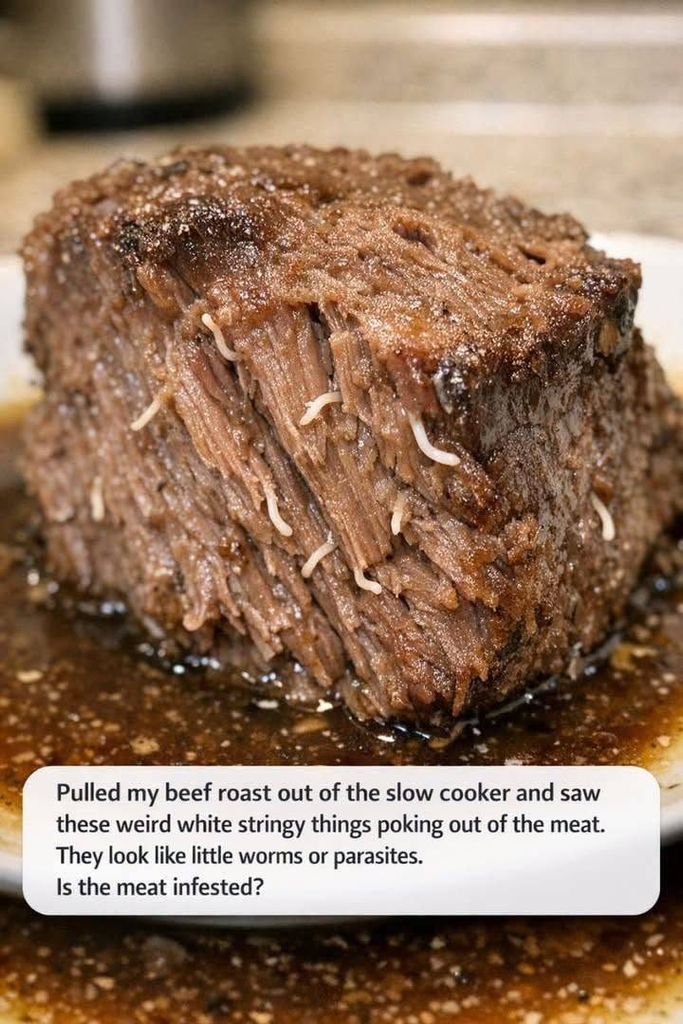
Finding strange white, string-like pieces sticking out of a cooked beef roast can be extremely unsettling. At first glance, they may look like tiny worms or parasites, especially when they appear curled, pale, and elongated.
But the appearance shown in this photograph is much more consistent with connective tissue, collagen, or sinew from the beef than with live worms.
Slow cooking can actually make these structures much more noticeable because the heat and moisture soften the surrounding muscle while leaving some strands of connective tissue intact.
That said, a photograph alone cannot definitively identify an unknown object in food. If something genuinely looks like a living organism, moves independently, or the meat has other unusual signs of contamination, it should not simply be eaten.
Let’s look at what may be happening.
The White Strings Are Most Likely Connective Tissue
Beef isn’t made entirely of muscle fibers.
A piece of meat also contains different types of connective tissue. These tissues help hold muscles together and attach muscles to other structures.
Connective tissue contains proteins such as collagen, which can appear as pale or whitish strands.
When beef is cooked slowly for several hours, collagen gradually changes and contributes to the tenderness and texture of the meat. However, not every strand disappears completely.
Some tougher connective-tissue fibers can remain visible after cooking.
This is particularly common in cuts of beef intended for:
Pot roast
Pulled beef
Stews
Braising
Slow cooking
Shredded beef
When you pull the meat apart, these pale strands can become exposed.
They may look surprisingly similar to thin worms.
Why Do They Look So Much Like Worms?
This is what makes the photograph so unsettling.
A strand of connective tissue can be:
White or cream-colored
Long and thin
Curved
Slightly translucent
Firm or rubbery
Attached firmly to the meat
More visible after cooking
Those characteristics can make it resemble a small worm at first glance.
But there’s an important difference.
Connective tissue is physically part of the meat.
If you pull the meat apart, the strands often remain attached to the surrounding tissue.
A parasite would be biologically separate from the muscle, although some parasites can occur within tissues.
The appearance alone isn’t enough to make a diagnosis, but the fact that these strands are embedded throughout a cooked roast strongly supports the possibility of normal meat tissue.
Slow Cooking Makes Connective Tissue More Noticeable
Slow cookers are particularly good at changing the texture of tougher cuts of beef.
A roast can contain substantial amounts of collagen and other connective tissue.
During long cooking, heat and moisture gradually soften these structures.
The muscle fibers become tender enough to pull apart easily.
That’s why a roast that was relatively firm when raw can become shreddable after several hours.
But some connective tissue remains visible.
When you pull the roast apart, those strands can stretch between pieces of muscle.
This can create exactly the strange appearance shown in the photograph.
What Is Collagen Doing in the Meat?
Collagen is an important structural protein.
In living animals, connective tissue containing collagen provides support and helps hold tissues together.
In meat, connective tissue is one of the factors affecting tenderness.
When certain cuts of beef are cooked slowly, collagen can gradually break down and contribute to a softer texture.
This is one reason tough cuts can become deliciously tender after long, moist cooking.
However, the collagen doesn’t necessarily disappear completely.
Some pieces of connective tissue may remain as pale strings.
So seeing white strands in a slow-cooked roast isn’t automatically evidence of contamination.