Try These Hacks When Your Key Fob Stops Working: Simple Tricks Every Driver Should Know
Many modern vehicles feature a push-button ignition system.
These vehicles use a smart key that communicates electronically with the car to confirm that an authorized key is present.
If the key fob battery becomes weak, the vehicle may struggle to detect it from a normal distance.
However, some vehicles have a backup system designed to recognize the key even when its battery is nearly depleted.
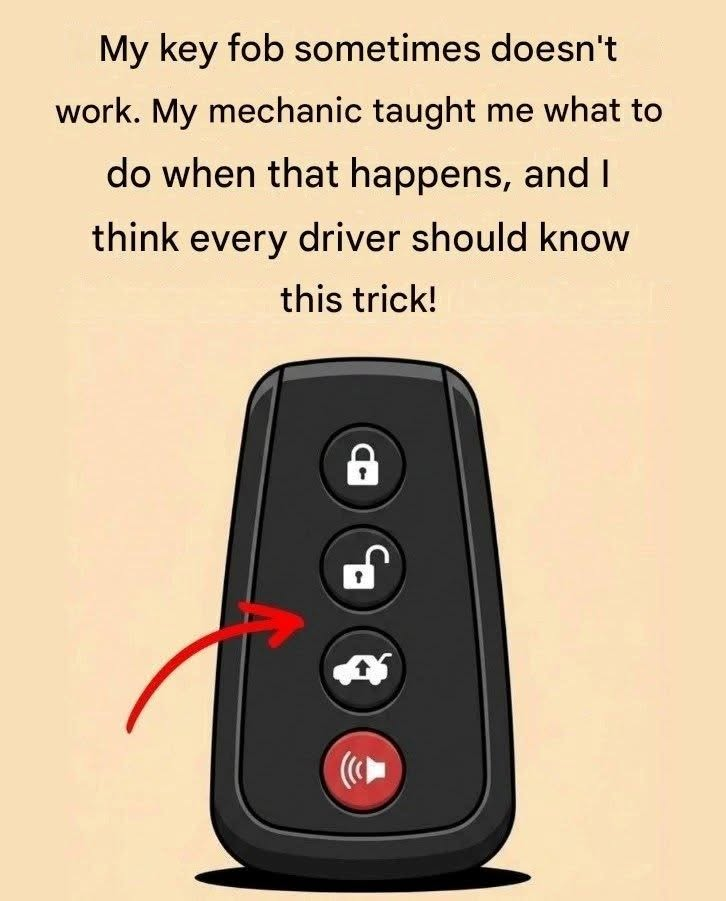
Depending on the manufacturer and model, this may involve holding the key fob directly against the start button or placing it in a designated emergency key location.
Try the following:
Sit inside the vehicle.
Check the owner’s manual for the emergency key detection procedure.
Position the key fob exactly where the manufacturer specifies.
Press the brake pedal if required.
Press the start button.
The vehicle may recognize the key through a backup proximity detection system.
This is an especially useful feature because it can allow you to start the car even when the remote’s battery is too weak for normal wireless operation.
Important: Not every vehicle uses the same procedure. Some require placing the key in a specific slot, while others use a designated area near the steering column or center console.
3. Use the Hidden Mechanical Key
Many drivers do not realize that their electronic key fob contains a traditional mechanical key.
This small metal key is usually concealed inside the remote.
It is designed to provide access to the vehicle when the electronic locking system cannot be used.
To access it:
Look for a small release button or sliding switch on the key fob.
Press or slide the release mechanism.
Pull out the metal key.
Locate the driver’s door lock.
Insert the key and unlock the door manually.
Some vehicles hide the physical lock beneath a small plastic cover on the door handle.
If you cannot see a keyhole, check the owner’s manual for its location.
Remember that opening the door mechanically does not necessarily disable the vehicle’s alarm system. Some cars may sound an alarm until they recognize the authorized key.
The mechanical key is an important backup feature, so every driver should know where it is and how to use it before an emergency occurs.
4. Move Away From Possible Radio Interference
Sometimes the problem has nothing to do with the key fob itself.
Electronic devices and radio-frequency interference can occasionally affect communication between a vehicle and its remote.
For example, certain electronic equipment, wireless transmitters, or nearby radio systems may interfere with the signal.
If your remote works normally in one location but fails in another, interference may be a possibility.
Try these simple steps:
Move away from other electronic equipment.
Remove the key fob from a bag containing several electronic devices.
Move closer to the vehicle.
Try pressing the unlock button again.
Test the remote in another location.
You can also try using the mechanical key to enter the vehicle if the remote remains unresponsive.
If the problem occurs repeatedly in the same parking area but disappears elsewhere, radio interference may be worth investigating.
5. Check Whether the Key Fob Buttons Are Damaged
Another possible explanation is physical damage.
Key fobs are handled frequently, carried in pockets, dropped onto hard surfaces, and sometimes exposed to moisture.
Over time, their internal buttons and electronic components can wear out.
Look for these warning signs:
A button feels loose or unusually soft.
The plastic casing is cracked.
The buttons are stuck.
The remote has been dropped repeatedly.
The key fob was exposed to water.
Only one button works while the others do not.
If only one button has stopped responding, the problem may involve the button’s internal contact rather than the battery.
Avoid pouring cleaning liquids into the remote or attempting to repair delicate electronic components without the proper knowledge.
If the casing is damaged or the remote has suffered water exposure, a qualified automotive locksmith or technician can inspect it.
6. Try the Spare Key Fob
If your vehicle came with two key fobs, testing the spare is one of the easiest ways to identify the problem.
For example, if the spare remote works perfectly but the main remote does not, the problem is more likely related to the original key fob.
Possible causes include:
A depleted battery.
Damaged internal circuitry.
Worn-out buttons.
A damaged antenna.
A synchronization issue.
However, if neither remote works, the problem may involve the vehicle rather than the key fobs.
The vehicle’s battery, receiver, electrical system, or central locking system may need inspection.
Testing the spare remote can therefore help narrow down the cause before you spend money on repairs.
7. Check Your Car Battery
A key fob is not the only electrical component involved in unlocking and starting a modern vehicle.
The car itself also needs sufficient electrical power.
If the vehicle’s battery is weak or completely discharged, certain electronic systems may stop responding normally.
You might notice:
Interior lights that appear unusually dim.
Dashboard warning lights.
Electrical accessories that do not work.
Doors that fail to respond to remote commands.
An engine that does not start.
If the key fob appears to work but the vehicle does not respond, the car battery may be part of the problem.
However, remember that a completely unresponsive remote can also have several other causes.
If you suspect the vehicle battery is discharged, have it tested rather than repeatedly attempting to start the engine.
8. Learn How to Reprogram or Resynchronize Your Key Fob