What Does the “G” Mean on a Manual Stick Shift? Many Drivers Don’t Know
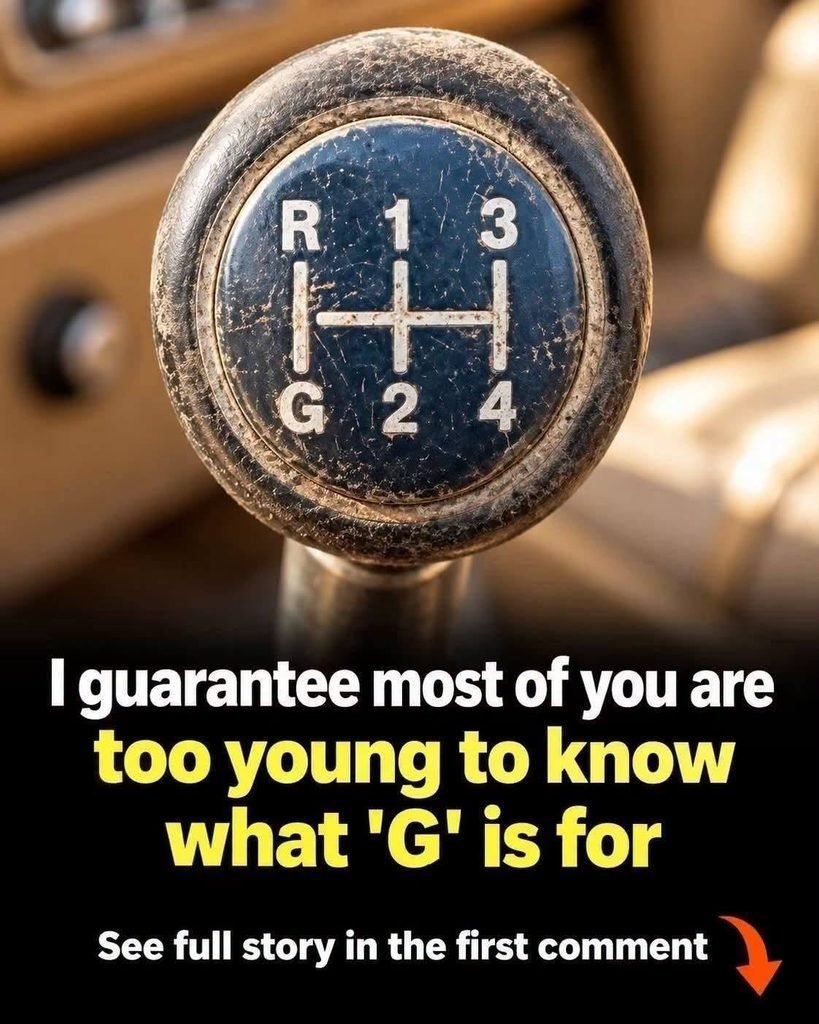
If you have ever driven an older manual-transmission vehicle, you may have noticed something unusual on the gear-shift pattern: 1, 2, 3, 4, R — and sometimes a mysterious “G.”
For drivers who grew up with modern cars, the letter G can be confusing. Is it another gear? Does it mean “Go”? Is it used for driving uphill? Or is it simply an old-fashioned marking that no longer has a purpose?
The answer depends on the vehicle, because “G” does not have one universal meaning across every manual transmission.
However, on some older vehicles, trucks, off-road vehicles, and specialized transmissions, G can refer to a very low gear, sometimes called a crawler gear or granny gear.
This gear is designed for situations where the vehicle needs maximum pulling power at very low speeds, rather than normal road speed.
Here’s what it means and why some vehicles have it.
What Is a G Gear?
In certain manual transmissions, G is used for an extremely low gear ratio.
Its purpose is to allow the vehicle to move very slowly while giving the driven wheels a large amount of torque.
Imagine trying to push a heavy object.
You wouldn’t necessarily want to move it quickly. You would want leverage.
A very low gear provides a similar advantage to the vehicle.
The engine can operate at a useful speed while the gearing reduces the speed at the wheels and increases the torque available at them.
This can be useful when:
Starting with a heavy load
Pulling a trailer
Climbing a very steep hill
Driving over rough terrain
Moving slowly off-road
Operating certain commercial vehicles
Getting a heavily loaded vehicle moving from a standstill
Why Is It Sometimes Called “Granny Gear”?
You may hear the term “granny gear” when people talk about extremely low gears.
It’s an informal nickname rather than an official technical term.
The name comes from the idea that the vehicle moves so slowly in this gear that even a very cautious driver could control it easily.
In reality, the important feature isn’t the name.
It’s the very low gear ratio.
The lower the gear ratio, the greater the torque multiplication at the wheels, although the vehicle’s speed is reduced.
Is G the Same as First Gear?
Not necessarily.
In some vehicles, G is actually lower than first gear.
This means the driver can use G to get the vehicle moving when the load is extremely heavy or the terrain is difficult.
Once the vehicle is moving, the driver can shift into first gear and then continue through the higher gears.
However, this depends entirely on the transmission design.
Some vehicles may use the letter G for a different function.
That’s why you shouldn’t assume that every vehicle with a G has exactly the same gear arrangement.
Why Would a Car Need Such a Low Gear?
To understand the purpose of G, it helps to understand the relationship between engine speed, wheel speed, and torque.
A transmission doesn’t simply make the engine “stronger.”
Instead, it changes the relationship between the engine and the wheels.
With a very low gear, the engine can turn relatively quickly while the wheels turn much more slowly.
In return, the wheels receive greater torque.
For example, imagine a heavy truck stopped at the bottom of a steep hill.
If the driver tried to start in a relatively high gear, the engine might struggle because the wheels would require a large amount of torque.
A very low gear makes the initial movement easier.
The vehicle moves slowly, but it has much more pulling ability at the wheels.
Why Don’t Modern Cars Usually Have a G Gear?
Most modern passenger cars don’t need an extremely low crawler gear.
A normal family car is designed for everyday driving.
Its transmission is optimized for:
Starting from a stop
City traffic
Accelerating
Cruising
Highway driving
Fuel efficiency
A very low gear would rarely be necessary.
Commercial trucks and specialized vehicles are different.
They may carry enormous loads or pull heavy trailers, so having additional low gearing can be extremely useful.
That’s why unusual gear markings are more likely to be found on older trucks, agricultural vehicles, commercial vehicles, and specialized off-road machinery.