Why Does Your Cat Gently Bite You? Understanding the Hidden Message Behind This Behavior
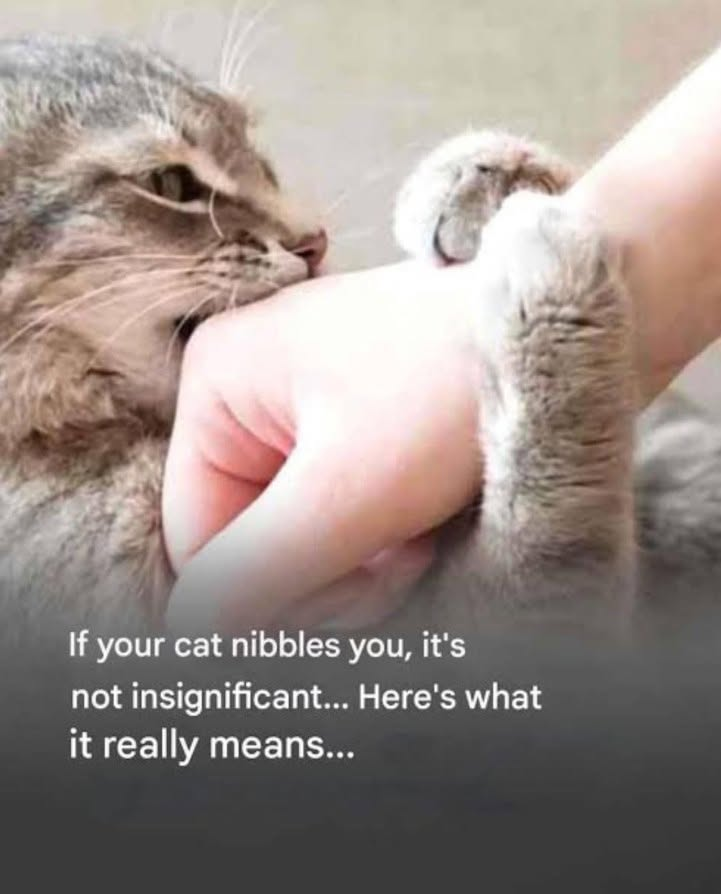
Have you ever been petting your cat when, without warning, it gently grabs your hand with its paws and gives you a little bite? Perhaps your cat nibbles your fingers while you are relaxing on the couch, grooming itself beside you, or cuddling in your lap.
For many cat owners, this behavior can be confusing. One moment, the cat seems completely relaxed and affectionate. The next, it is nibbling a hand that has done nothing to upset it.
Does your cat bite you because it loves you? Is it trying to communicate something? Or could it be telling you that it has had enough attention?
The truth is that cats use gentle biting for several reasons, and understanding the circumstances surrounding the behavior can help you interpret what your furry companion is communicating.
Although a gentle nibble is often harmless, it is important not to assume that every bite is a sign of affection. Your cat’s body language, the situation, and the intensity of the bite all provide useful clues.
1. Your Cat May Be Showing Affection
One possible explanation for gentle nibbling is social bonding.
Cats sometimes use their mouths during friendly interactions, particularly when grooming themselves or another cat. This behavior, known as allogrooming when directed toward another individual, can help maintain social relationships.
Some cats also gently mouth or nibble their human companions during relaxed interactions.
If your cat approaches you voluntarily, settles beside you, appears relaxed, and gives you a soft nibble without showing signs of tension, the behavior may occur as part of a positive social interaction.
You might also notice your cat rubbing its face against your hand, purring, kneading a blanket, or remaining close to you afterward.
These behaviors can be consistent with comfort and familiarity.
However, a bite alone cannot prove that your cat is expressing love. Cats communicate through combinations of behavior, posture, facial expressions, and vocalizations.
The most useful approach is to consider the entire interaction rather than interpreting one action in isolation.
2. Your Cat May Be Grooming You
Have you noticed your cat licking your fingers before gently nibbling them?
This may be related to social grooming.
Cats groom themselves regularly, and some also groom familiar cats or people. Licking, gentle mouthing, and other close-contact behaviors can occur during these interactions.
When your cat licks your hand and follows with a soft nibble, it may be engaging in a familiar grooming-related behavior.
Some cats appear particularly interested in grooming their owners’ hands, hair, or skin.
Others may lick a person for a few seconds before switching to play or moving away.
The important point is that feline grooming behavior does not always follow a pattern that humans would expect. A cat may combine licking, gentle biting, rubbing, and resting during the same interaction.
If the behavior is gentle and your cat seems comfortable, it may simply be one of the ways it interacts with you.
You do not need to encourage the biting, however. If you would prefer your cat not to put its teeth on your skin, calmly redirect its attention toward an appropriate toy.
3. Your Cat May Be Overstimulated by Petting
One of the most common reasons a cat suddenly bites during petting is overstimulation.
Some cats enjoy being stroked for only a short period before the sensation becomes uncomfortable or irritating.
At first, your cat may purr, lean into your hand, or close its eyes. After several seconds or minutes, it may begin to feel overwhelmed and communicate that it wants the interaction to stop.
The bite may seem to happen without warning, but subtle signs often appear beforehand.
Watch for the following signals:
The tail begins flicking or whipping from side to side.
The ears turn sideways or flatten backward.
The skin along the back twitches.
The cat suddenly becomes tense.
The head turns quickly toward your hand.
The cat stops leaning into the petting.
The pupils become enlarged in an exciting or stressful situation.
Not every cat displays all these signs, and enlarged pupils can have several explanations. Nevertheless, a combination of changes in posture and behavior may indicate that your cat needs a break.
If you notice these signals, stop petting and give your cat space.
Avoid scolding or restraining the animal. Allowing it to end the interaction can help prevent future bites.
Over time, you may discover that your cat enjoys brief strokes around the cheeks and head but dislikes prolonged petting along the back or near the tail.
Learning these preferences can make interactions more comfortable for both of you.