Why Your Nail Clipper Has That Small Round Hole — And Why It Still Matters Today
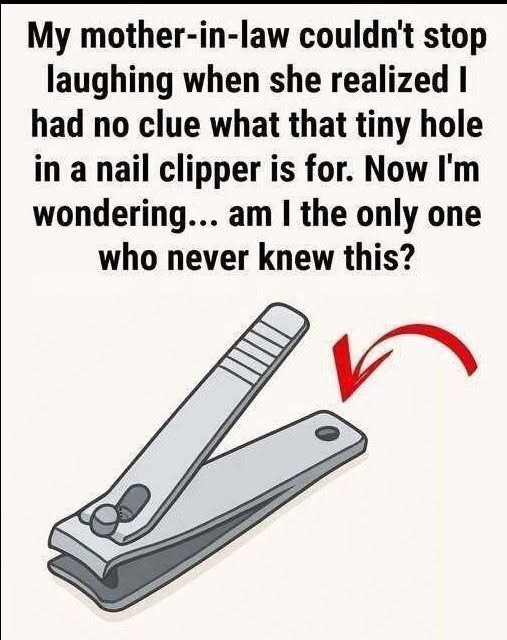
Have you ever looked closely at a nail clipper and wondered what the tiny round hole near the end is actually for?
Most people never think about it.
It’s such a small detail that it is easy to assume it is simply part of the design. But on many traditional nail clippers, that little hole has a practical purpose: it can be used to attach the clipper to a key ring, chain, lanyard, or other small holder.
In other words, the hole can turn an easy-to-lose grooming tool into something you can keep attached to your keys, travel kit, bathroom organizer, or another convenient location.
And there is another interesting detail: depending on the design and manufacturer, similar-looking holes can serve different purposes. So the exact function isn’t always identical on every nail clipper.
Let’s take a closer look at this tiny feature.
The Small Hole Everyone Ignores
A standard nail clipper is made from only a few basic components.
You normally have:
Two opposing cutting edges
A metal body
A lever
A pivot or fastening point
A handle section
The lever provides the mechanical advantage needed to bring the two cutting edges together.
Near the rear of the lever, many clippers have a small circular opening.
At first glance, it can look completely unnecessary.
After all, the clipper works perfectly well without the hole being involved in the actual cutting action.
That’s because its purpose is often related to storage and attachment rather than cutting.
It’s Useful for Attaching Your Nail Clipper
One of the simplest explanations for the hole is that it allows the clipper to be attached to something.
For example, you can pass a small:
Key ring
Cord
Chain
Lanyard
Hook
through the opening.
This can be useful because nail clippers are remarkably easy to misplace.
They are small enough to disappear into:
Bathroom drawers
Toiletry bags
Suitcases
Desk drawers
Medicine cabinets
Pockets
Attaching one to a key ring or another holder makes it much easier to find when you need it.
Why Would Anyone Want to Attach a Nail Clipper to Their Keys?
It might sound unnecessary today, but small grooming tools have long been designed with portability in mind.
People travel.
They camp.
They work away from home.
They carry toiletry kits.
And sometimes they simply want a small tool available without carrying an entire grooming set.
A hole gives manufacturers an inexpensive way to make the tool easier to carry or secure.
The same basic idea appears in many everyday objects.
Small tools often have openings designed for:
Hanging
Attachment
Storage
Carrying
Organization
The feature costs very little to incorporate during manufacturing but can make the product more convenient.
The Hole Doesn’t Make the Nail Clipper Cut Better
This is an important distinction.
The small hole isn’t normally part of the cutting mechanism.
The cutting action comes from the relationship between the lever, pivot, and cutting jaws.
When you press the lever down, the force is transferred through the mechanism and brings the two cutting edges together.
The hole at the opposite end doesn’t provide the cutting force.
Instead, it is generally a practical feature associated with portability or attachment.
Why Is the Hole Usually Round?
You might wonder why manufacturers don’t simply make a rectangular opening.
A round hole is a simple and durable design.
It works naturally with:
Rings
Hooks
Small chains
Cords
Clips
A circular opening also distributes force around its edge relatively evenly.
This is useful when the object is repeatedly attached and detached.
It’s a classic example of simple engineering: a tiny opening can make a small tool much easier to carry.