4 Ways to Erase Age Spots with Baking Soda for Younger, More Even Skin
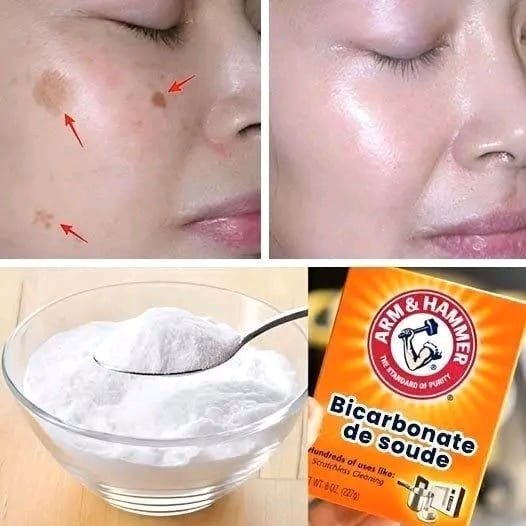
Age spots, also called sun spots or solar lentigines, are common areas of darker pigmentation that can develop on the face, hands, shoulders, arms, and other parts of the body. They are often associated with years of sun exposure and tend to become more noticeable with age. Because they can affect the appearance of the skin, many people look for simple home remedies that promise to make them disappear.
Baking soda is one of the most frequently mentioned ingredients in homemade skincare recipes. It is inexpensive, widely available, and has a mildly abrasive texture. However, the popular claim that baking soda can safely “erase” age spots deserves some clarification.
Baking soda is alkaline, while healthy facial skin normally has a mildly acidic environment. Applying baking soda directly to the skin can disturb the skin barrier and may cause dryness, irritation, redness, burning, or increased sensitivity. Scrubbing dark spots with baking soda can also create tiny amounts of irritation that may actually make pigmentation more noticeable, particularly in people whose skin tends to develop dark marks after inflammation.
So rather than relying on baking soda to remove pigmentation, it is better to understand what causes age spots and which approaches are gentler and more reliable.
1. Understand What Age Spots Really Are
Age spots are flat areas of increased pigmentation. They commonly appear after repeated exposure to ultraviolet radiation from the sun.
UV exposure stimulates pigment-producing cells called melanocytes. These cells produce melanin, the pigment responsible for skin and hair color. Over time, repeated exposure can lead to localized areas where pigmentation becomes more concentrated.
Age spots can vary from light brown to darker brown and are usually flat rather than raised. They may occur individually or appear in groups.
Although age spots are usually harmless, not every dark spot on the skin is necessarily an age spot. Some skin cancers and precancerous lesions can resemble ordinary pigmentation.
This is particularly important if a spot:
Changes in size or shape
Develops several different colors
Has an irregular or poorly defined border
Begins bleeding
Becomes persistently itchy or painful
Develops a crust or sore
Changes noticeably over a short period
A new or changing pigmented lesion should be evaluated by a dermatologist rather than treated at home.
2. Why Baking Soda Is Not a Reliable Spot Remover
Baking soda, or sodium bicarbonate, has several household uses, but that does not automatically make it an appropriate facial skincare treatment.
One reason it appears in home remedies is its mildly abrasive texture. When rubbed onto the skin, it can remove some surface flakes and temporarily make the skin feel smoother.
However, surface exfoliation is not the same thing as removing the excess pigment responsible for an age spot.
Another issue is pH. The skin’s natural surface environment is mildly acidic. Baking soda is alkaline. Applying it repeatedly may interfere with the skin barrier and increase dryness and irritation.
Some homemade recipes also combine baking soda with lemon juice, vinegar, or other acidic ingredients. This creates additional problems because irritating mixtures can cause inflammation. In some people, inflammation can trigger post-inflammatory hyperpigmentation, leaving the skin darker rather than lighter.
For that reason, using baking soda as a regular treatment for facial pigmentation is not recommended.
3. A Safer Approach: Gentle Exfoliation
If uneven skin tone is the concern, a properly formulated exfoliating skincare product can be considerably more appropriate than rubbing baking soda onto the face.
Ingredients such as alpha-hydroxy acids can help loosen dead skin cells and gradually improve the appearance of uneven texture and pigmentation.
Examples include:
Lactic acid
Glycolic acid
Mandelic acid
These ingredients should be introduced gradually because excessive exfoliation can irritate the skin.
A simple routine is generally better than combining multiple strong products. Using several exfoliating ingredients simultaneously can increase irritation without necessarily producing faster results.
People with sensitive skin should be especially cautious and consider discussing persistent pigmentation with a dermatologist.
4. Protecting Your Skin From the Sun Is Essential
One of the most important steps for preventing age spots from becoming darker is protecting the skin from ultraviolet radiation.
Even if a treatment successfully improves pigmentation, continued sun exposure can encourage pigmentation to return or become more pronounced.
Daily broad-spectrum sunscreen can help protect exposed skin from ultraviolet radiation. Applying enough sunscreen and reapplying it when appropriate is important, particularly during prolonged outdoor activities.
Other useful measures include:
Wearing a wide-brimmed hat
Seeking shade during intense sunlight
Wearing protective clothing
Avoiding intentional tanning
Limiting prolonged exposure to strong midday sunlight
Sun protection is not simply an anti-aging step. It is also an important part of maintaining a more even skin tone.