Over time, repeated exposure may cause decorative finishes to fade, become dull, or wear away.
Metallic decorations can be particularly vulnerable.
Older dishes can be even more difficult to evaluate because their original manufacturer instructions may no longer be available.
If an item is valuable, sentimental, antique, or decorative, hand washing is usually the safer choice.
Why Can Glass Break in a Dishwasher?
The photograph showing broken glass can make it look as though a dishwasher simply exploded.
In reality, several things can cause glassware to break.
One possibility is thermal shock.
Glass expands and contracts when its temperature changes. If a piece of glass experiences a rapid or uneven temperature change, stress can develop within the material.
Another possibility is an existing defect.
A tiny chip, scratch, or hairline crack may weaken a glass without being obvious during normal use.
Then the combination of heat, vibration, water pressure, and contact with another object can cause it to fail.
Glass can also break if items are loaded too closely together.
If two glasses repeatedly touch during a cycle, one may strike another hard enough to cause damage.
For this reason, dishwasher loading matters.
How to Load Glasses Safely
When putting ordinary dishwasher-safe glasses into the machine, make sure each one is positioned securely.
Avoid overcrowding.
Glasses should not be pressed tightly against each other.
They should sit in the rack rather than being balanced precariously.
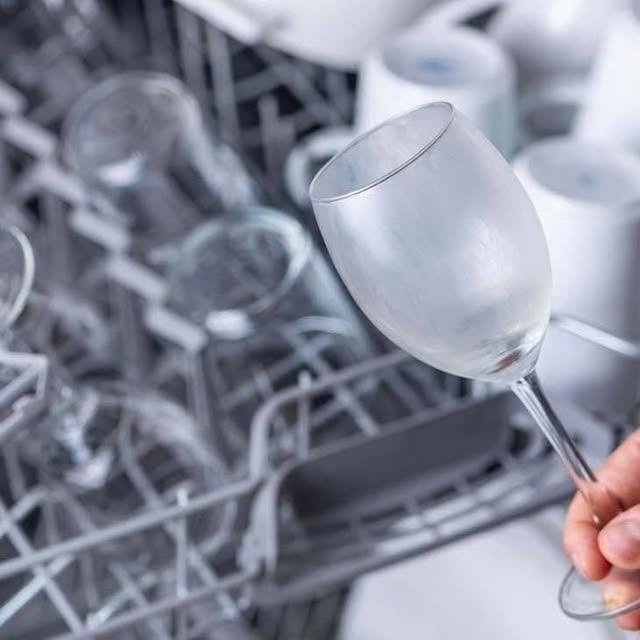
If a glass is chipped, cracked, unusually thin, or otherwise damaged, do not put it in the dishwasher simply because it normally carries a “dishwasher-safe” label.
Dishwasher-safe does not mean damage-proof.
A damaged glass can fail under conditions that a perfect glass would easily tolerate.
What About Plates and Bowls?
Most standard plates and bowls made specifically for everyday kitchen use are designed to tolerate dishwasher conditions.
However, placement still matters.
Avoid stacking dishes so tightly that water cannot reach their surfaces.
Make sure bowls are angled appropriately so dirty water can drain rather than collect inside them.
Large plates should not block the spray arms.
After loading, it can be useful to manually rotate the spray arms to ensure they can move freely.
A blocked spray arm can reduce cleaning performance and potentially damage dishes or the dishwasher.
Don’t Put Items in the Dishwasher Just Because They Fit
This is an important rule.
The fact that an item physically fits inside the dishwasher does not mean the dishwasher is the right place to clean it.
Dishwashers use combinations of:
Heat + water + detergent + pressure + time.
Some materials handle all five extremely well.
Others do not.
When you’re uncertain about an item, check the manufacturer’s care instructions rather than guessing.
What You Should Do After a Glass Breaks
If a glass breaks inside your dishwasher, do not immediately reach inside with your bare hands.
Small pieces can hide in the rack, filter area, corners, and bottom of the machine.
First, turn the dishwasher off and allow it to cool if it has just completed a hot cycle.
Wear appropriate hand protection and carefully remove large pieces.
Inspect the racks and interior.
Pay particular attention to the bottom of the dishwasher and the filter area.
Small fragments can remain hidden even when the larger pieces have been removed.
If you suspect glass has entered areas you cannot safely access, consult the dishwasher manufacturer’s instructions or a qualified appliance professional.
Do not simply restart the dishwasher and assume everything will be fine.
A Simple Rule to Remember
Before putting an unusual item into your dishwasher, ask three questions:
Is the material dishwasher-safe?
Does the manufacturer specifically allow dishwasher cleaning?
Could heat, detergent, water pressure, or movement damage it?
If you cannot answer the first two questions confidently, hand washing is often the safer option.
Final Thoughts
Dishwashers are incredibly useful, but they are not suitable for every kitchen item.
The eight categories that deserve particular caution are:
Wooden cutting boards and utensils
Cast-iron cookware
Sharp kitchen knives
Crystal and delicate glassware
Certain nonstick cookware
Plastic items that are not dishwasher-safe
Insulated travel mugs and thermos containers
Items with delicate finishes, decorations, or construction
The broken-glass scene in the image is a good reminder that dishwasher safety isn’t only about whether an object can technically survive a wash cycle. The condition of the item, the way it is loaded, the temperature, and the manufacturer’s instructions all matter.
And remember: not every dishwasher-safe item is equally durable.
If something is expensive, delicate, sentimental, antique, sharply edged, made from a questionable material, or simply unfamiliar, taking a few minutes to wash it by hand can be much safer than discovering after a cycle that it wasn’t meant to go into the dishwasher in the first place.