Boil Garlic in Milk and Drink It: A Traditional Recipe With a Closer Look at What It Can—and Cannot—Do
Garlic and milk may seem like an unusual combination, but versions of this drink have been used in traditional home cooking for generations.
The recipe is simple: garlic cloves are gently cooked in milk until soft, creating a warm, mildly sweet and savory drink. It is often shared online as a natural remedy for everything from high blood pressure and cholesterol to colds, digestion, sleep, and immunity.
Some of those claims go far beyond the available evidence.
Garlic is a nutritious food with biologically active compounds, and research suggests that certain garlic preparations may have modest effects on cardiovascular risk factors. But drinking garlic boiled in milk once is not a proven treatment for disease. Research on garlic supplements and extracts also cannot automatically be applied to this homemade drink. (NCCIH)
Still, if you enjoy garlic and milk, this can be a comforting homemade recipe worth trying.
Why Do People Boil Garlic in Milk?
Garlic has been used as both food and traditional medicine for thousands of years.
It contains sulfur-containing compounds that are responsible for much of its characteristic smell and flavor. Garlic has also been studied for possible effects on cardiovascular health, blood pressure, cholesterol, blood sugar, and other health outcomes.
The National Center for Complementary and Integrative Health notes that there is limited evidence that garlic supplements may modestly reduce blood pressure in people with hypertension, while evidence for several other popular claims remains limited or uncertain.
The important word here is supplements.
A homemade glass of garlic milk isn’t the same thing as a standardized garlic extract used in a clinical trial.
What Makes Garlic Interesting?
Garlic contains compounds that have attracted considerable scientific interest.
When garlic is crushed or chopped, chemical reactions produce compounds such as allicin, which contributes to garlic’s characteristic aroma.
The amount and type of these compounds can change depending on:
Whether the garlic is raw or cooked
How finely it is chopped
How long it is cooked
The temperature
The type of garlic preparation
This is one reason researchers studying garlic don’t necessarily use the same preparation that people make at home.
Does Garlic Help Lower Blood Pressure?
This is one of the more interesting areas of garlic research.
Several clinical trials and meta-analyses have investigated garlic preparations in people with elevated blood pressure.
For example, a 2025 systematic review and meta-analysis of 108 randomized controlled trials involving more than 7,000 participants reported modest improvements in several cardiovascular risk markers among people consuming garlic, including blood pressure. The researchers found an average reduction of about 3.7 mmHg in systolic blood pressure and 2.0 mmHg in diastolic blood pressure compared with controls. (PubMed)
Other reviews have also reported reductions in blood pressure, although the results have not always been consistent.
A systematic review specifically examining garlic preparations in people with hypertension concluded that the evidence suggested a possible blood-pressure benefit but noted that the evidence was not strong and that better long-term studies were needed. (PubMed)
So the most accurate statement is:
Garlic may have a modest blood-pressure effect, but it should not be considered a replacement for prescribed hypertension treatment.
What About This Garlic Milk Recipe?
This is where it’s important to separate a food recipe from a medical treatment.
The studies showing possible blood-pressure benefits generally examined specific garlic preparations, supplements, extracts, or controlled doses.
They did not establish that drinking one glass of garlic boiled in milk produces the same effect.
Therefore, it would be misleading to say:
“Drink this once and your blood pressure will become normal.”
There is no good evidence supporting that claim.
Instead, think of garlic milk as a traditional food or comforting drink that can be included in a balanced diet.
Does Boiling Garlic Destroy Its Benefits?
Cooking changes garlic’s chemistry.
Some compounds formed when garlic is freshly crushed are sensitive to heat, so prolonged cooking can alter their levels.
That doesn’t mean cooked garlic is useless.
It simply means that raw garlic, cooked garlic, garlic powder, aged garlic extract, and garlic supplements aren’t chemically identical.
This distinction is important when interpreting scientific research.
If a clinical trial uses a standardized aged garlic extract, you cannot assume that boiling several cloves in milk creates an equivalent preparation.
The Simple Garlic Milk Recipe
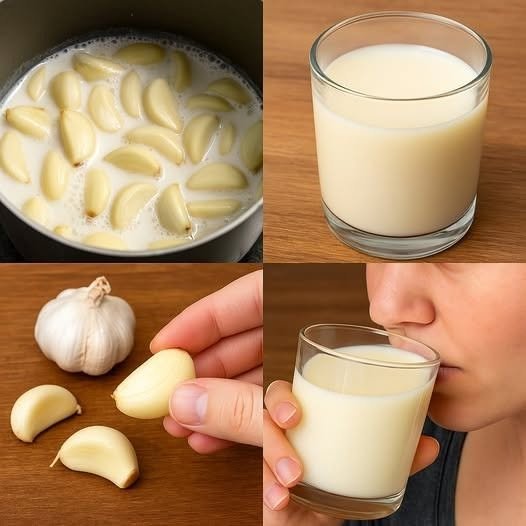
If you’d like to make the drink shown in the image, you only need a few ingredients.
Ingredients
1 cup milk
3–5 fresh garlic cloves
Optional: a small amount of honey or another sweetener for taste
Optional: a pinch of cinnamon
You don’t need a large amount of garlic to make the drink.
How to Make Garlic Milk
Step 1: Prepare the garlic
Peel 3–5 fresh garlic cloves.
You can leave them whole or lightly crush them.
Lightly crushing the cloves releases more of their compounds before cooking.
Step 2: Add the milk
Pour approximately one cup of milk into a small saucepan.
Add the garlic cloves.
Step 3: Heat gently
Place the saucepan over low to medium-low heat.
Bring the mixture to a gentle simmer rather than a vigorous boil.
Stir occasionally.
Step 4: Cook until the garlic softens
Continue cooking for approximately 10–15 minutes, or until the cloves become soft and the milk becomes infused with garlic flavor.
Avoid letting the milk boil aggressively because it can foam and spill over.
Step 5: Adjust the flavor
Remove from the heat.
If you prefer a sweeter drink, you can add a small amount of honey after the mixture has cooled somewhat.
You can also add a small pinch of cinnamon if you enjoy the flavor.
Step 6: Drink warm
The finished drink can be consumed warm.
If the flavor is too strong, use fewer cloves the next time.