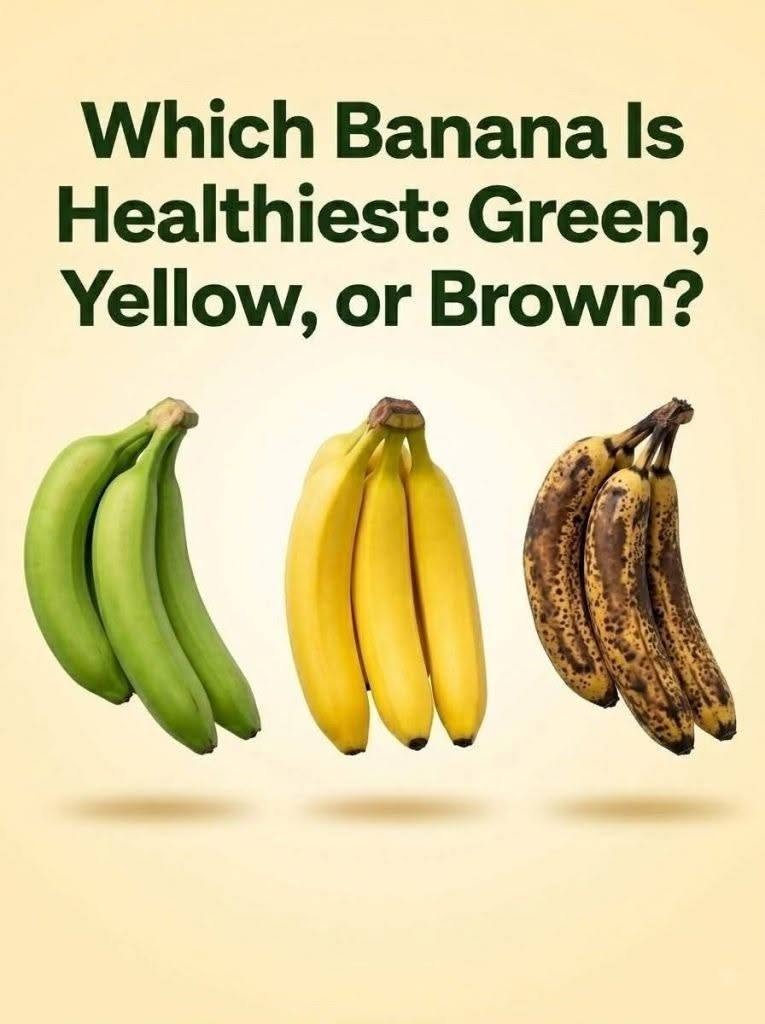
Which Banana Is Actually the Healthiest: Green, Yellow, or Brown?
Walk through any grocery store and you’ll see bananas at different stages of ripeness. Some are firm and green, others are bright yellow, and some are covered with brown spots.
But does the color actually change the nutritional value?
Yes. As a banana ripens, its starches gradually break down into simpler sugars, changing its texture, sweetness, digestibility, and potentially its effect on blood sugar. That means there isn’t one banana that is automatically “the healthiest” for everyone.
Instead, the healthiest choice depends on what you’re looking for.
Green bananas have an advantage when it comes to resistant starch, while yellow bananas are softer and easier to digest. Very ripe brown-spotted bananas are sweeter and contain more readily available sugars, but they still provide useful nutrients.
Here’s what happens at each stage.
1. Green Bananas: The Resistant-Starch Champion
Green bananas are underripe bananas.
They contain substantially more resistant starch than ripe bananas. Resistant starch is a type of carbohydrate that isn’t completely digested in the small intestine. Some of it reaches the large intestine, where gut bacteria can ferment it. (PubMed Central (PMC))
This is one of the biggest nutritional differences between a green banana and a fully ripe banana.
What makes resistant starch interesting?
Resistant starch behaves in some ways similarly to dietary fiber.
Research has investigated its potential effects on:
Digestive health
Blood-glucose regulation
Satiety
Gut bacteria
Insulin metabolism
Bowel function
A systematic review of studies involving green banana products found that many of the investigated benefits were related to gastrointestinal health and glucose/insulin metabolism. However, the researchers also emphasized that studies varied considerably in the type and amount of green banana used, and more research is needed. (PubMed Central (PMC))
So green bananas are promising—but they aren’t a treatment for diabetes or other diseases.
Why Green Bananas Aren’t as Sweet
If you’ve ever bitten into a very green banana, you probably noticed something immediately:
It’s not very sweet.
That’s because much of the carbohydrate is still present as starch rather than simple sugars.
As ripening progresses, enzymes break down starch into smaller carbohydrates and sugars. The banana becomes:
Sweeter
Softer
More fragrant
Easier to chew
Easier to digest
This is why a green banana and a brown-spotted banana can taste dramatically different even though they’re the same fruit.
2. Yellow Bananas: The Everyday Middle Ground
A yellow banana is usually what most people think of when they picture a ripe banana.
At this stage, the banana has become softer and sweeter, while still retaining useful amounts of fiber, potassium, vitamin B6, and other nutrients.
For many people, a normally ripe yellow banana is an excellent everyday choice.
It’s convenient, naturally sweet, portable, and requires no preparation.
Yellow bananas can be especially useful when you want:
A quick snack
Carbohydrates before physical activity
A naturally sweet addition to breakfast
A smoothie ingredient
An easy-to-digest fruit
The fact that a yellow banana contains more available sugar than a green banana doesn’t make it an unhealthy food.
The overall diet, portion size, and individual health needs matter much more than banana color alone.
3. Brown-Spotted Bananas: Sweeter, Softer, and More Easily Digested
As bananas continue ripening, brown spots begin appearing on the peel.
Eventually, the fruit becomes extremely soft and sweet.
This doesn’t mean the banana has suddenly become “bad.”
A banana with brown spots can still be nutritious.
The major change is that more of its starch has been converted into sugars, making the fruit taste considerably sweeter.
This is why very ripe bananas are particularly useful for:
Banana bread
Pancakes
Smoothies
Oatmeal
Homemade desserts
Mashed banana recipes
You can often use a very ripe banana to add sweetness to a recipe without needing as much added sugar.
Does Ripening Destroy the Banana’s Nutrients?
Not exactly.
Ripening changes the form and availability of carbohydrates, but it doesn’t turn the banana into an unhealthy food.
Bananas continue to provide nutrients throughout the ripening process.
The major nutritional difference people should pay attention to is the transformation of starch into sugars.
Green bananas are particularly notable for their resistant starch content. (PubMed Central (PMC))
As the banana becomes yellow and then brown-spotted, the starch becomes increasingly available as simpler carbohydrates.
So instead of asking:
“Which color is healthiest?”
A better question is:
“Which ripeness stage fits my nutritional needs?”
Green Bananas and Blood Sugar
This is one area where the difference between ripeness stages becomes particularly interesting.
Resistant starch is digested differently from rapidly digestible starch and can result in a slower release of glucose.
Research on green banana products has investigated their effects on glucose and insulin metabolism. Some studies have reported favorable effects, but the evidence isn’t strong enough to say that eating green bananas alone prevents or treats diabetes.