How to Check If Honey Is Real or Fake: What Actually Works
Honey is one of the world’s oldest natural sweeteners, and it is also one of the foods that people frequently worry about buying in an adulterated form.
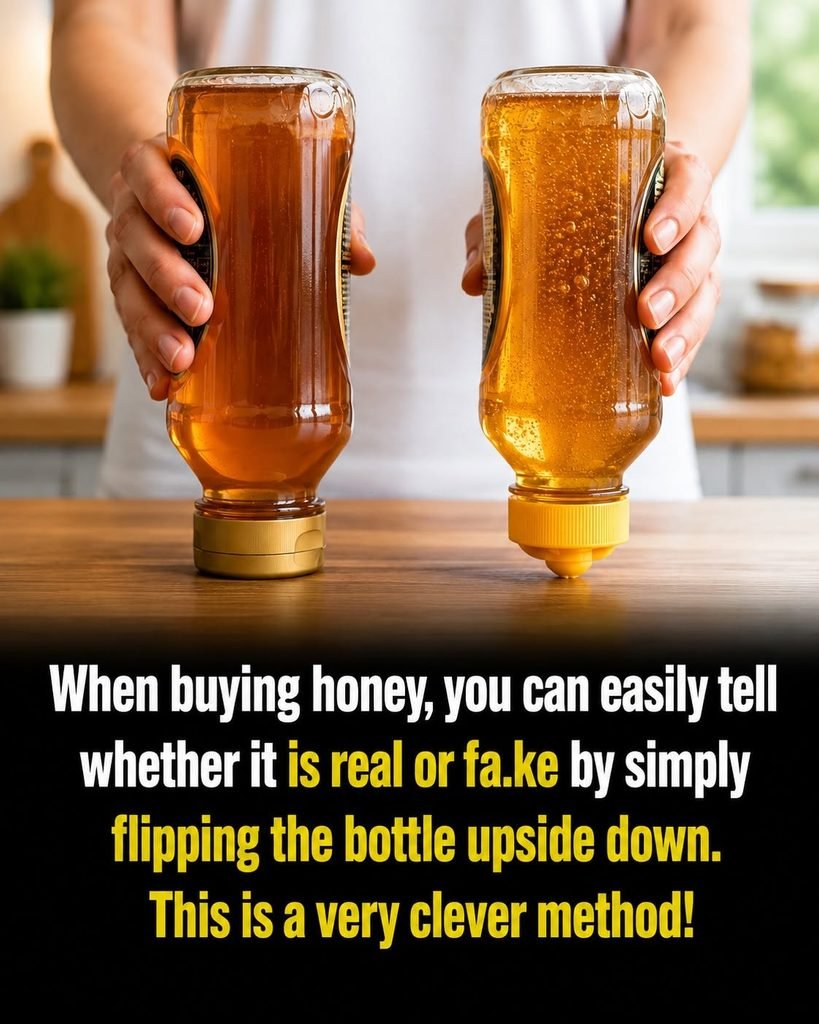
You may have seen viral videos claiming that you can identify “real honey” simply by turning the bottle upside down and watching how quickly a bubble moves.
It looks convincing—but the upside-down bottle test cannot reliably prove whether honey is genuine or fake.
Honey naturally varies in thickness depending on its floral source, temperature, moisture content, age, and whether it has crystallized. These factors can change how quickly it moves inside a bottle, even when the honey is completely authentic.
So how can you actually judge the quality of honey?
The Upside-Down Bottle Test Is Not a Reliable Test
The image suggests that flipping a honey bottle upside down can reveal whether the honey is real.
The idea is usually that genuine honey moves slowly while diluted or fake honey moves quickly.
But viscosity is affected by many things.
Honey becomes thinner when it is warm and thicker when it is cold. Different varieties of honey also naturally have different textures.
Therefore, a thick honey isn’t automatically pure, and a thinner honey isn’t automatically fake.
You can use the appearance and texture of honey as clues, but you cannot confirm authenticity from how fast a bubble moves through the bottle.
The Water Test Isn’t Proof Either
Another popular home test involves dropping a spoonful of honey into a glass of water.
According to viral posts, “real” honey supposedly stays together while fake honey immediately dissolves.
Unfortunately, this isn’t a reliable authenticity test either.
Honey is water-soluble because it contains sugars.
The speed at which it disperses can depend on temperature, viscosity, moisture content, and how the honey is introduced into the water.
A genuine honey can eventually dissolve.
A product containing added syrup may also behave in ways that make the test look convincing.
So the water test can be interesting as an experiment, but it shouldn’t be used to determine whether honey is authentic.
What About the Thumb Test?
Another popular trick is placing a drop of honey on your thumb.
The claim is that real honey supposedly stays in place while fake honey runs.
Again, this is mainly a test of thickness, not authenticity.
A thick honey may stay on your thumb.
A warm honey may spread more quickly.
Neither observation proves what ingredients are actually present.
Crystallization Does Not Mean Honey Is Fake
This is one of the biggest misconceptions about honey.
Many people believe that genuine honey remains liquid forever.
That’s not true.
Real honey can crystallize.
Crystallization is a natural process caused by the sugars in honey forming crystals.
Some types of honey crystallize quickly, while others remain liquid for much longer.
The texture can become:
Grainy
Creamy
Thick
Pale
Almost solid
This doesn’t mean the honey has gone bad.
In fact, crystallization is a normal characteristic of many genuine honeys.
Can Crystallized Honey Be Used?
Absolutely.
If your honey has crystallized and you prefer it liquid, you can gently warm the container in warm water.
Avoid excessively high temperatures, especially if preserving the natural characteristics of the honey is important to you.
You should also never microwave honey in a sealed container.
Once warmed gently, the crystals can dissolve and the honey can become liquid again.
What Does Real Honey Look Like?
There is no single appearance that proves honey is authentic.
Honey can range from almost transparent and pale yellow to amber, reddish, or very dark brown.
Its color depends partly on the flowers from which the bees collected nectar.
Its texture can also vary considerably.
Some honey is very runny.
Some is thick.
Some crystallizes quickly.
Some remains liquid for a long time.
So judging honey solely by color or thickness can be misleading.
Read the Ingredient Label
One of the simplest things consumers can do is check the label carefully.
If a product is sold as pure honey, honey should be the ingredient being represented.
If the label lists additional sweeteners or syrups, then you’re dealing with a honey-containing product rather than simply honey.
Words such as syrup, glucose syrup, corn syrup, sugar syrup, or other sweetening ingredients are important clues.
However, labeling rules vary by country, so the exact terminology used on packaging can differ.
Buy From a Traceable Source
Knowing where your honey comes from can be more useful than performing viral kitchen experiments.