Breaking News: The Disturbing Image Linking a McDonald’s Worker to Raw Meat Has Social Media Talking — But What Do We Actually Know?
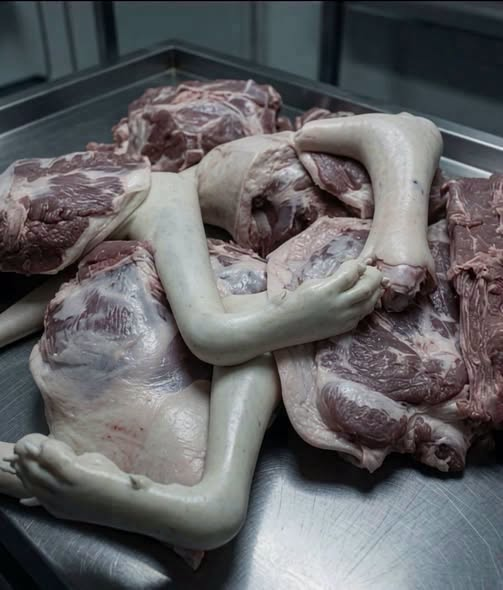
A disturbing image circulating online has caught the attention of social media users, accompanied by a dramatic caption suggesting a shocking incident involving a McDonald’s worker. The photograph appears to show pale, human-like arms lying among pieces of raw meat on a stainless-steel tray. Its unusual appearance has prompted questions, speculation, and alarm among people who have encountered it online.
However, before accepting the caption as fact, it is important to separate what the photograph actually shows from what the accompanying message claims. The image alone does not establish that a McDonald’s employee was involved in an incident, that human body parts were found in food, or that any restaurant served contaminated meat. No verifiable details about the location, date, people involved, or circumstances are provided in the caption.
This distinction matters because shocking images can spread rapidly when they are paired with frightening headlines. Understanding how to evaluate such posts can help people avoid misinformation while still taking legitimate food-safety concerns seriously.
Why Is This Image Causing Such a Strong Reaction?
The photograph is unsettling because it combines two things that people do not expect to see together: what appears to be human-like limbs and raw meat prepared for handling or processing.
The pale shapes resemble arms, complete with hands and fingers. They are positioned among several pieces of reddish meat on a metal surface that looks similar to a commercial food-preparation tray. The unusual combination creates an immediate emotional reaction.
For many viewers, the first response may be disgust or fear. Others may wonder whether the image shows a butcher’s display, a special-effects prop, an artificial creation, or an actual incident.
That uncertainty makes the image particularly effective as social media content. When viewers cannot immediately identify what they are looking at, they may be more likely to stop scrolling, read the caption, leave a comment, or share the post with friends.
Yet an emotional reaction is not evidence that a headline is accurate.
A photograph can look disturbing without documenting a real crime. It can also be genuine but presented without the context necessary to understand it. In other cases, a real image may be edited, manipulated, or paired with an unrelated story.
Without reliable information about the photograph’s origin, its precise meaning remains uncertain.
Does the Image Prove That a McDonald’s Worker Was Involved?
No. The image and its short caption do not provide enough information to establish that conclusion.
The words accompanying the photograph begin with a dramatic announcement about a McDonald’s worker, but the statement is incomplete. It does not identify the employee, name a restaurant, specify a date, or describe a verifiable event.
There is also no visible restaurant sign, employee identification, or other unmistakable detail in the photograph that establishes a connection to McDonald’s.
The metal tray and raw meat are not sufficient evidence of such a connection. Similar trays and food-handling surfaces are used in many commercial kitchens, butcher shops, meat-processing facilities, and other food-related environments.
Even if an image genuinely depicts a food-preparation area, that does not establish where it was taken or what happened there.
To verify a claim involving a restaurant employee, investigators would generally look for independent reporting, statements from the relevant business, official records where applicable, and information identifying the original source of the photograph.
Until such evidence is available, it would be irresponsible to accuse a named company or an unidentified worker of wrongdoing based on the image alone.
Could the Photograph Be Artificially Generated or Manipulated?