Why Are Some Electrical Outlets Installed Upside Down? The Real Reason Explained
Have you ever walked into a house, hotel, office, or workshop and noticed that one electrical outlet appears to be installed upside down?
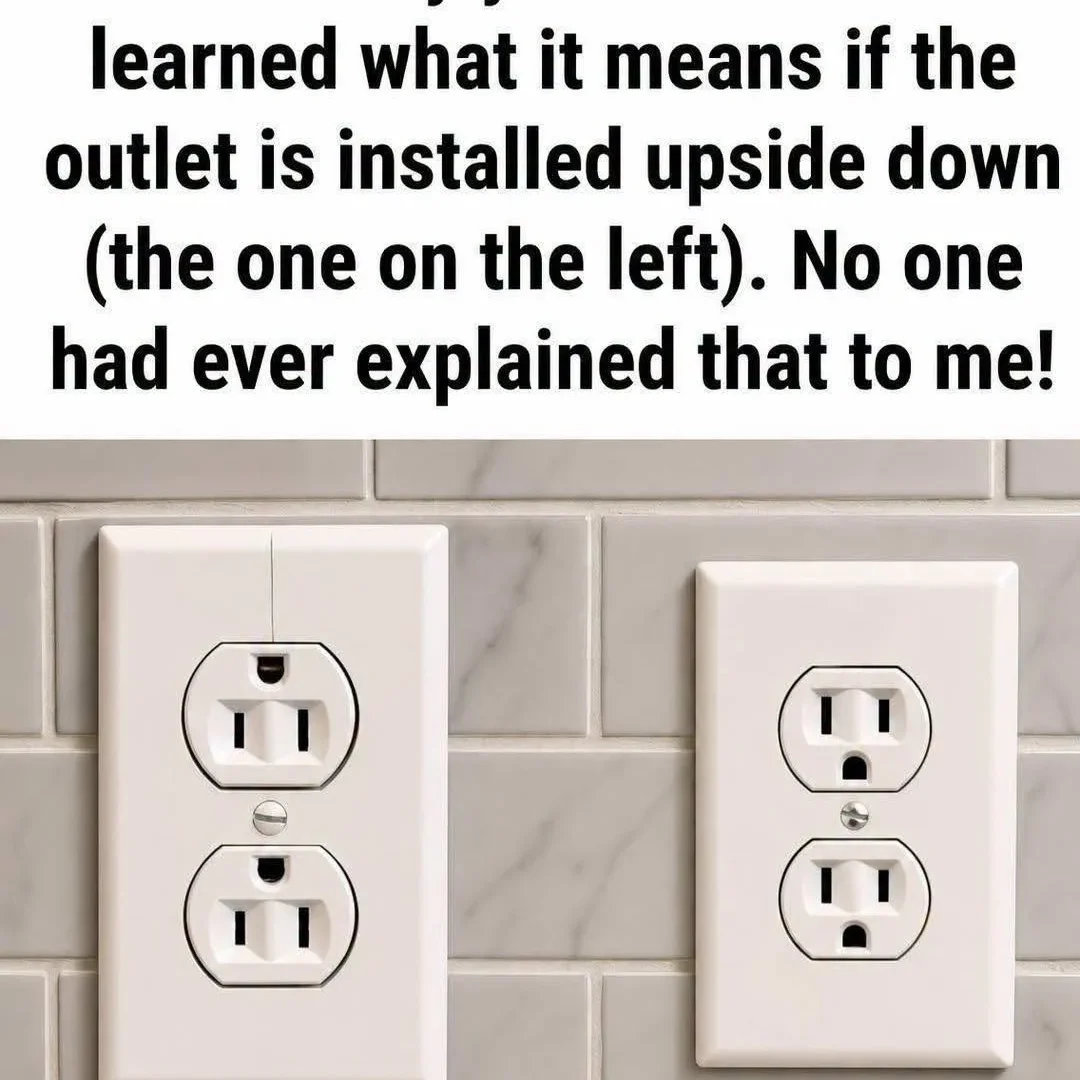
The photograph shows two standard-looking outlets. The outlet on the left has the round grounding opening at the top, while the outlet on the right has the grounding opening at the bottom.
A viral caption suggests that the upside-down outlet has a special hidden meaning.
There is some truth behind the idea, but the explanation is often exaggerated.
The most important fact is this:
An electrical receptacle being installed with the ground opening up does not automatically mean that something is wrong. In many places, either orientation can be used, depending on local practice, the electrician, the building, or the specific installation.
There can, however, be a practical safety reason for choosing the ground-up orientation.
First, What Does “Upside Down” Actually Mean?
A typical North American-style grounded receptacle has three openings:
Two vertical slots for the power conductors
One rounded or U-shaped opening for the grounding connection
When the grounding opening is at the bottom, people often consider that the normal orientation.
When the grounding opening is at the top, the receptacle looks “upside down.”
But electrically, the receptacle doesn’t become upside down in the sense that it stops working.
The power connections remain the same.
The grounding connection remains the same.
The electrical function of the receptacle isn’t determined simply by whether the ground opening is above or below the two slots.
So Why Would an Electrician Install It Ground-Up?
One reason is plug safety.
Consider a heavy electrical cord plugged into a wall outlet.
The plug may have a relatively large body, and the cord may pull downward.
If the plug becomes partially disconnected or is damaged, the orientation of the receptacle can affect what happens if a conductive object comes into contact with it.
With the grounding opening at the top, the grounding pin of a three-prong plug can potentially provide a safer mechanical arrangement in certain situations.
The idea is that if something metallic were to fall onto a partially pulled-out plug, the grounded portion could be encountered before the energized contacts.
This is one reason some electricians and facilities prefer ground-up installation.
However, this should not be interpreted as meaning that every ground-up outlet is installed specifically because of this safety strategy.
Is Ground-Up Actually Safer?
It can offer a particular safety advantage in some circumstances, especially with certain plug shapes and installations.
But that doesn’t mean a ground-down outlet is inherently dangerous.
A properly installed, properly grounded receptacle can be safe in either orientation.
Electrical safety depends much more on things such as:
Correct wiring
Proper grounding
Appropriate circuit protection
Properly rated receptacles
Secure connections
Correct installation
Ground-fault protection where required
Intact plugs and cords
Simply turning an outlet upside down doesn’t transform an unsafe electrical system into a safe one.