Clove in an Onion Household Trick: Why You Should Try It
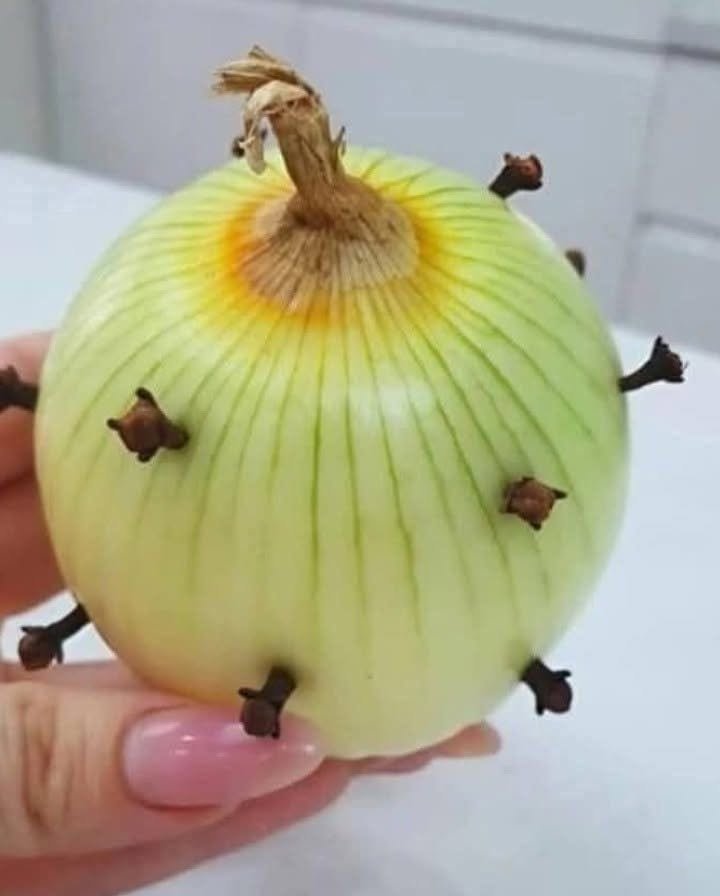
The simple combination shown in the image—a whole onion with cloves pushed into its surface—looks unusual, but it is based on a very old household idea: combining the strong natural aromas of onion and cloves to create a fragrant object that can be used around the home.
Cloves have a powerful aroma because they contain eugenol, an aromatic compound responsible for much of their distinctive smell. Onions also contain sulfur-containing compounds that produce their characteristic pungent odor.
Together, these ingredients create a strong scent that some people use as a traditional household remedy for unpleasant odors and as a possible way to discourage certain insects.
However, it’s important to separate traditional household tricks from scientifically established pest-control methods. An onion covered with cloves may smell strong, but it should not be considered a guaranteed replacement for proper insect control or sanitation.
What Is the Onion-and-Clove Trick?
The method is extremely simple.
You need:
1 whole onion
Several whole cloves
Peel the outermost dry layer of the onion if necessary, but leave the onion intact.
Then take whole cloves and push them directly into the onion.
You can distribute them around the surface or concentrate them in one area.
The result is essentially a natural aromatic object that releases the fragrance of both ingredients into the surrounding air.
Some people place it in kitchens, near windows, around dining areas, or in other places where strong food odors or occasional insects are a concern.
Why Use Cloves?
Cloves have been used traditionally in cooking, food preservation, and household practices for centuries.
Their strong fragrance comes largely from eugenol, a naturally occurring aromatic compound.
This is the same reason cloves can make a kitchen smell warm and spicy even when only a small quantity is being used.
The aroma is quite intense, and insects may respond differently to strong plant odors than humans do.
Laboratory studies have found that clove-derived compounds can have insect-repellent properties against certain species under specific conditions.
That does not, however, mean that placing a few cloves in an onion will eliminate insects from an entire home.
The real-world effect depends on the insect species, concentration, ventilation, temperature, and how long the scent remains strong.
Why Add the Cloves to an Onion?
The onion provides a convenient natural base for holding the cloves.
Instead of placing loose cloves around a room, pushing them into the onion keeps them together.
As the onion sits, the cloves continue releasing their characteristic aroma.
The onion itself also has a strong smell, particularly after its surface has been cut or damaged. A whole onion generally produces much less odor than a cut onion, but the combination can still create a noticeable aromatic effect.
The practice is therefore more accurately described as an aromatic household trick than a scientifically proven pest-control system.
Can an Onion With Cloves Repel Flies?
This is one of the most common claims associated with strong-smelling natural ingredients.
Certain insects dislike particular odors, and clove oil and eugenol have demonstrated repellent activity against some insects.
But there is an important difference between a concentrated essential oil studied under controlled conditions and a few whole cloves inserted into an onion.
The concentration of aromatic compounds released from the onion will be much lower.
Therefore, an onion with cloves might make an area less attractive to some insects temporarily, but you shouldn’t expect it to provide reliable protection against flies, mosquitoes, ants, cockroaches, or other pests.
If insects are repeatedly entering your home, addressing the source is much more effective.
That means:
Keeping food covered
Cleaning spills promptly
Emptying garbage regularly
Keeping kitchen surfaces clean
Repairing gaps around doors and windows
Using screens
Removing standing water
Keeping pet food areas clean
Natural scents can be an additional household measure, but they shouldn’t replace basic pest prevention.
How to Make the Onion-and-Clove Arrangement
Making it takes only a few minutes.
Step 1: Choose a firm onion
Select an onion that is firm and free from soft spots, mold, or visible decay.
Yellow, white, or other common onions can be used.
Step 2: Remove loose outer skin
Remove only the loose, papery outer layers.
Keep the onion whole.
Step 3: Insert the cloves
Take whole dried cloves and gently press them into the onion.
You can arrange them randomly or create a decorative pattern.
Don’t push them so deeply that they become difficult to remove.
Step 4: Place it in an appropriate location
Set the onion on a small plate or shallow dish.
A plate is preferable to placing it directly on a countertop because the onion can eventually release moisture.
Step 5: Monitor it
Check the onion regularly.
Because it is a fresh vegetable, it will eventually deteriorate.
If it becomes soft, wet, moldy, or develops an unpleasant rotten odor, throw it away.
Where Can You Put It?
If you’re experimenting with this household trick, several locations make more sense than others.
In the Kitchen
The kitchen is probably the most logical location because onions and cloves are both associated with food preparation.
The strong aroma may help mask some mild food odors, although it shouldn’t be considered a substitute for ventilation.
Near a Window
If you’re using it as a traditional insect-deterrent experiment, placing it near an area where insects commonly enter may make more sense than putting it in the middle of a room.
Remember that its effectiveness is not guaranteed.
Near a Dining Area
Some people use aromatic ingredients around outdoor or indoor eating areas.
However, the smell of cloves and onions may itself be unpleasant to some people, so placement should take personal preference into account.