4 Ways to Reduce the Appearance of Age Spots — And Why Baking Soda May Not Be the Answer
Age spots are one of the most common changes that appear on the skin as people get older. They are usually flat areas of brown, tan, or darker pigmentation that develop on parts of the body that receive a lot of sunlight, particularly the face, hands, shoulders, forearms, and upper chest.
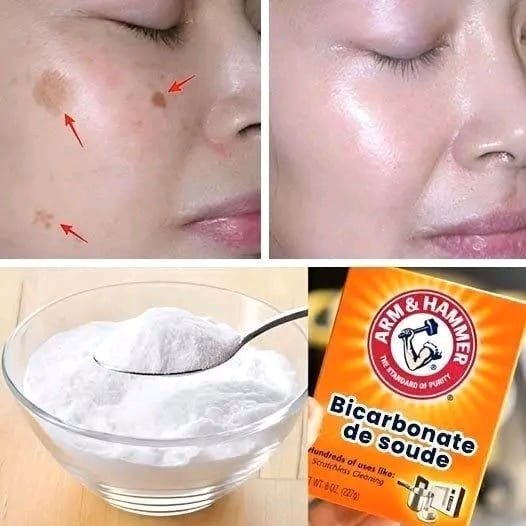
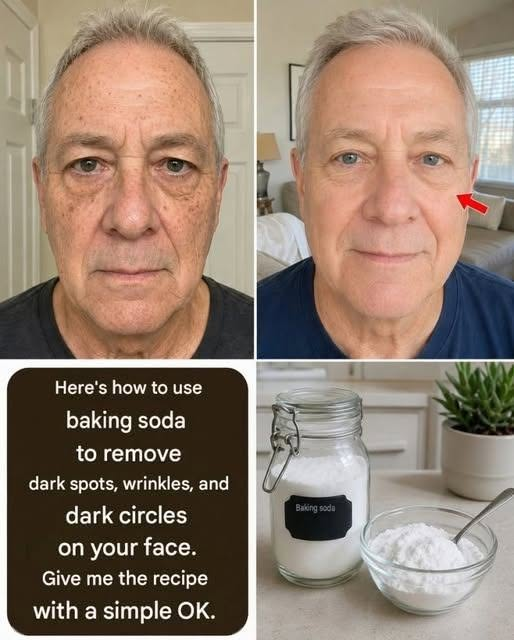
Because these spots can make the skin look uneven, many people search for simple home remedies to make them disappear. Baking soda is frequently promoted online as a natural treatment for dark spots, sometimes with claims that it can make the skin look younger within days.
However, there is an important distinction between temporarily changing the appearance of the skin and actually treating excess pigmentation.
Baking soda does not have strong evidence showing that it can safely erase age spots. Because it is alkaline and mildly abrasive, applying it repeatedly to the face can irritate the skin, damage the skin barrier, and potentially make pigmentation more noticeable.
Fortunately, there are safer approaches that can help improve uneven pigmentation.
What Are Age Spots?
Age spots are commonly called solar lentigines.
They develop primarily as a result of cumulative exposure to ultraviolet radiation from the sun. Over many years, UV exposure can stimulate pigment-producing cells called melanocytes and cause areas of increased melanin production.
Age spots are generally:
Flat
Brown, tan, or darker than surrounding skin
Round or irregularly shaped
Usually painless
Common on sun-exposed areas
More frequent with increasing age
Despite their name, age spots aren’t caused simply by getting older.
Sun exposure is an important contributor.
This is why someone who has spent many years outdoors without consistent sun protection may develop visible pigmentation earlier or more extensively than someone with less cumulative UV exposure.
1. Daily Sun Protection
If the goal is to prevent age spots from becoming darker and to reduce the development of new pigmentation, sun protection is one of the most important steps.
UV radiation can continue stimulating pigment even after a dark spot has appeared.
Without protection, treatments intended to improve pigmentation may also work less effectively.
A broad-spectrum sunscreen with an appropriate SPF can help protect the skin from both UVA and UVB radiation.
For people concerned about facial pigmentation, sunscreen should be used consistently on exposed areas rather than only on days spent at the beach.
Other useful strategies include:
Wearing a wide-brimmed hat
Seeking shade during intense sunlight
Wearing protective clothing
Avoiding prolonged direct sun exposure
Reapplying sunscreen when appropriate, especially outdoors
Sun protection is not an overnight treatment.
Its benefit comes from consistency.
2. Vitamin C and Other Brightening Ingredients
Some topical skincare ingredients can gradually improve the appearance of uneven pigmentation.
Vitamin C is one commonly used ingredient.
Topical vitamin C has antioxidant properties and may help reduce the appearance of some forms of pigmentation over time.
However, not every vitamin C product is equally effective. Formulation, concentration, stability, storage, and individual skin sensitivity can all influence results.
Other ingredients used in products targeting hyperpigmentation include:
Niacinamide
Azelaic acid
Retinoids
Kojic acid
Certain exfoliating acids
These ingredients work in different ways.
Some influence pigment production, some increase skin-cell turnover, and others can improve the overall appearance of uneven skin tone.
Results generally take weeks or months rather than minutes.
That is important because social-media posts often make pigmentation treatments appear dramatically faster than they really are.
3. Retinoids Can Help Improve Uneven Skin
Retinoids are vitamin A derivatives that have been used in dermatology and skincare for many years.
They can increase skin-cell turnover and may gradually improve uneven pigmentation and the appearance of sun-damaged skin.
Some retinoids are available in over-the-counter products, while stronger forms may require medical supervision depending on the country and formulation.
Retinoids can initially cause:
Dryness
Peeling
Redness
Irritation
Increased sensitivity
For that reason, using more product does not necessarily mean getting faster results.
A small amount used appropriately can be more sensible than repeatedly applying aggressive amounts.
People with sensitive skin should be particularly cautious when introducing retinoid products.
And because some retinoid products can increase sensitivity to sunlight, daytime sun protection remains important.
4. Professional Treatments Can Be More Effective for Persistent Spots
When pigmentation is particularly noticeable or does not respond to skincare, dermatologists can offer professional treatments.
Depending on the type and location of the pigmentation, options may include:
Chemical peels
Certain chemical peels remove or loosen damaged surface skin and can gradually improve uneven pigmentation.
The strength and type of peel matter.
Strong chemical treatments should not be performed casually at home because burns, scarring, and worsening pigmentation can occur.
Laser treatments
Certain laser and light-based treatments can target unwanted pigmentation.
These treatments can be effective for appropriately selected patients, but results depend on the specific type of pigmentation and the person’s skin characteristics.
People with darker skin tones require particularly careful treatment selection because some procedures can trigger post-inflammatory hyperpigmentation.
Cryotherapy
A dermatologist may sometimes use controlled freezing to treat individual age spots.
This is a medical procedure and should be performed by an appropriately trained professional.
Prescription treatments
Depending on the diagnosis, a dermatologist may recommend prescription creams or other treatments designed to reduce pigmentation.
The appropriate treatment depends on what is actually causing the dark spot.