Did You Know? If Hair Grows on Your Ears, Here’s What It Really Means
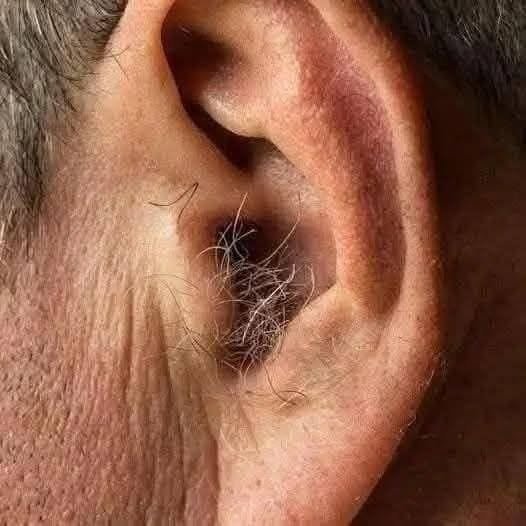
Seeing noticeable hair growing around or inside the ears can be surprising, especially when it becomes more visible with age. Social media often attaches dramatic explanations to ear hair, suggesting that it is a warning sign of a serious disease, poor circulation, or a particular problem inside the body.
The truth is much less alarming.
Ear hair is usually a normal feature of human hair growth, and it commonly becomes more noticeable as people get older. Genetics, hormones, age, and the natural behavior of hair follicles all influence how much hair develops around the ears.
Having ear hair does not, by itself, mean that something is wrong with your health.
At the same time, unusual changes in hair growth can occasionally be associated with medications, hormonal changes, or other conditions. The important thing is to look at the entire picture rather than assuming that one physical feature reveals a hidden disease.
Why Does Hair Grow on the Ears?
Hair follicles are found on much of the human body, including the skin around the ears.
The amount, thickness, color, and growth pattern of body hair vary greatly between individuals.
Some people naturally have very little visible ear hair. Others develop noticeable hairs around the outer ear, near the opening of the ear canal, or on the skin immediately in front of the ear.
This variation is influenced by genetics and hormones.
The hair itself isn’t necessarily serving an important medical function.
Like other body hair, it develops from follicles that respond to hormonal signals and genetic instructions.
Ear Hair Often Becomes More Noticeable With Age
One of the most common reasons people notice ear hair later in life is simply aging.
Hair growth patterns change as we get older.
Certain follicles become less active, while others can continue producing thicker or longer hairs.
This can result in more noticeable hair in areas such as:
The ears
The eyebrows
The nose
The nostrils
The chin
The cheeks
A person who had almost invisible ear hair in their 30s may notice several longer hairs decades later.
That does not automatically indicate a medical problem.
Hormones Influence Hair Growth
Hair follicles respond to hormones called androgens.
Androgens are present in both men and women, although levels and patterns differ.
As people age, changes in hormone levels and the sensitivity of individual hair follicles can alter where hair grows and how thick it becomes.
This helps explain why some men develop more prominent hair around their ears as they get older.
Women can also develop increased facial or body hair as hormone patterns change, particularly around and after menopause.
Therefore, ear hair isn’t exclusively a male phenomenon.
Genetics Play a Major Role
If your father, grandfather, or other relatives have noticeable ear hair, you may be more likely to develop it yourself.
Genetics influence:
Hair thickness
Hair color
Hair density
Hair growth rate
Hair distribution
How strongly follicles respond to hormones
This is why two people of the same age can have completely different amounts of ear hair.
One person might have almost none.
Another might have several thick, dark hairs.
Both can be perfectly healthy.
Ear Hair Does Not Mean Your Body Is “Fighting” Something
Some viral posts suggest that hair appearing on the ears means the body is responding to poor circulation, heart disease, toxins, or another hidden problem.
There isn’t good evidence that ordinary ear hair serves as a reliable diagnostic sign for these conditions.
A physical characteristic shouldn’t be treated as a medical test unless it has been scientifically established as one.
Ear hair alone cannot tell you whether your heart is healthy, whether your blood vessels are blocked, or whether your circulation is poor.
If you are concerned about cardiovascular health, appropriate measurements such as blood pressure, cholesterol testing, blood sugar assessment, medical history, and professional evaluation are much more meaningful than examining ear hair.
What About the Claims Linking Ear Hair to Heart Disease?
You may have encountered claims that men with hairy ears are more likely to have heart disease.
This idea has appeared in popular health discussions for many years.
Some older observational reports explored possible associations between certain patterns of external ear features or ear hair and cardiovascular disease.
However, an association observed in a population does not mean that ear hair causes heart disease or that it can be used to diagnose heart disease in an individual.
Age is an especially important factor.
Both ear hair and cardiovascular disease become more common with increasing age. That means two things can appear together without one causing the other.
This is an important concept called confounding.
For example, if something becomes more common as people age, it may appear to be associated with another age-related condition even when it isn’t a useful diagnostic marker.
So if you have ear hair, there is no reason to assume that you have heart disease because of it.