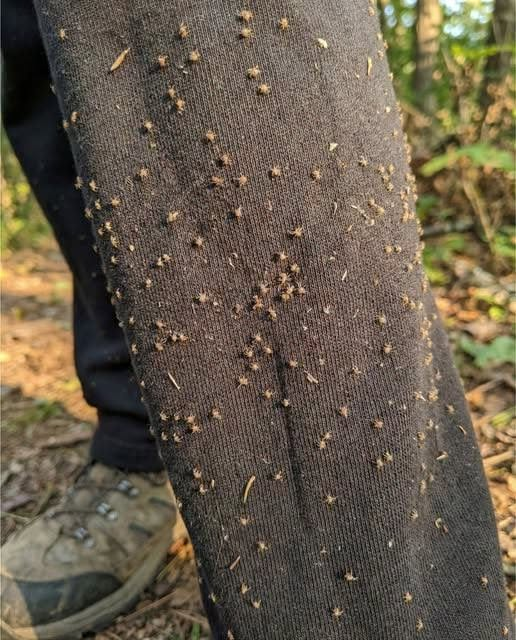
These Tiny Things Covered My Pant Leg After a Walk—What Are They?
Have you ever gone for a walk outdoors, enjoyed the fresh air, and returned home only to discover that your pants were covered with dozens of tiny, strange-looking objects? At first glance, they might look like small insects, seeds, pieces of dried plants, or even tiny burrs. If you have ever experienced this, you are not alone.
The image shows numerous tiny tan and brown objects attached to a person’s pant leg after walking through what appears to be a wooded or grassy area. Although the photograph alone cannot confirm exactly what they are, one likely explanation is that they are plant seeds or seed-bearing structures that cling to clothing, a natural dispersal strategy used by many plants.
Some plants produce seeds with hooks, bristles, hairs, or sticky surfaces that allow them to attach to passing animals and people. Other possibilities include dried plant fragments or small insects. Identifying the objects accurately requires examining their shape and texture more closely.
Understanding how these tiny objects work can explain why they appear after an ordinary walk, how to remove them, and how to avoid bringing them indoors.
1. Why Do Tiny Objects Stick to Your Pants After a Walk?
Nature has developed many ingenious ways for plants to spread their seeds. Some seeds travel through the air, some float on water, and others are carried by animals.
One particularly effective method is called epizoochory, which occurs when seeds or fruits are transported on the outside of an animal’s body.
Instead of relying entirely on wind or gravity, certain plants produce structures that attach to fur, feathers, or clothing. When an animal moves through vegetation, the seeds catch on its body and travel to another location.
Humans can accidentally perform the same role.
Walking through tall grass, woodland edges, overgrown paths, or fields containing mature weeds can expose clothing to hundreds of tiny plant structures. The objects may remain attached even after the person leaves the area.
Some are designed with microscopic hooks that catch individual fabric fibers. Others have stiff bristles or rough surfaces that make them difficult to remove.
This process is a normal part of plant reproduction. The plant does not need to recognize a person or deliberately target clothing. It simply benefits when its seeds are carried away from the parent plant.
2. Could They Be Seeds From Bur-Producing Plants?
One possibility is that the objects are seeds or fruits from plants that produce burrs.
Burrs are plant structures that often have hooks, spines, or bristles. They attach to fur, feathers, and fabric, helping the plant disperse its seeds.
Several plant groups use this strategy.
Burdock
Burdock plants produce round seed heads covered with hooked bracts. These structures can cling firmly to clothing and animal fur.
They are usually larger and more recognizable than the tiny objects in the photograph, although smaller fragments may also become attached.
Beggar-ticks
Plants in the Bidens group produce narrow seeds with barbed tips. These seeds can attach to clothing and become surprisingly difficult to remove.
They often resemble tiny dark slivers rather than rounded particles.
Stickseed plants
Certain plants in the Hackelia and related groups produce small fruits or seeds covered with hooks or bristles. These structures can catch on fabric during a walk.
Other wild grasses and weeds
Many grasses and wild plants have seeds or seed coverings that attach to clothing through stiff hairs, rough surfaces, or small projections.
The exact species depends on the location, season, and vegetation along the walking route.
Although the objects in the photograph may be plant material, their appearance is not detailed enough to identify a particular plant confidently.