Peace Lily: Can One Ingredient Really Make It Bloom for 10 Years?
Peace lilies are among the most popular indoor plants because they have beautiful green leaves, tolerate lower light than many flowering houseplants, and can produce elegant white flowers called spathes.
That is why viral gardening posts often promise an amazing shortcut:
“Add this one ingredient and your peace lily will bloom for up to 10 years.”
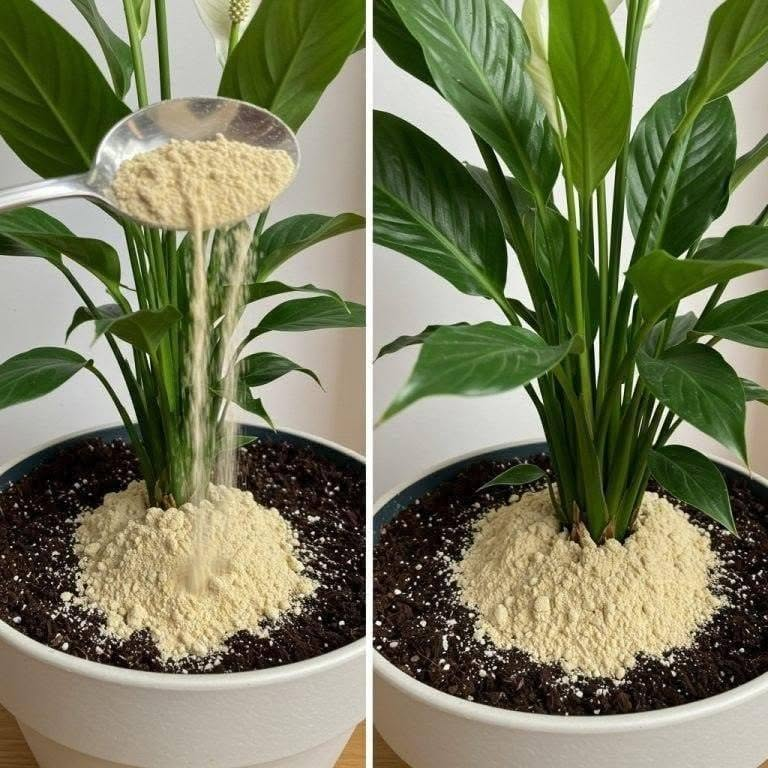
The photograph shows a pale powder being added around the base of a peace lily. It may be intended to represent a household powder or fertilizer, but the image alone does not establish exactly what the powder is.
More importantly, there is no single household ingredient that can guarantee a peace lily will bloom continuously for ten years.
A healthy peace lily can live for many years indoors, but flowering depends on several factors—including light, watering, temperature, nutrition, potting conditions, plant age, and general health.
The “One Ingredient” Claim Needs Some Context
Plants don’t work quite like a recipe where adding one special ingredient produces a predictable result.
Peace lilies need several essential nutrients. They also need enough light to produce the energy required for growth and flowering.
If a plant is suffering because it receives very little light, adding more fertilizer won’t necessarily make it flower.
Likewise, if the roots are sitting in constantly wet soil, adding a nutrient powder could actually make the situation worse.
So rather than searching for a magic powder, it is much better to understand what the plant actually needs.
What Does the White Powder in the Image Represent?
The photograph doesn’t provide enough information to identify the powder with certainty.
Several gardening posts use photographs like this to promote different homemade plant treatments, including:
baking soda
flour
powdered milk
crushed eggshells
cinnamon
fertilizer
bone meal
other household powders
These products do not all have the same effect.
Some may provide nutrients under certain circumstances, while others are mainly used for unrelated purposes.
For that reason, you shouldn’t copy an unidentified powder treatment simply because a viral photograph shows a plant looking healthier afterward.
If you don’t know exactly what a substance is, don’t put it into your plant’s soil.
What Actually Makes a Peace Lily Flower?
One of the most important factors is light.
Peace lilies are often described as low-light plants, but “low light” does not mean “no light.”
A peace lily can survive in relatively dim conditions, but survival and flowering are two different things.
A plant may remain green and alive while producing very few flowers if it doesn’t receive enough usable light.
Bright, Indirect Light Is Usually Best
A good location is generally somewhere with plenty of natural light without intense direct midday sunlight hitting the leaves for long periods.
For example, a spot near a bright window with filtered light can work well.
If the plant is several meters away from a window in a dark corner, it may stay alive but struggle to flower.
Too Much Direct Sun Can Also Cause Problems
Peace lilies don’t necessarily benefit from being placed directly against a very hot, sunny window.
Strong direct sunlight can cause:
leaf scorch
pale or bleached leaves
brown patches
excessive water loss
wilting
The goal is bright but gentle light.
Watering Is Extremely Important
Peace lilies are famous for dramatic wilting.
When they become thirsty, their leaves can suddenly droop.
After watering, they often recover surprisingly quickly.
However, repeatedly allowing the plant to become extremely dry isn’t ideal.
At the same time, constantly soaking the soil is also dangerous.
The roots need access to oxygen. If the pot remains waterlogged for long periods, roots can become damaged and may eventually rot.
A Better Way to Water
Instead of following a rigid calendar, check the soil.
Insert your finger into the upper part of the potting mix.
If the surface and upper layer feel dry, the plant may need watering.
If the soil is still very wet, wait.
The exact schedule depends on:
pot size
temperature
humidity
light level
soil mixture
season
plant size
A plant in a warm, bright room may need water much more frequently than one sitting in a cool, dim room.
Drainage Matters More Than Many Viral Recipes
A peace lily should ideally be grown in a container that allows excess water to escape.
If water has nowhere to go, the roots can remain saturated.
A decorative pot without drainage may look beautiful, but it can create serious problems if water accumulates at the bottom.
After watering, excess water should be allowed to drain away rather than sitting around the roots.
What Nutrients Does a Peace Lily Need?
Like other plants, peace lilies need several nutrients.
The major nutrients include:
nitrogen
phosphorus
potassium
They also require smaller quantities of other nutrients, including magnesium, calcium, sulfur, iron, and several micronutrients.
This is why a properly formulated houseplant fertilizer is generally more predictable than random kitchen ingredients.
Nitrogen
Nitrogen is particularly important for healthy leaf growth.
A nitrogen deficiency can contribute to pale or weak foliage.
But excessive nitrogen isn’t necessarily better.
Too much nitrogen can encourage lots of leafy growth while not producing the result the gardener wants.
Phosphorus Isn’t a Magic Flowering Switch
A common gardening myth is that adding large quantities of phosphorus automatically makes any plant flower.
That’s an oversimplification.
Plants need phosphorus, but adding excessive phosphorus to soil that already contains enough isn’t a guaranteed way to produce flowers.
Good plant nutrition is about balance, not simply adding as much of one nutrient as possible.
Potassium Also Has a Role
Potassium contributes to numerous plant functions, including water regulation and overall plant health.
But once again, more isn’t automatically better.
Excess fertilizer can accumulate in the soil and damage roots.
That’s why following the instructions for a proper fertilizer is safer than repeatedly adding concentrated homemade mixtures.
How Often Should You Fertilize a Peace Lily?
Peace lilies generally don’t require heavy feeding.
A diluted, balanced houseplant fertilizer can be used during periods of active growth according to the product’s instructions.
It’s better to start conservatively than to assume more fertilizer equals more flowers.
If a plant has been neglected for a long time and the soil has become depleted, appropriate feeding may help.
But fertilizer cannot compensate for poor light, damaged roots, inappropriate watering, or other fundamental problems.