Remember That If You Always Sleep on Your Right Side, You… Here’s What You Should Know
The position you sleep in can affect much more than your comfort.
For some people, sleeping on one side may influence digestion, heartburn, snoring, breathing, shoulder discomfort, and the quality of their sleep. One of the most widely shared claims online is that sleeping on your right side is bad for you, while sleeping on your left side is always better.
The reality is more specific.
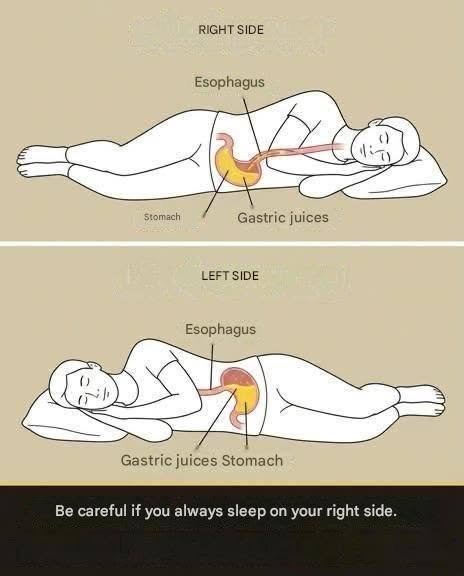
For people who experience acid reflux or gastroesophageal reflux disease (GERD), sleeping on the left side can often be more comfortable and may reduce nighttime reflux. Sleeping on the right side can make reflux worse for some people.
But this does not mean that everyone who sleeps on their right side is harming their health.
Your preferred sleeping position isn’t automatically dangerous, and you don’t need to force yourself into an uncomfortable position simply because of a viral graphic.
Why Does Sleeping Position Affect Acid Reflux?
To understand the difference, it helps to look at the anatomy of the stomach.
Your stomach isn’t shaped like a perfectly symmetrical container. Its position relative to the esophagus changes when you lie down.
The esophagus carries food from your mouth toward your stomach. At the bottom is a muscular valve called the lower esophageal sphincter.
Normally, this valve helps keep stomach contents from flowing backward into the esophagus.
When this barrier doesn’t work effectively, stomach contents can move upward.
That’s what happens with acid reflux.
When you’re standing or sitting, gravity helps keep stomach contents down.
When you’re lying horizontally, gravity no longer provides the same assistance.
Your sleeping position can therefore influence where stomach contents sit in relation to the opening of the esophagus.
Why the Left Side Can Be Better for Reflux
For people who suffer from nighttime heartburn, lying on the left side often has an advantage.
Because of the way the stomach and esophagus are positioned, lying on the left side can help keep stomach contents lower in the stomach.
This can reduce the opportunity for acidic stomach contents to move upward into the esophagus.
Research has found that people with GERD can experience less nighttime acid exposure when sleeping on the left side compared with sleeping on the right side or on the back.
This doesn’t mean that everyone will experience a dramatic difference.
Some people may notice an immediate improvement.
Others may notice little or no difference.
But if you regularly wake up with heartburn, sour liquid in your throat, coughing, or a burning sensation in your chest, experimenting with left-side sleeping may be worthwhile.
Why the Right Side May Trigger More Heartburn
The opposite effect can occur when someone with reflux lies on the right side.
In this position, the relationship between the stomach, its contents, and the lower esophageal sphincter can make it easier for gastric contents to move toward the esophagus.
That can mean:
More heartburn
More acid reaching the esophagus
Longer acid exposure
More nighttime reflux symptoms
More waking during the night
This is one reason some people notice that their reflux becomes worse shortly after turning onto their right side.
If you’ve ever eaten a large meal and then gone to bed, you may have experienced this yourself.