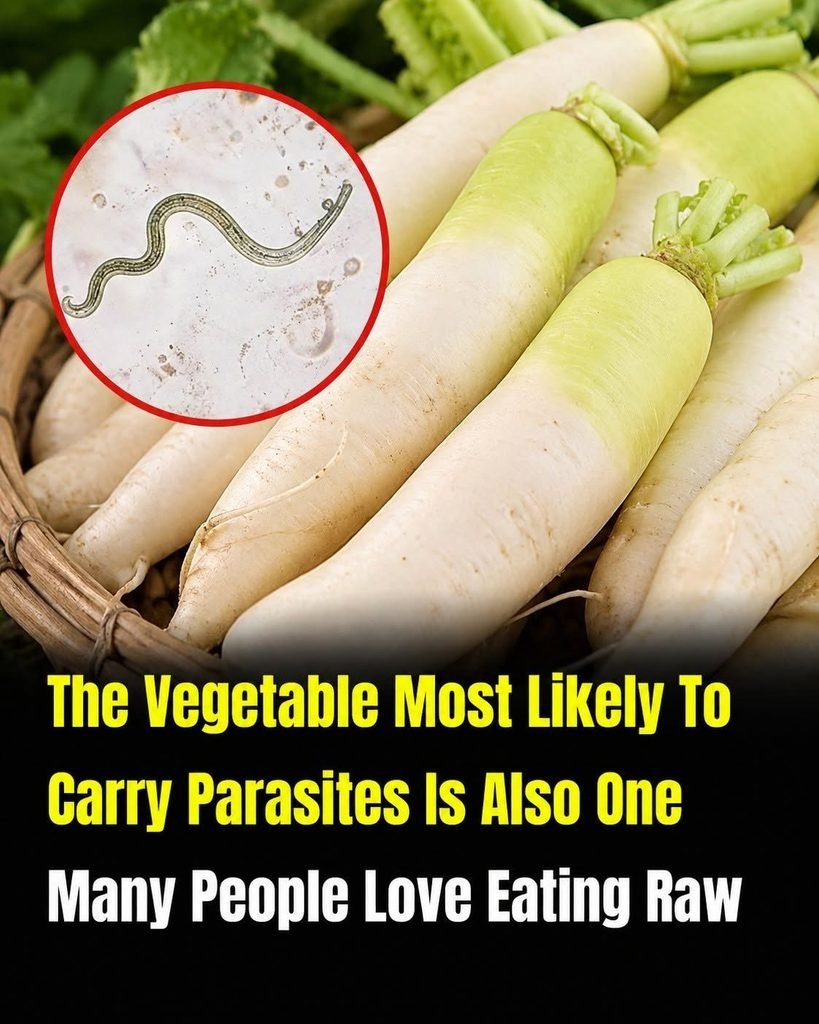
The Vegetable Many People Love Eating Raw May Carry Parasites — What You Should Know Before Eating It
There is a reason raw vegetables have become such an important part of healthy eating. They are fresh, crunchy, colorful, and packed with nutrients. Radishes, in particular, are popular because they can be eaten straight from the refrigerator, sliced into salads, added to sandwiches, or enjoyed with a little salt and lemon.
But there is an important side of the story that is often overlooked.
Raw vegetables can sometimes become contaminated with harmful microorganisms, including parasites, when they come into contact with contaminated soil, water, animals, or poor handling conditions.
The vegetable shown in the viral image appears to be a white radish, commonly known as daikon. The image suggests that this vegetable is especially likely to carry parasites because people often eat it raw.
That claim needs some clarification.
There is no reliable reason to say that daikon is universally “the vegetable most likely to carry parasites.” Many different raw vegetables can become contaminated if they are grown, harvested, washed, transported, or prepared under unsafe conditions.
The bigger issue isn’t that radishes are inherently dangerous.
The important issue is how raw vegetables become contaminated and how you can reduce the risk before eating them.
Why Can Raw Vegetables Carry Parasites?
Vegetables grow in an environment where they can come into contact with soil, water, insects, animals, and agricultural materials.
If soil or irrigation water is contaminated with certain microorganisms or parasite eggs, those contaminants can potentially reach the surface of vegetables.
This can happen with vegetables grown close to or below the soil surface.
Root vegetables can be particularly exposed to soil because the edible portion develops underground.
However, this doesn’t mean that every radish contains parasites.
It simply means that proper food handling is important.
What Is a Daikon Radish?
Daikon is a large white radish that is particularly popular in Japanese, Korean, Chinese, and other Asian cuisines.
It has a crisp texture and a mild-to-slightly-spicy flavor.
Daikon can be:
Eaten raw
Added to salads
Pickled
Grated
Cooked in soups
Added to stews
Roasted
Stir-fried
Used as a garnish
Because of its crunchy texture and refreshing flavor, many people enjoy eating it raw.
That’s perfectly normal.
The key is to make sure the vegetable is properly cleaned before consumption.
Why Eating Raw Vegetables Requires Good Hygiene
Cooking provides an important food-safety advantage because sufficient heat can destroy many harmful microorganisms.
When you eat a vegetable raw, you don’t have that cooking step.
That means cleaning, handling, storage, and preparation become especially important.
A vegetable may look perfectly clean while still carrying microscopic contamination.
Dirt isn’t always visible.
That’s why simply looking at a radish and deciding that it “looks clean” isn’t enough.
Soil Is One Possible Source of Contamination
Root vegetables grow in soil.
Soil naturally contains enormous numbers of microorganisms.
Most are harmless and part of normal ecosystems.
However, contaminated soil can sometimes contain organisms that can cause illness.
Animal feces, untreated manure, contaminated irrigation water, and other environmental sources can introduce harmful organisms into agricultural environments.
The vegetable may then become contaminated during growing or harvesting.
This is one reason washing fresh produce is so important.
Contaminated Water Can Also Be a Problem
Water used during farming can come from different sources.
If irrigation water is contaminated, microorganisms can potentially reach produce.
Water can also become relevant after harvesting.
Produce may be washed, processed, transported, or prepared using water.
If those processes aren’t hygienic, contamination can spread.
This is why food safety involves much more than what happens in your kitchen.
It begins at the farm and continues through harvesting, transportation, storage, supermarkets, restaurants, and finally your home.
Does Washing Radishes Remove Parasites?
Proper washing can reduce dirt and many contaminants on the surface of fresh produce.
However, washing isn’t a guarantee that every possible parasite or microorganism will be eliminated.
That’s why washing should be considered one part of good food safety rather than a magical sterilization process.
For vegetables such as radishes and daikon, start by removing visible dirt.
Then rinse them thoroughly under clean running water.
Rub the surface with your hands while rinsing.
For firm produce, a clean produce brush can help remove dirt from the surface.
After washing, use a clean towel or paper towel to dry the vegetable if appropriate.