Two Spoons in the Morning: Can a Natural Remedy Really Help Bone Pain, Diabetes, Nerves, Depression, and Fatigue?
But this is very different from claiming that a particular two-tablespoon remedy eliminates hemorrhoids.
Persistent bleeding should not automatically be attributed to hemorrhoids.
Rectal bleeding can have other causes and deserves appropriate medical evaluation, especially when it is unexplained or recurrent.
Why One Remedy Cannot Realistically Treat All These Problems
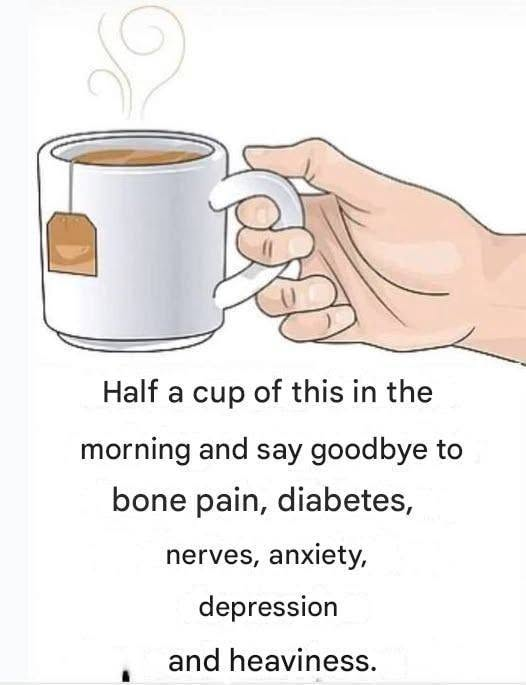
Look at the list in the image.
It includes:
Bone pain
Nerve pain
Cartilage pain
Anxiety
Depression
Insomnia
Rheumatism
Hemorrhoids
Fatigue
These problems involve completely different body systems.
Bone and cartilage involve the musculoskeletal system.
Nerve pain involves the nervous system.
Diabetes involves metabolic regulation.
Depression and anxiety involve complex interactions between the brain, body, and environment.
Hemorrhoids involve blood vessels and tissues in the rectal area.
Insomnia involves sleep regulation.
Fatigue can arise from many different conditions.
Expecting one spoonful of a substance to correct all of these problems is therefore a major red flag.
The Importance of Knowing What Is Actually in the Remedy
The photograph shows a glass of liquid, but the exact ingredient isn’t clearly identified in the text.
That’s important.
Before taking any homemade remedy, you should know exactly what it contains.
Different ingredients can have completely different effects.
For example, some substances can:
Irritate the stomach
Affect blood sugar
Affect blood pressure
Interact with medications
Affect blood clotting
Trigger allergies
Affect kidney function
The fact that something is found in a kitchen does not automatically make concentrated doses harmless.
“Natural” Does Not Mean Risk-Free
This is one of the most important lessons when reading health content online.
Natural substances can be biologically active.
That is precisely why some of them can have effects on the body.
Herbs, spices, seeds, extracts, oils, and other natural products can interact with medications or cause side effects in certain people.
Concentrated preparations can be very different from consuming a normal amount of a food as part of a meal.
Two Tablespoons Can Be a Significant Amount
The phrase “just two tablespoons” makes a remedy sound harmless.
But two tablespoons can represent a substantial quantity depending on the ingredient.
Two tablespoons of one food may be completely ordinary.
Two tablespoons of a concentrated extract or certain oils could be very different.
That’s why dosage should never be judged by the number of spoonfuls alone.
The actual substance matters.
A Healthy Morning Routine Can Still Be Valuable
Although the specific claim in the image is exaggerated, there is nothing wrong with creating a healthy morning routine.
A good routine might include:
Drinking an appropriate amount of water
Eating a balanced breakfast when desired
Getting some morning movement
Taking prescribed medications correctly
Getting adequate sleep
Limiting excessive caffeine
Eating fruits and vegetables throughout the day
Maintaining regular physical activity
These habits may support overall health without promising miraculous results.
Nutrition Really Does Matter
A balanced diet provides the body with nutrients needed for normal functioning.
Protein supports muscles and other tissues.
Calcium and vitamin D contribute to bone health.
Iron is important for oxygen transport.
Vitamin B12 supports normal blood and neurological function.
Vitamin C contributes to collagen formation and supports normal connective tissue.
Magnesium participates in many biological processes.
But eating nutritious foods is different from claiming that one particular ingredient can cure every disease.
Health usually comes from patterns rather than magic ingredients.
What About Supplements?
Supplements can sometimes be useful when someone has a confirmed deficiency or a specific nutritional need.
But taking large amounts of vitamins or minerals without a reason is not necessarily beneficial.
Some nutrients can become harmful at excessive doses.
This is especially important for people taking medications or living with kidney, liver, or other chronic conditions.
A healthcare professional can help determine whether supplementation is appropriate.
When a “Natural Remedy” Should Raise a Red Flag
Be particularly skeptical when a post claims that one ingredient can simultaneously:
Cure multiple unrelated diseases
Eliminate pain instantly
Reverse chronic disease
Replace medication
Work for everyone
Produce dramatic results in only a few days
Require no lifestyle changes
Have “no side effects”
These are classic warning signs of exaggerated health claims.
Real medical treatments generally have limitations, varying effectiveness, possible side effects, and different results between individuals.
Don’t Stop Medication Because of a Viral Recipe
This deserves special attention.
If someone is taking medication for diabetes, depression, anxiety, arthritis, high blood pressure, nerve pain, or another chronic condition, they should not suddenly stop their medication because a social-media post recommends a natural remedy.
Some medications need to be reduced gradually.
Others control conditions that can become dangerous when treatment is suddenly stopped.
A natural food can be part of a healthy diet without replacing medically necessary treatment.
What If the Remedy Seems to Work?
Sometimes people genuinely feel better after trying a particular food or drink.
That experience should not be dismissed.
But feeling better after taking something does not automatically prove that the substance cured the underlying disease.
Symptoms can naturally fluctuate.
Placebo effects can influence how people perceive symptoms.
Other changes may happen at the same time.
For example, someone might start a new morning drink while also sleeping better, drinking more water, eating healthier food, or exercising more.
Improvement is real, but the cause may be more complicated than the social-media caption suggests.
How to Evaluate a Health Claim
Before believing a viral remedy, ask several questions.
What exactly is the ingredient?
If the post doesn’t clearly identify it, that’s already a problem.
What condition is it supposed to treat?
Is there actual evidence for that specific condition?
How strong is the evidence?
A laboratory experiment is not the same as a clinical trial in humans.
What dose was studied?
The amount used in research may be completely different from two tablespoons.
Could it interact with medication?
This is especially important for people with chronic diseases.
Is the claim promising too much?
If one ingredient supposedly treats ten unrelated conditions, skepticism is appropriate.
The Most Important Message
The image isn’t necessarily wrong because natural foods have no health benefits.
Many natural foods are genuinely nutritious.
The problem is the leap from “this food contains beneficial compounds” to “two tablespoons will eliminate numerous diseases.”
Those are completely different claims.
Healthy food can support the body.
It does not automatically replace diagnosis and treatment.
Final Thoughts
The idea of taking two tablespoons every morning and saying goodbye to bone pain, nerve pain, cartilage problems, anxiety, depression, insomnia, rheumatism, hemorrhoids, and fatigue sounds appealing—but it is far too broad to be considered a reliable medical recommendation.
The image also does not clearly identify the exact substance being recommended, which makes it impossible to judge the supposed remedy or its appropriate dose.
Different symptoms have different causes.
Persistent fatigue may require a blood test.
Joint pain may require an examination.
Nerve pain may require evaluation of the nervous system or underlying metabolic causes.
Depression and anxiety deserve proper mental-health care.
Persistent insomnia may require assessment of sleep habits or an underlying sleep disorder.
And unexplained bleeding should never be dismissed as simply hemorrhoids.
Natural foods can absolutely be part of a healthy lifestyle, but there is no good reason to believe that one unidentified two-tablespoon remedy can cure all of these unrelated conditions.
The safest approach is to enjoy nutritious foods as part of a balanced diet, use natural remedies cautiously, and seek appropriate medical advice when symptoms are persistent, severe, or unexplained.
A simple morning habit can support your health—but it should not be confused with a universal cure.