15 Brilliant Baking Soda Tricks Every Woman Should Know
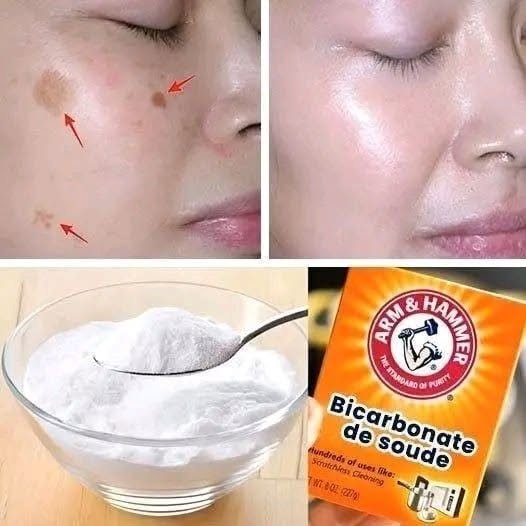
Baking soda is sometimes advertised as a homemade treatment for dark spots, acne, or oily skin.
This is not an ideal approach.
Facial skin has a natural protective barrier and an acidic surface environment. Baking soda is considerably more alkaline than the skin.
Repeated exposure can contribute to dryness, irritation, and barrier disruption.
If you’re trying to improve dark spots or uneven skin tone, products specifically formulated for facial skin are generally more appropriate.
Gentle cleansing, moisturizer, and daily sun protection are much more important foundations.
What About Baking Soda for Teeth?
This is another popular online trick.
Baking soda can be found in some commercially formulated toothpastes and can help with certain types of surface staining.
But that doesn’t mean you should aggressively scrub your teeth with dry baking soda.
Your teeth contain enamel, which can be damaged by excessive abrasion.
For everyday dental care, brushing twice a day with fluoride toothpaste and cleaning between the teeth are much more important.
If you have hardened tartar, baking soda will not safely remove it. Dental calculus generally requires professional removal.
Never Use Baking Soda as a Vaginal Treatment
One of the most important warnings concerns intimate use.
Some viral recipes recommend inserting baking soda into the vagina, using it as a vaginal wash, or using it to eliminate odor.
This is not a good DIY practice.
The vagina has its own natural environment and microbiome. Homemade alkaline solutions can disturb that balance and cause irritation.
If you notice a new or persistent vaginal odor, unusual discharge, itching, burning, pelvic pain, or discomfort, don’t attempt to cover the symptoms with baking soda.
These symptoms can have different causes, including infections that require appropriate treatment.
The same principle applies to vaginal douching in general: the vagina does not need homemade cleansing solutions to remain healthy.
Don’t Use Baking Soda to Treat Serious Skin Problems
A viral recipe may claim that baking soda can cure a rash, fungal infection, eczema, or another skin condition.
Don’t rely on it for these problems.
A rash can have many different causes, and the wrong treatment can make irritation worse or delay appropriate care.
If a rash is spreading, painful, infected-looking, blistering, or persistent, seek medical advice.
What About Mixing Baking Soda With Lemon?
This combination appears frequently in homemade beauty recipes.
Lemon juice is acidic, while baking soda is alkaline. When combined, they react and produce bubbles.
That reaction may look impressive, but it doesn’t mean the mixture is an effective skincare treatment.
Lemon juice can irritate skin, and exposure to certain citrus compounds followed by sunlight can cause problematic skin reactions.
For facial care, it’s better to use products specifically formulated and tested for skin rather than kitchen mixtures.
What About Baking Soda and Vinegar?
Baking soda and vinegar are also frequently combined for cleaning.
They react strongly because one is alkaline and the other is acidic.
The resulting fizz can help loosen some dirt in certain cleaning situations, but the reaction also neutralizes much of the original acid and base.
For household cleaning, use the right product for the specific surface rather than assuming that more fizz means more cleaning power.
And never mix household cleaning chemicals indiscriminately. Some combinations can produce dangerous gases.
How to Store Baking Soda Properly
Keep baking soda in a dry, sealed container.
Moisture can cause it to clump and can affect its usefulness.
If you use baking soda for both cooking and household cleaning, consider keeping separate containers so that a cleaning product doesn’t accidentally become mixed with food ingredients.
Always check the packaging and expiration information when using it for cooking.
5 Things to Remember Before Trying a Viral Baking-Soda Hack
1. Natural Doesn’t Always Mean Safe
Baking soda is a familiar kitchen ingredient, but your skin and body are not the same as a kitchen surface.
2. More Isn’t Better
A stronger mixture doesn’t necessarily work better and may increase irritation.
3. Don’t Put It Inside the Body
Avoid using homemade baking-soda preparations inside the vagina or other sensitive internal areas.
4. Stop if Your Skin Burns
Burning, redness, swelling, or significant itching means the product may be irritating your skin.
5. Don’t Let Home Remedies Delay Medical Care
If you have persistent symptoms, unusual pain, infection-like symptoms, or another health concern, identify the cause rather than repeatedly treating the symptoms with household ingredients.
Final Thoughts
Baking soda is genuinely useful, but its best uses are often much simpler than the dramatic claims found on social media.
It can help freshen shoes, absorb refrigerator odors, clean certain surfaces, deodorize carpets, freshen trash cans, and support a variety of household cleaning tasks.
When it comes to personal care, however, more caution is needed.
Using baking soda aggressively on your face, teeth, scalp, or underarms can cause irritation. Using it inside the vagina or as a vaginal douche is particularly inappropriate because it can disturb the natural vaginal environment.
The safest approach is to think of baking soda as a versatile household ingredient, not a miracle medicine.
For everyday beauty and health concerns, products specifically designed for the body are generally more predictable and safer. And when a symptom persists or seems unusual, finding the underlying cause is much more valuable than trying another viral kitchen remedy.