8 Plants That May Help Repel Mice, Spiders, and Other Insects Around Your Home
Eucalyptus is famous for its strong, distinctive fragrance.
Certain eucalyptus oils contain compounds such as eucalyptol, and eucalyptus-derived preparations have been investigated and used in insect-repellent products.
However, this doesn’t mean that simply putting a eucalyptus plant inside your home will eliminate insects.
The concentration of aromatic compounds released naturally by a plant can be very different from the concentration in a formulated repellent.
Use caution with eucalyptus
Eucalyptus leaves and concentrated essential oils should not be treated casually.
Essential oils are highly concentrated substances.
They can irritate skin and can be dangerous if swallowed, particularly for children and pets.
If you have pets, especially cats or dogs, research the specific plant and any oil product before using it around them.
Don’t assume that because something is “natural,” it is automatically harmless.
7. Marigolds
Marigolds are colorful flowering plants that are often recommended for gardens because their strong scent may discourage some insects.
They are particularly popular around vegetable gardens.
Marigolds can attract beneficial insects while also adding color to outdoor spaces.
However, internet claims sometimes exaggerate their abilities.
Planting a row of marigolds around a garden isn’t guaranteed to create an insect-proof barrier.
Their usefulness depends on the species of marigold, the pest involved, environmental conditions, and how the plants are arranged.
Why gardeners still like them
Even without making exaggerated pest-control claims, marigolds can be valuable because they are:
Attractive
Relatively easy to grow
Useful in garden design
Suitable for containers
Compatible with many garden settings
They’re best considered part of a healthy garden rather than a substitute for pest management.
8. Catnip
Catnip is an interesting addition to the list because it contains a compound called nepetalactone.
Research has shown that nepetalactone can have insect-repellent activity, particularly against certain mosquitoes and other insects.
But catnip comes with an obvious complication.
Cats love it.
Some cats respond strongly to catnip, while others don’t respond at all.
If you grow catnip indoors, your cat may decide that your carefully maintained plant is their personal playground.
Growing catnip
Catnip generally prefers:
Sunlight
Well-drained soil
Moderate watering
Room to spread
If you don’t want it taking over your garden, a container is often a good choice.
What About Mice?
This is where many online articles become misleading.
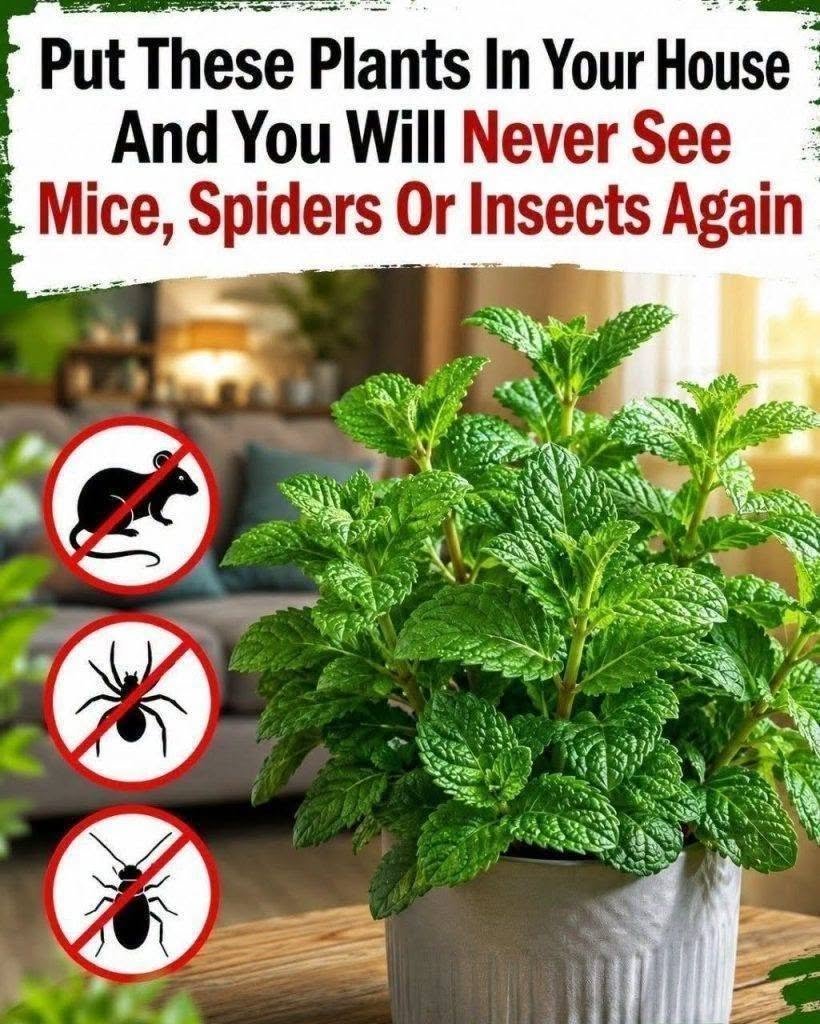
Plants such as peppermint are frequently promoted as if they can make an entire house completely mouse-free.
There isn’t a reliable guarantee that simply growing mint or another aromatic plant will eliminate a mouse infestation.
Mice are primarily looking for:
Food
Water
Shelter
Warmth
Safe nesting locations
If a mouse finds an easy way into a house and discovers food and shelter, the presence of a few fragrant plants isn’t necessarily going to stop it.
The most important mouse-control step is exclusion
Inspect your home for gaps and openings.
Pay attention to:
Areas around pipes
Door gaps
Foundation cracks
Garage entrances
Utility openings
Ventilation openings
Spaces around windows
Areas beneath cabinets
Seal appropriate openings with suitable materials.
Keep food in sealed containers.
Clean crumbs and spills promptly.
Don’t leave pet food sitting out unnecessarily overnight.
Keep garbage properly contained.
These measures address the reasons mice enter homes rather than simply trying to make the house smell unpleasant to them.