The Real Deal on Covering Your Sink Before Vacation
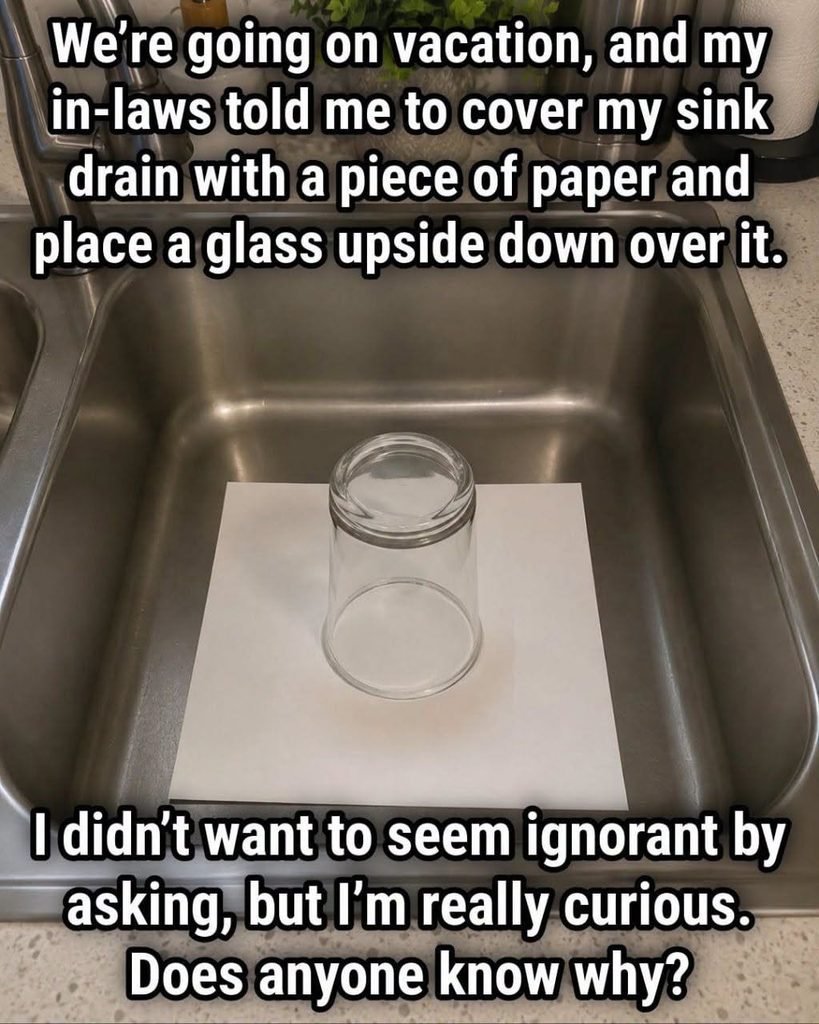
If you’ve ever prepared your home before leaving for vacation, you may have come across a strange-looking household tip: cover the sink drain with a piece of paper and place a glass upside down over it before leaving the house.
At first glance, it seems almost too simple to have a purpose.
Why would anyone put a sheet of paper over a sink drain? And why place an upside-down glass on top of it?
The answer has to do with something most people rarely think about: the plumbing trap underneath the sink and what can happen when a drain is left unused for a long period of time.
The viral image shows a kitchen sink with a sheet of paper positioned over the drain and a glass placed upside down on top. Although this can serve as a temporary physical barrier, the more important part of the story is understanding what happens inside your plumbing while you’re away.
What Is Actually Under Your Sink?
Look underneath almost any household sink and you’ll find a curved section of drainpipe.
This curved section is commonly called a P-trap.
Its job is much more important than simply carrying wastewater away.
After you use the sink, a small amount of water remains inside the curved portion of the pipe. This water creates a barrier between your home’s interior and the drainage system.
That water barrier helps prevent unpleasant gases and odors from traveling backward through the drain and into your home.
Normally, you don’t even notice it.
Every time you use the sink, fresh water passes through the drain and replenishes the water in the trap.
But when a sink isn’t used for a long time, something different can happen.
The Problem With Leaving a Sink Unused
Water doesn’t remain in a trap forever.
It can gradually evaporate, especially in warm, dry conditions.
If you’re away for several days or weeks, a rarely used drain may receive no fresh water during that entire period.
Eventually, enough water can evaporate that the protective barrier becomes weaker or disappears completely.
Once the trap dries out, odors from the drainage system may have a much easier path into the room.
This is one reason people sometimes return from a long vacation and notice that a bathroom, laundry room, basement, or rarely used sink smells strange.
The problem isn’t necessarily that the sink itself became dirty.
The problem can be the plumbing trap.
So Why Cover the Drain?
Covering a drain can provide an additional physical barrier while the sink isn’t being used.
The idea behind the paper-and-glass method is relatively simple.
The paper covers the drain opening, while the upside-down glass holds the paper down and creates another barrier above the opening.
This can potentially help reduce the movement of insects, debris, and odors directly through the drain opening.
However, there is an important detail:
The glass-and-paper trick does not replace the water inside the P-trap.
If the trap underneath the sink completely dries out, covering the top of the drain doesn’t magically restore the water seal.
It can still act as a temporary barrier, but it shouldn’t be considered a guaranteed plumbing solution.