Blood Pressure Medication Under Review After Heart Risk Findings: What the Research on Nifedipine Really Shows
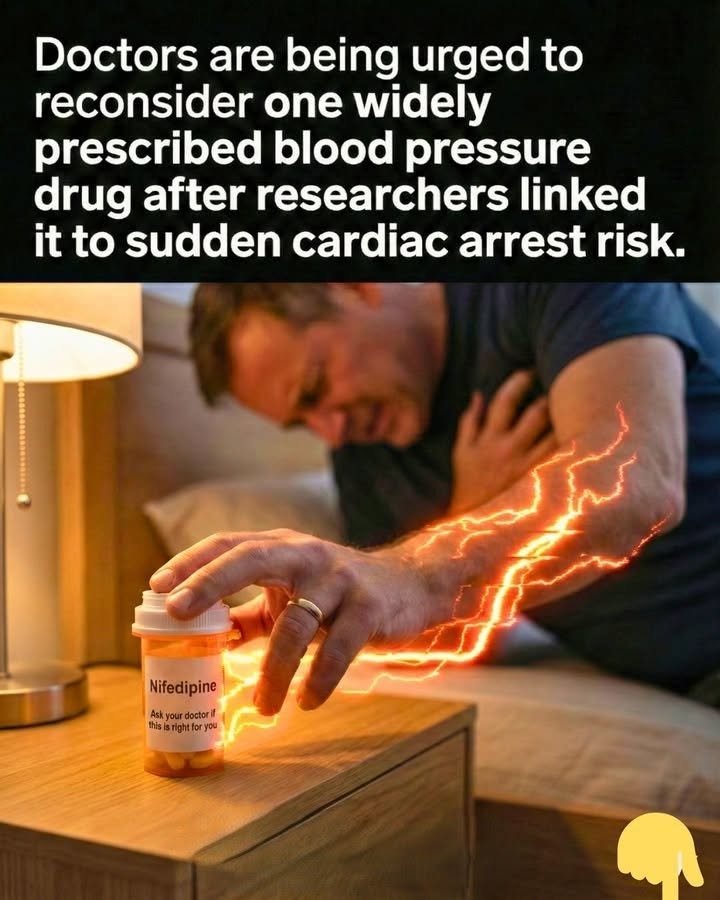
A viral health post is circulating with a striking warning: “Doctors are being urged to reconsider one widely prescribed blood pressure drug after researchers linked it to sudden cardiac arrest risk.” The medication shown in the image is nifedipine, a calcium-channel blocker used to lower blood pressure and treat certain forms of chest pain.
The claim has a real scientific basis—but the wording can be misleading.
Research has found an association between higher-dose nifedipine and out-of-hospital cardiac arrest, particularly when compared with another medication in the same broad family. However, this does not mean that everyone taking nifedipine is suddenly at high risk, nor does it mean people should stop taking their prescription.
In fact, current hypertension guidelines still include long-acting dihydropyridine calcium-channel blockers among recommended first-line blood-pressure medications.
So what did researchers actually discover, and what should patients know?
What Is Nifedipine?
Nifedipine belongs to a group of medicines called dihydropyridine calcium-channel blockers.
These medications work primarily by relaxing the smooth muscle in the walls of arteries. This widens the blood vessels, allowing blood to flow more easily and reducing the pressure against which the heart has to pump.
Nifedipine has been used for many years to treat conditions such as:
High blood pressure
Certain types of angina
Some circulation-related conditions
Hypertension during particular clinical circumstances
There are different formulations of nifedipine. This distinction is extremely important when discussing its safety.
Immediate-release nifedipine and long-acting nifedipine should not simply be treated as identical medications.
The Research Behind the Viral Claim
The concern highlighted in the image comes largely from a population-based study published in the European Heart Journal – Cardiovascular Pharmacotherapy.
Researchers examined real-world data from two European countries, using large registries of out-of-hospital cardiac arrest.
The study included:
2,503 cardiac-arrest cases and 10,543 controls in the Netherlands
More than 8,000 cardiac-arrest cases and 40,000 controls in Denmark
The investigators compared people taking different dihydropyridine calcium-channel blockers, particularly nifedipine and amlodipine. (OUP Academic)
The results attracted attention because high-dose nifedipine—defined in the study as 60 mg or more per day—was associated with a higher risk of out-of-hospital cardiac arrest.
In the Netherlands analysis, high-dose nifedipine was associated with an adjusted odds ratio of approximately 1.45 compared with non-use of dihydropyridines. In the Danish analysis, the corresponding figure was approximately 1.96.
That sounds alarming, but there is an important distinction.
Association Does Not Automatically Mean the Drug Caused the Cardiac Arrest
This was an observational study.
Researchers looked at real-world medication use and cardiac-arrest events and found an association. Such research can identify important safety signals, but it cannot establish with certainty that nifedipine itself caused every cardiac arrest observed.
People taking high doses of nifedipine may differ from people who are not taking it in many ways.
For example, they may have:
More severe hypertension
More cardiovascular disease
Other medical conditions
Different combinations of medications
Different ages or risk profiles
Researchers can statistically adjust for many factors, but observational research cannot eliminate every possible source of confounding.
That is why a headline such as “nifedipine causes sudden cardiac arrest” goes beyond what the study actually demonstrated.
The Dose Appeared to Matter
One of the most interesting findings was that the association was particularly apparent with higher doses.
The researchers reported that high-dose nifedipine (≥60 mg/day) was associated with increased out-of-hospital cardiac-arrest risk, whereas the association was not statistically significant for low-dose nifedipine (<60 mg/day).
This is an important detail that viral posts often leave out.
It does not mean that low-dose nifedipine is automatically risk-free. Rather, it means that the study’s strongest signal was observed at the higher dose.
The researchers also found that the results were different for amlodipine, another dihydropyridine calcium-channel blocker.
Nifedipine Versus Amlodipine
The comparison with amlodipine is particularly important.
In the study, nifedipine was associated with higher out-of-hospital cardiac-arrest risk than amlodipine, particularly at higher doses.
However, this should not be interpreted as a recommendation for everyone taking nifedipine to switch to amlodipine.
Medication choice depends on the individual patient.
Doctors consider factors such as:
Blood-pressure readings
Age
Kidney function
Heart disease
Other medications
Side effects
Other medical conditions
The formulation and dose being used
A drug that is appropriate for one patient may not be appropriate for another.