What Is This White String Inside the Egg? The Strange-Looking Truth
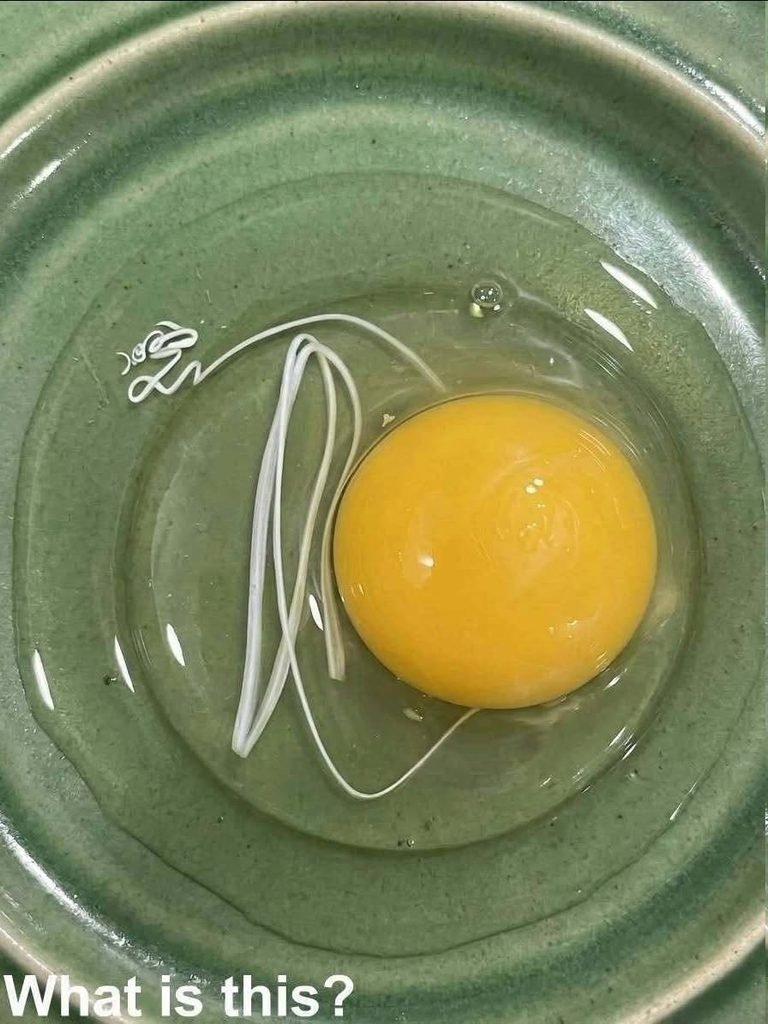
If you cracked an egg and found a long, white, ribbon-like strand beside the yolk, you might immediately think something is wrong with the egg.
It can certainly look unusual—especially when the strand is long and twisted like the one in the photograph.
But there is no need to panic.
That strange white structure is most likely a chalaza (pronounced kuh-LAY-zuh), a completely normal part of an egg. It is not a worm, parasite, embryo, or piece of plastic.
In fact, seeing a prominent chalaza can simply be a sign that you’re looking at a normal egg with a relatively strong, thick albumen structure. The USDA describes chalazae as twisted, cord-like strands of egg white that help anchor the yolk in the center of the egg. (Ask FSIS)
So What Exactly Is the White Ribbon?
The structure is called a chalaza.
Eggs normally contain two chalazae—one toward each side of the yolk.
They are made from twisted strands of the egg white and act somewhat like little anchors.
Their job is to help keep the yolk suspended in the middle of the egg rather than allowing it to move freely around the shell.
When you crack an egg, one of these structures may remain attached to the yolk while extending outward into the surrounding egg white.
Sometimes it is barely noticeable.
Other times, it can be surprisingly long and obvious.
That’s what makes photographs like this one look so strange.
Is It a Worm?
No.
A chalaza can look remarkably similar to a thin white worm, especially when it is stretched out.
But it isn’t an organism.
It is a naturally occurring part of the egg.
The USDA specifically describes chalazae as twisted cord-like strands of egg white that anchor the yolk in the center of the albumen. (Ask FSIS)
So if you see a white string attached to the yolk, don’t automatically assume you’ve discovered a parasite.
Is It a Chicken Embryo?
No.
A normal unfertilized table egg does not contain a developing chick.
The chalaza is simply part of the egg’s internal structure.
Even when an egg has been fertilized, the presence of a chalaza itself does not indicate that an embryo is developing.
The strange-looking white cord has a completely ordinary biological purpose.
Why Does It Sometimes Look Like a Long String?
The chalaza is naturally twisted.
When the egg is intact, the surrounding egg white and yolk keep the structure in place.
After you crack the egg onto a plate, the egg white spreads out.
The chalaza can stretch, unravel slightly, or remain attached to the yolk while extending across the plate.
That can make it look much longer than you would expect.
The example in the photograph is particularly noticeable because the surrounding egg white is relatively clear and the white strand has stretched away from the yolk.
Does a Prominent Chalaza Mean the Egg Is Fresh?
Not necessarily, but it can be associated with better interior egg quality.
As eggs age, their internal structure gradually changes.
According to the USDA, the egg white becomes thinner over time, while the yolk becomes flatter and more easily broken. The chalazae also become less prominent and weaker as the egg loses quality.
So a clearly visible, strong chalaza can occur in a relatively fresh, high-quality egg.
However, you shouldn’t use the chalaza alone as an exact freshness test.
Other characteristics matter too.
What Does a Fresh Egg Usually Look Like?
When you crack a fresh egg onto a plate, you may notice:
A relatively firm egg white
A rounded, elevated yolk
A distinct thick portion of albumen
A visible chalaza
The yolk remaining relatively centered
As an egg gets older, the white generally becomes more watery and the yolk becomes flatter.
The USDA explains that refrigeration slows these quality changes. (Ask FSIS)
Why Is the Egg White Sometimes Cloudy?
Another unusual egg appearance is a cloudy or milky-looking white.
That can actually be a positive sign of freshness.
The USDA notes that cloudy egg white is associated with a very fresh egg, while a clearer, thinner white can indicate that the egg has aged.
So an egg that looks slightly unusual isn’t automatically bad.
Eggs naturally have several different structures and appearances that people may not recognize.